

How to Reduce Body Fat Percentage
Two people can stand on the same scale, read the same number, and be in very different states of health. The one carrying more muscle and less fat will generally have better metabolic health, lower disease risk, and a leaner appearance even though the scale shows identical results.
That gap is body fat percentage and closing it requires a different approach than simply trying to weigh less.
This guide covers what the research actually says about reducing body fat percentage, not just body weight, and gives you specific, actionable strategies for each piece of the puzzle.
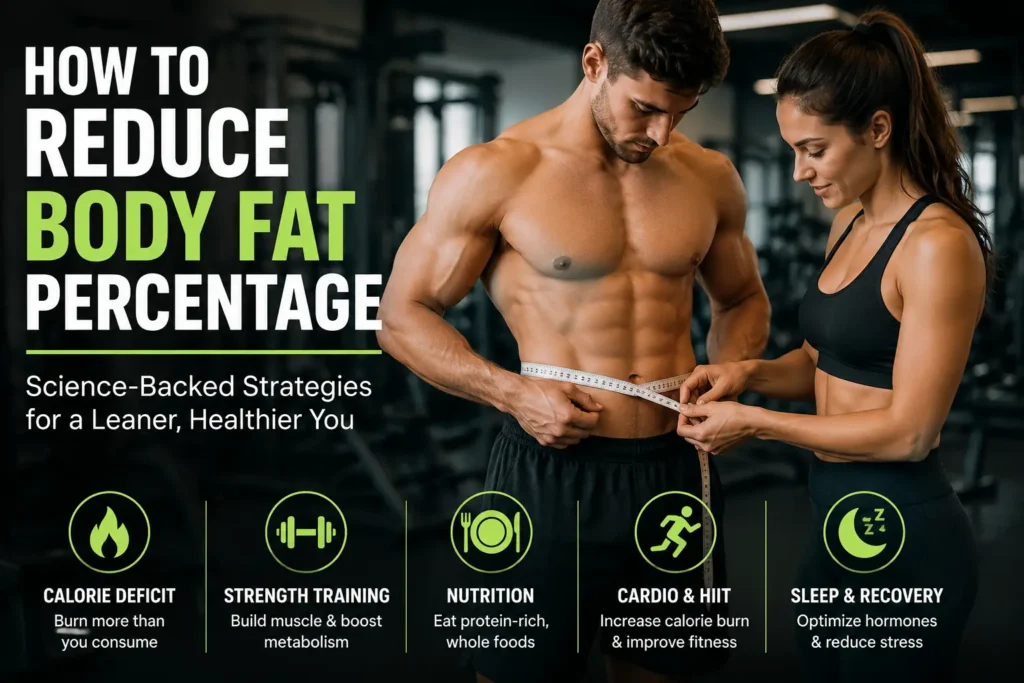
Before applying any of these strategies, use our Body Fat Calculator to find your current baseline. Progress is hard to measure without one.
Key Takeaways
- A calorie deficit of 300-500 calories per day is the sweet spot: enough to drive fat loss, small enough to preserve muscle and energy
- Protein at 1.6-2.0 g per kg of body weight per day is the most evidence-backed range for keeping muscle while losing fat, per the International Society of Sports Nutrition
- Strength training 2-4 times per week is not optional cardio alone cannot prevent muscle loss during prolonged calorie restriction
- Sleep deprivation raises ghrelin (hunger hormone) by 28% and lowers leptin (fullness hormone) by 18%, per research published in the Annals of Internal Medicine making every dietary choice harder
- Spot reduction does not work. A 2007 study in Medicine & Science in Sports & Exercise (Kostek et al.) found no localized fat loss even after 12 weeks of training one arm exclusively
What Is Body Fat Percentage?
Body fat percentage is the share of your total body weight that is fat tissue. A person weighing 80 kg at 20% body fat carries 16 kg of fat and 64 kg of lean mass, that lean mass includes muscle, bone, organs, and body water. Your Lean Body Mass Calculator can give you that lean mass number directly.
Not all fat is a problem. Your body needs essential fat to support hormone production, organ protection, temperature regulation, and the absorption of fat-soluble vitamins. The American Council on Exercise defines essential fat at 2-5% for men and 10-13% for women. Below those thresholds, hormonal and metabolic function start to break down.
The fat that drives health risk is excess storage fat particularly visceral fat, the deep abdominal fat that wraps around internal organs. The World Health Organization and the CDC both link excess visceral fat to increased risk of cardiovascular disease, type 2 diabetes, and metabolic syndrome.
BMI, by comparison, tells you almost nothing useful. It compares weight to height and has no way to distinguish fat from muscle. A trained athlete and a sedentary person can have identical BMI scores and completely different health pictures. Body fat percentage is the more meaningful number.
Why Body Fat Percentage Matters
Body fat percentage tells you far more than body weight ever can. It helps you understand whether the weight you are losing is actually body fat or valuable lean muscle. Tracking body fat percentage also gives a clearer picture of your progress, especially if the number on the scale isn’t changing much because you are building muscle while losing fat.
Monitoring body fat percentage alongside waist circumference and other health markers provides a more complete view of your overall health than body weight alone.
Body Fat Percentage Chart for Men & Women
A body fat percentage chart helps you compare your current body fat level with healthy reference ranges. These categories are general guidelines rather than strict targets, Individual results can vary depending on age, ethnicity, genetics, and muscle mass.
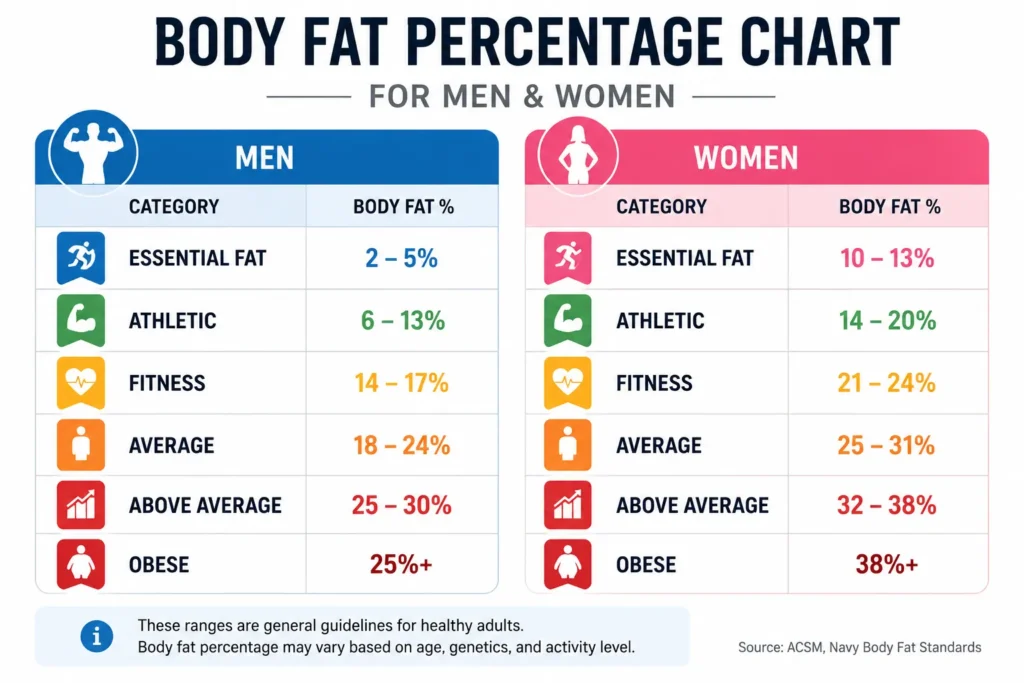
Remember that the goal isn’t simply to reach the lowest possible body fat percentage. Instead, aim for a range that supports your health, energy levels, performance, and lifestyle. If you are actively reducing body fat, use the chart to monitor long-term progress rather than chasing a specific number.
How to Reduce Fat From Body
Reducing body fat percentage has one core requirement: your body needs to use stored fat as fuel more than it stores new fat. Everything else food choices, training methods, sleep habits either creates that condition or undermines it.
Create a Sustainable Calorie Deficit
A calorie deficit is the non-negotiable starting point. When you consistently consume fewer calories than you burn, your body turns to stored fat to make up the difference. No fat-loss strategy bypasses this mechanism.
What most people get wrong is the size of the deficit. A deficit of 300-500 calories per day is where the evidence consistently points large enough to produce 0.25–0.5 kg of fat loss per week, small enough to protect energy levels, workout performance, and muscle tissue.
Larger deficits (700+ calories) often produce faster early results but run into problems: increased hunger, muscle loss, metabolic slowdown, and a high dropout rate. Most people who take this approach regain the weight quickly after stopping. A moderate deficit maintained consistently beats an aggressive deficit maintained for three weeks.
Prioritize Protein at Every Meal
Protein is the most important single dietary variable for improving body composition during a calorie deficit and the most commonly undereaten one.
Here’s the problem: when you’re in a sustained calorie deficit, your body doesn’t just burn fat. It also breaks down muscle tissue for energy. Adequate protein intake is the primary way to slow that process. The International Society of Sports Nutrition recommends 1.6-2.0 g of protein per kg of body weight per day for people trying to preserve muscle during fat loss. A 75 kg person should target roughly 120-150 g of protein daily.
Protein also has a higher thermic effect than any other macronutrient. Your body burns approximately 20-30% of protein calories just through the process of digestion, versus 5-10% for carbohydrates.
Good sources: lean meats, poultry, fish, eggs, Greek yogurt, cottage cheese, legumes, and tofu. Distribute protein across meals rather than concentrating it, muscle protein synthesis responds to consistent availability throughout the day, not one large bolus.
Eat More Fiber-Rich Foods
Fiber slows digestion, blunts blood sugar spikes after meals, and extends the feeling of fullness. In practice, higher fiber diets make a calorie deficit significantly easier to maintain because hunger becomes less of a constant battle.
The USDA Dietary Guidelines 2020-2025 recommend 25 g of fiber per day for women and 38 g per day for men. Most adults in Western diets consume roughly half that.
Best sources: vegetables, fruits, oats, legumes, and whole grains. The simplest change you can make: fill half your plate with vegetables before adding anything else. This single habit brings most people measurably closer to their fiber target while displacing higher calorie foods.
Stay Hydrated Throughout the Day
Water supports metabolism, digestion, nutrient transport, and exercise performance. Even mild dehydration as little as 1-2% of body weight measurably reduces physical performance and can present as hunger rather than thirst, leading to unnecessary extra eating.
The National Academies of Sciences, Engineering, and Medicine set adequate daily water intake at 3.7 litres total for men and 2.7 litres for women, including water from food. Drinking water before meals has been shown to reduce calorie intake at that meal in some studies, though the effect is modest.
Hydration is not a fat-loss strategy on its own, but consistent dehydration creates friction against every other process that is.
Best Diet to Reduce Body Fat Naturally
There is no single best diet for reducing body fat. Every dietary pattern that works Mediterranean, low-carb, high-protein, calorie tracking, works through the same mechanism: it helps you maintain a calorie deficit while eating in a way you can sustain. The specific macronutrient ratio matters far less than that.
Focus on Whole, Nutrient-Dense Foods
Whole foods are more filling per calorie than ultra-processed alternatives, contain more fiber and protein, and are harder to overeat. This isn’t about food being “clean” or “dirty” it’s about how food behaves in your body.
A 2019 randomized controlled trial published in Cell Metabolism (Hall et al., NIH) put 20 healthy adults in a controlled environment and gave them unlimited access to either ultra-processed or unprocessed food for two weeks at a time. Despite the diets being matched for presented calories, the ultra-processed group consumed an average of 508 more calories per day. No intentional overeating the food simply bypassed normal satiety signalling.
Build most meals around: lean proteins, vegetables, whole grains, legumes, and fruits. Ultra-processed food doesn’t have to disappear from your diet, but it shouldn’t dominate it.
Don’t Fear Healthy Fats
Dietary fat does not cause body fat accumulation but a calorie surplus does. Fat is an essential macronutrient that supports hormone production, brain function, and the absorption of vitamins A, D, E, and K. Dropping fat too low in your diet interferes with hormone production and makes meals less satisfying, both of which undermine long term consistency.
Choose healthier fat sources and be mindful of portion sizes, since fat is calorie-dense at 9 kcal per gram. Avocados, olive oil, fatty fish, nuts, and seeds are all appropriate in a fat-loss diet. The goal is quality and awareness, not elimination.
Balance Your Carbohydrates
Carbohydrates are not the reason most people struggle to reduce body fat. A calorie surplus is. For anyone who exercises regularly, carbohydrates are the primary fuel for moderate to high intensity training. Removing them isn’t necessary for fat loss and typically makes training harder and less productive.
The useful distinction is between refined and complex carbohydrates. Refined carbohydrates, such as white bread, pastries, and sugary drinks, digest quickly and contribute little to satiety. In contrast, complex carbohydrates, including oats, brown rice, sweet potatoes, whole-grain bread, and legumes, digest more slowly, provide more fiber, and support sustained energy.
Pair carbohydrates with protein and vegetables. That combination slows digestion, extends fullness, and supports training performance.
Portion Control Matters More Than Perfection
Calorie intake determines fat loss outcomes more than any specific food choice. Portion control is where most people’s well-intentioned plans fall apart and it’s also where small consistent habits produce the biggest practical result.
Useful strategies: use smaller plates, eat slowly (it takes about 20 minutes for fullness signals to reach your brain after eating), stop when satisfied rather than full, and plan at least some meals in advance. Removing impulsive food decisions from your week is one of the highest leverage changes available. You don’t need to weigh every meal, you need enough structure to avoid consistently overeating.
Reduce Body Fat Exercise
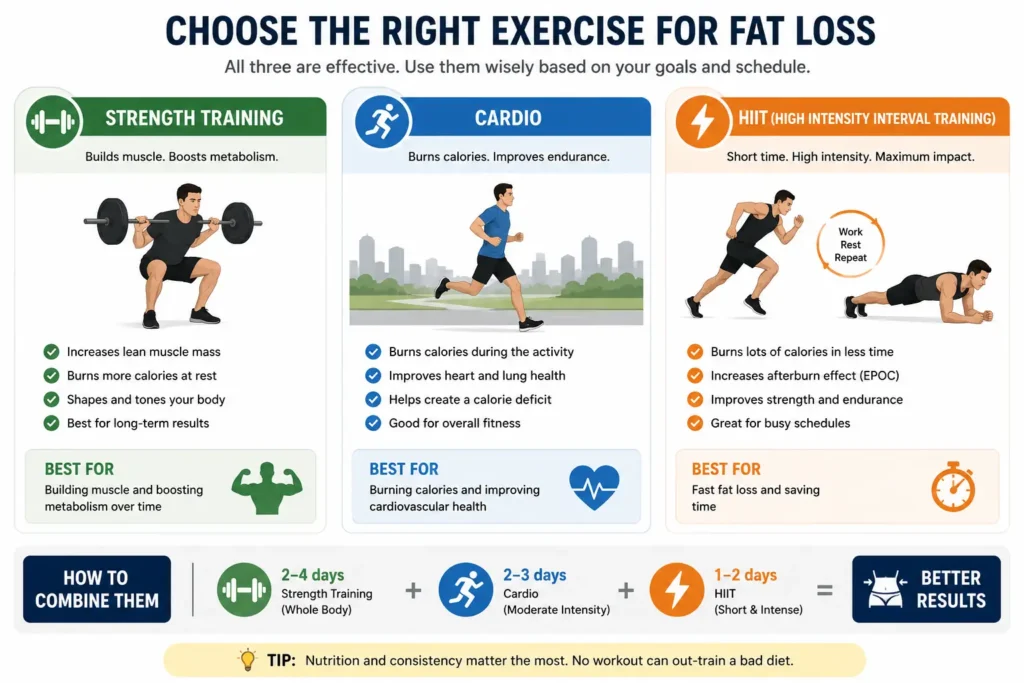
Exercise matters for body fat reduction but not primarily because of the calories it burns. A 45 minute moderate run burns roughly 400-500 calories for an average adult. That’s undone by one large muffin. The real value of exercise for body composition is what it does over time: it preserves muscle, supports a healthy metabolic rate, and improves the hormonal environment for fat loss.
Prioritize Strength Training
Strength training is the most underused and most important tool in most people’s fat-loss plan.
During a calorie deficit, your body has no automatic reason to maintain muscle. Resistance training provides that signal. The American College of Sports Medicine recommends 2-4 resistance training sessions per week for muscle maintenance and development.
Compound exercises work multiple muscle groups at the same time, making them one of the most efficient ways to build strength while supporting fat loss. Squats, deadlifts, lunges, bench presses, rows, shoulder presses, and pull-ups are excellent choices, and many can be performed either at the gym or at home with minimal equipment.
A clarification worth making: during fat loss, the goal is not necessarily to build new muscle. It’s to not lose the muscle you already have. The training stimulus required for preservation is lower than the stimulus required for growth. Consistent training at 2-3 sessions per week is enough for most people to maintain lean mass during a moderate calorie deficit.
Include Cardio for Additional Calorie Burn
Cardiovascular exercise adds to daily calorie expenditure, improves heart health, and supports metabolic function. It’s a useful tool just not the primary one that most beginners make it.
The World Health Organization recommends 150-300 minutes of moderate-intensity aerobic activity per week for adults. Brisk walking, cycling, swimming, rowing, and jogging all count. The most important factor in choosing a cardio modality is whether you’ll actually do it. A walk you complete beats a sprint session you skip every time.
Add HIIT in Moderation
High Intensity Interval Training alternates near maximal effort bursts with recovery periods. Research including a widely cited 2011 review by Boutcher published in the Journal of Obesity confirms HIIT improves cardiovascular fitness and increases calorie burn both during and after exercise through elevated post-exercise oxygen consumption (EPOC).
But HIIT is oversold for most beginners. The intensity required for genuine HIIT carries injury risk for people without an aerobic foundation, and recovering from it competes with recovery from strength training. For conditioned individuals, 1–3 HIIT sessions per week alongside strength training is an effective combination. For beginners, building a cardio base with moderate-intensity exercise first is the smarter sequence.
Don’t Underestimate Daily Movement
Non-Exercise Activity Thermogenesis (NEAT) calories burned through all physical activity outside structured exercise is one of the most underappreciated variables in fat loss. NEAT includes walking, standing, household tasks, taking stairs, and every other incidental movement throughout your day.
For sedentary individuals, NEAT might account for 200 calories per day. For highly active people, it can exceed 1,000 calories. That 800-calorie gap exists without ever setting foot in a gym.
The simplest intervention: walk more. A target of 8,000-10,000 steps per day produces meaningful additional calorie expenditure, requires no equipment, doesn’t impair recovery, and can be sustained indefinitely.
How to Reduce Body Fat Percentage for Women
The core physiology is the same for everyone calorie deficit, protein, strength training, sleep. The context is different.
Women naturally carry more essential body fat than men: 10-13% versus 2-5%, per the American Council on Exercise. This reflects the fat requirements of hormonal and reproductive function. Healthy body fat ranges for women are therefore higher than male reference ranges, and comparing female results to male benchmarks gives a distorted picture.
The most common mistake women make when trying to reduce body fat is eating too little while significantly increasing cardio. This combination often produces rapid initial weight loss but comes at a cost: muscle loss, hormonal disruption, declining energy and workout performance, and results that don’t stick. The number on the scale drops but not because of body composition improvement.
A more effective and sustainable approach: moderate calorie deficit, protein at 1.6–2.0 g/kg/day, strength training 2-3 times per week, and sleep treated as a non-negotiable rather than a variable.
One practical note: body measurements naturally fluctuate across the menstrual cycle due to water retention changes driven by estrogen and progesterone. Tracking weekly or monthly trends rather than daily readings removes this noise and gives a more accurate picture of actual fat loss progress.
Can You Lose Body Fat Fast?
You can accelerate fat loss, but biology sets a ceiling on how quickly fat tissue can actually be converted to energy.
Research generally puts the upper limit for fat oxidation somewhere around 31 kcal per kg of fat mass per day. For a person carrying 15 kg of fat, that’s roughly 465 calories of fat-derived energy per day equivalent to about 50 g of fat. Any weight lost beyond that rate during extreme restriction is not fat. It’s coming from water, glycogen, and lean tissue.
This is why aggressive deficits produce fast scale results but poor body composition outcomes: the weight comes off quickly, but a larger share of it is muscle and water rather than fat.
For the fastest fat loss without sacrificing muscle: push your calorie deficit toward the upper end of the sustainable range (around 500 calories below maintenance), keep protein high (1.6-2.0 g/kg), maintain strength training, and add walking rather than adding more gym sessions. This approach pushes results toward the upper end of what is biologically sustainable.
Lifestyle Habits That Support Long-Term Fat Loss
Prioritize Quality Sleep
Sleep is not passive recovery. During deep sleep, your body releases growth hormone, repairs muscle tissue, and regulates the hormonal signals that control appetite. Consistently cutting sleep short disrupts all of these.
A landmark study published in the Annals of Internal Medicine in 2004 (Spiegel, Tasali, Penev, and Van Cauter at the University of Chicago) restricted healthy young men to approximately 5 hours of sleep per night. Compared to 8+ hours, sleep restriction reduced leptin by 18% and raised ghrelin by 28%. Those hormonal shifts translated into 24% higher hunger ratings and strong cravings specifically for calorie-dense carbohydrates.
The National Sleep Foundation recommends 7-9 hours per night for adults. You can be dialled in on your diet and training and still struggle with fat loss if you’re running a consistent sleep debt. The appetite consequences are biological, not a willpower problem.
Manage Stress Levels
Chronic stress raises cortisol, a hormone that promotes fat storage particularly in the abdominal region. Sustained elevated cortisol also increases cravings for high sugar, high fat foods, impairs sleep quality, and reduces motivation to exercise.
This doesn’t mean stress is the sole reason anyone struggles to lose fat. It means unmanaged chronic stress stacks several variables against you simultaneously: hunger goes up, sleep gets worse, training consistency drops, and the hormonal environment shifts toward fat storage.
Effective management doesn’t require major lifestyle changes: regular walking, consistent sleep, social connection, and genuinely disconnecting from screens all produce measurable reductions in cortisol. These are physiological inputs with physiological outputs, not vague wellness advice.
Stay Consistent Instead of Perfect
One missed workout or one unplanned meal does not derail real progress. What derails progress is the response to those events, treating them as failures, extending the break, or deciding the whole effort was pointless.
People who successfully reduce body fat percentage and maintain it over time share one consistent behaviour: they return to their routine at the next meal or the next workout rather than waiting for a fresh start. Sustainable habits maintained at 80% consistency outperform perfect programs abandoned after two weeks.
Common Mistakes That Slow Fat Loss
Eating Too Little
Extremely low-calorie intakes often below 1,200 calories for women or 1,500 for men, produce fast initial weight loss but progressively reduce energy, impair training performance, increase muscle loss, and slow resting metabolic rate. They’re also unsustainable for most people beyond a few weeks.
A 300-500 calorie deficit is where the evidence consistently lands. Below that threshold, the trade-offs outweigh the benefits.
Skipping Strength Training
Cardio burns calories during exercise. Strength training preserves the muscle tissue that keeps your metabolism running efficiently across all 24 hours. During a calorie deficit without resistance training, a meaningful share of weight lost will be muscle rather than fat leaving you lighter, not necessarily leaner, and with a lower resting metabolic rate that makes maintaining results harder.
Drinking Your Calories
Sugary drinks, flavoured coffees, fruit juices, and alcohol are calorie-dense, digest quickly, and contribute almost nothing to fullness. It’s easy to consume 300-500 liquid calories in a day without registering them, which effectively cancels a full day’s calorie deficit.
Replacing high calorie beverages with water or unsweetened alternatives is one of the highest return changes most people can make with the least effort.
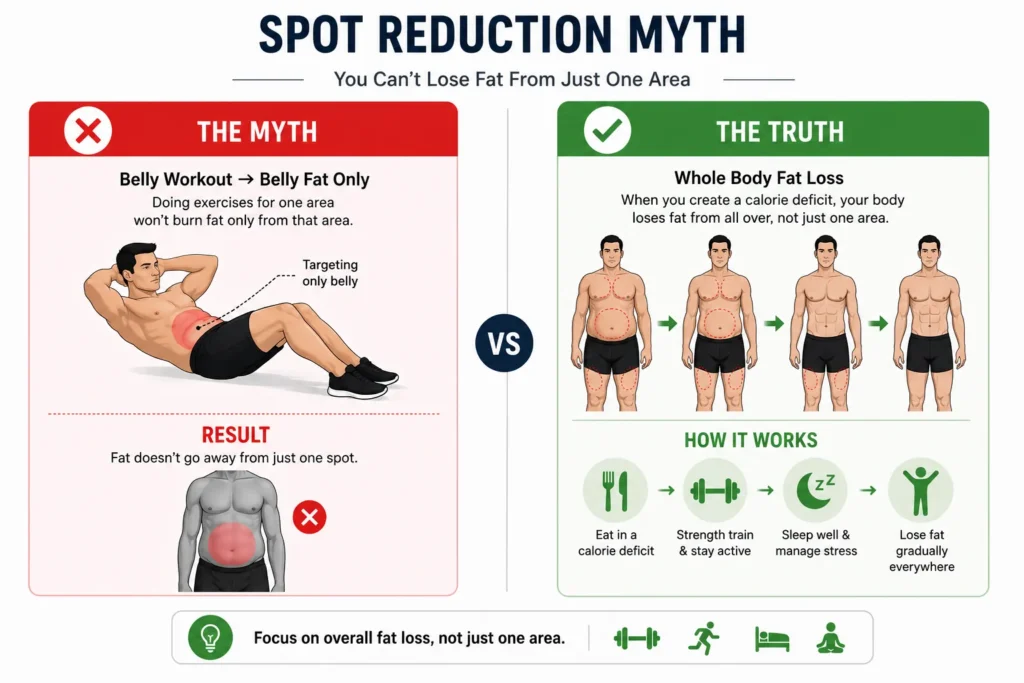
Expecting Spot Reduction
You cannot direct fat loss to a specific body area by exercising that area. This has been directly tested.
In a 2007 study published in Medicine & Science in Sports & Exercise (Kostek et al.), 104 participants trained one arm with five exercises twice per week for 12 weeks, leaving the other arm as a control. Fat loss was similar in both arms. The trained arm gained muscle. The fat distribution changed systemically, not locally.
Crunches don’t target belly fat. Arm exercises don’t reduce arm fat. Total body fat reduction driven by consistent calorie deficit and exercise is the only mechanism that changes fat in any specific area.
Ignoring Progress Beyond the Scale
Body weight naturally fluctuates by 1–3 kg across a single day based on hydration, sodium intake, food volume, and hormonal shifts. Using daily scale readings as your primary progress indicator is a reliable way to generate frustration without getting useful information.
Better metrics to track: waist circumference (the most clinically relevant single measurement), progress photos every four weeks, how clothes fit, and strength performance in training. These indicators often show meaningful change weeks before the scale reflects it.
How to Reduce Body Fat Quickly
For the fastest fat loss that doesn’t cost you muscle:
- Calorie deficit around 500/day —> aggressive enough to drive results, conservative enough to protect lean tissue
- Protein at 1.6–2.0 g/kg/day —> the single most protective dietary variable for muscle during fat loss
- Strength training minimum twice per week —> this signals your body that muscle is worth keeping
- Add daily steps rather than more gym sessions —> increasing NEAT through walking adds calorie expenditure without impairing recovery
- Sleep 7–9 hours —> growth hormone secretion during deep sleep directly supports both muscle repair and fat oxidation
There are no shortcuts around these mechanisms. Crash diets, detox programs, and extreme cardio produce fast scale results but poor body composition outcomes. The goal is fat loss, not just weight loss. Preserving muscle is what makes the difference between looking and feeling lean versus simply weighing less.
How to Measure Your Progress
No single measurement tells the complete story. Use several together.
Body Fat Percentage: Measure consistently every 2-4 weeks rather than daily. Use the same method each time our Body Fat Calculator uses the U.S. Navy formula and requires only a tape measure. For context on where your result falls, compare against a body fat percentage chart organized by category: essential fat, athletic, fitness, average, or obese. If you’re male, use a body fat percentage chart for men specifically, healthy ranges differ meaningfully between men and women due to differences in essential fat requirements.
Body Measurements: Waist circumference is the most clinically useful single measurement, as it approximates visceral fat levels. Also track hips, chest, and thighs to capture fat loss that may occur outside the abdominal region first.
Progress Photos: Consistent lighting and positioning every four weeks. Visual change is often clearer than scale numbers because it’s unaffected by daily hydration and glycogen shifts.
Strength Performance: If you’re lifting similar or heavier loads while in a calorie deficit, you’re preserving muscle. This is one of the clearest signals that your approach is working correctly.
Body Fat Loss Tips
Habits that work when maintained consistently over months:
- Eat mostly whole, minimally processed foods —> not because processed food is harmful but because whole foods are easier to eat less of
- Include protein at every meal —> aim for 30–40 g per meal as a practical starting target
- Fill half your plate with vegetables before adding anything else —> displaces calories, adds fiber and micronutrients simultaneously
- Walk more —> 8,000-10,000 steps per day produces meaningful calorie expenditure with zero recovery cost
- Strength train at least twice per week —> this is the minimum effective dose for muscle preservation during fat loss
- Sleep 7–9 hours —> non-negotiable if you want appetite hormones working in your favour
- Plan meals ahead —> removes hundreds of impulsive high-calorie decisions from your week
- Track waist measurements and photos alongside body weight —> the scale alone will mislead you at some point
- Measure your body fat percentage every 3–4 weeks using our Body Fat Calculator to confirm fat is being lost, not just weight
Frequently Asked Questions
Can you reduce body fat without losing muscle?
Yes. when you combine a moderate calorie deficit (300-500 calories/day) with adequate protein (1.6-2.0 g/kg/day) and regular strength training. These three together are the most evidence supported combination for fat loss while preserving lean tissue, per the International Society of Sports Nutrition’s position stand on protein and exercise.
What’s the healthiest rate of body fat loss?
For most adults, 0.25–0.5 kg of actual fat loss per week is a sustainable, muscle-protective rate. This corresponds to roughly a 300–500 calorie daily deficit. Faster rates are possible but shift the composition of weight lost increasingly toward muscle and water rather than fat.
Can you target fat loss from your stomach, arms, or thighs?
No. Spot reduction has been directly disproven by research. A 2007 study by Kostek et al. published in Medicine & Science in Sports & Exercise, found no localized fat loss after 12 weeks of one armed resistance training in 104 participants. Fat loss is distributed by genetics and hormones, not by which muscles you train.
Is cardio better than strength training for fat loss?
Neither alone is optimal. Cardio increases daily calorie expenditure and supports cardiovascular health. Strength training preserves muscle tissue and supports long term metabolic health. Used together, they produce better body composition outcomes than either produces alone. If forced to choose one: strength training preserves the muscle that makes fat loss meaningful and durable over time.
How long does it take to reduce body fat percentage?
At 0.25-0.5 kg of fat loss per week, moving from 25% to 20% body fat in a 75 kg person means losing roughly 3.75 kg of fat which takes approximately 8-15 weeks under a consistent 300-500 calorie deficit. Individual factors starting body composition, training history, sleep quality, stress, and hormonal health all affect the timeline. Focus on the rate of progress rather than a specific deadline.
Can I reduce body fat without going to the gym?
Yes. You can reduce body fat without going to the gym by maintaining a calorie deficit through your diet and staying physically active. Walking, bodyweight exercises, resistance bands, cycling, and home workouts can all reduce body fat when done consistently. While a gym can make strength training easier, it isn’t required for successful fat loss.
Final Thoughts
Reducing body fat percentage is simpler in principle than the fitness industry makes it sound, and harder in practice than most plans account for. The underlying mechanisms are a calorie deficit, protein, resistance training, quality sleep and consistency are well established and agreed upon across the major sports science and nutrition organizations. What requires effort is applying them consistently across weeks and months in a real life that includes stress, disrupted sleep, social events, and competing priorities.
Start by knowing where you stand. Use our Body Fat Calculator to find your current percentage, check it against a body fat percentage chart to understand your category, and pair it with our Lean Body Mass Calculator to track the muscle-to-fat split as you make progress.
Sustainable fat loss isn’t about finding the perfect diet. It’s about consistently repeating the habits that science has shown work over time.
This article is for informational purposes only and does not constitute medical advice. Consult a qualified healthcare professional before making significant changes to your diet, exercise routine, or lifestyle, particularly if you have a pre-existing medical condition.
References
- Hall KD, Ayuketah A, Brychta R, et al. (2019). Ultra-Processed Diets Cause Excess Calorie Intake and Weight Gain: An Inpatient Randomized Controlled Trial of Ad Libitum Food Intake. Cell Metabolism, 30(1), 67–77.
https://www.cell.com/cell-metabolism/fulltext/S1550-4131(19)30248-7 - Spiegel K, Tasali E, Penev P, Van Cauter E. (2004). Sleep curtailment in healthy young men is associated with decreased leptin levels, elevated ghrelin levels, and increased hunger and appetite. Annals of Internal Medicine, 141(11), 846–850.
https://www.acpjournals.org/doi/10.7326/0003-4819-141-11-200412070-00008 - Kostek MA, Pescatello LS, Seip RL, et al. (2007). Subcutaneous fat alterations resulting from an upper-body resistance training program. Medicine & Science in Sports & Exercise, 39(7), 1177–1185.
https://pubmed.ncbi.nlm.nih.gov/17596787/ - Boutcher SH. (2011). High-Intensity Intermittent Exercise and Fat Loss. Journal of Obesity, 2011:868305.
https://pubmed.ncbi.nlm.nih.gov/21113312/ - Stokes T, Hector AJ, Morton RW, et al. (2018). Recent Perspectives Regarding the Role of Dietary Protein for the Promotion of Muscle Hypertrophy with Resistance Exercise Training. Nutrients, 10(2), 180.
https://www.mdpi.com/2072-6643/10/2/180 - U.S. Department of Agriculture & U.S. Department of Health and Human Services. (2020). Dietary Guidelines for Americans, 2020–2025 (9th Edition).
https://www.dietaryguidelines.gov/sites/default/files/2020-12/Dietary_Guidelines_for_Americans_2020-2025.pdf - American Council on Exercise (ACE). Percent Body Fat Norms for Men and Women.
https://www.acefitness.org/resources/everyone/tools-calculators/percent-body-fat-calculator/ - American College of Sports Medicine (ACSM). (2021). ACSM’s Guidelines for Exercise Testing and Prescription (11th Edition).
https://www.acsm.org/education-resources/books/guidelines-exercise-testing-prescription - World Health Organization (WHO). (2020). WHO Guidelines on Physical Activity and Sedentary Behaviour.
https://www.who.int/publications/i/item/9789240015128 - National Sleep Foundation. (2015). Sleep Duration Recommendations. Sleep Health, 1(1), 40–43.
https://www.sleephealthjournal.org/article/S2352-7218(15)00015-7/fulltext


