How to Calculate Body Fat Percentage | Your Scale Is Lying to You
Your smart scale told you 18% body fat this morning. Yesterday it said 21%. Same body. Same week. That 3% swing is not progress it is your scale reacting to how much water you drank.
A 2021 study published in JMIR mHealth and uHealth tested three commercially available smart scales against DEXA scans and found fat mass errors reaching 4.4 to 8.0 kg across all three devices. Most people measuring body fat percentage are using the wrong tool and getting numbers they cannot act on. This guide tells you which body composition measurement method actually works for your situation, gives you the exact formulas, and explains why some fitness influencers deliberately manipulate body fat measurements to appear natural.
Key Takeaways
- Body fat percentage measures how much of your total body weight comes from fat tissue
- DEXA scan delivers plus or minus 1-2% accuracy and is the gold standard for body composition assessment
- The US Navy Method is free, takes 5 minutes, and validates within 3-4% of hydrostatic weighing
- A 2021 JMIR study found BIA smart scales miss fat mass by 2.2 to 8.0 kg – unreliable for tracking lean mass
- Skinfold calipers using the Jackson-Pollock formula reach 2-4% accuracy with one consistent practitioner
- Consistency of measurement beats absolute accuracy – pick one method and track the trend over time
What Is Body Fat Percentage?
Body fat percentage is the proportion of your total body mass made up of adipose tissue, compared to fat-free mass, muscle, bone, organs, water, and connective tissue.
The American Council on Exercise classifies body fat into five categories: essential fat, athlete range, fitness range, acceptable range, and obesity range. Essential fat is the minimum required for basic physiological function, approximately 2-5% for men and 10-13% for women. Storage fat, also called adipose fat, is everything above that threshold. That is what every measurement method below estimates.
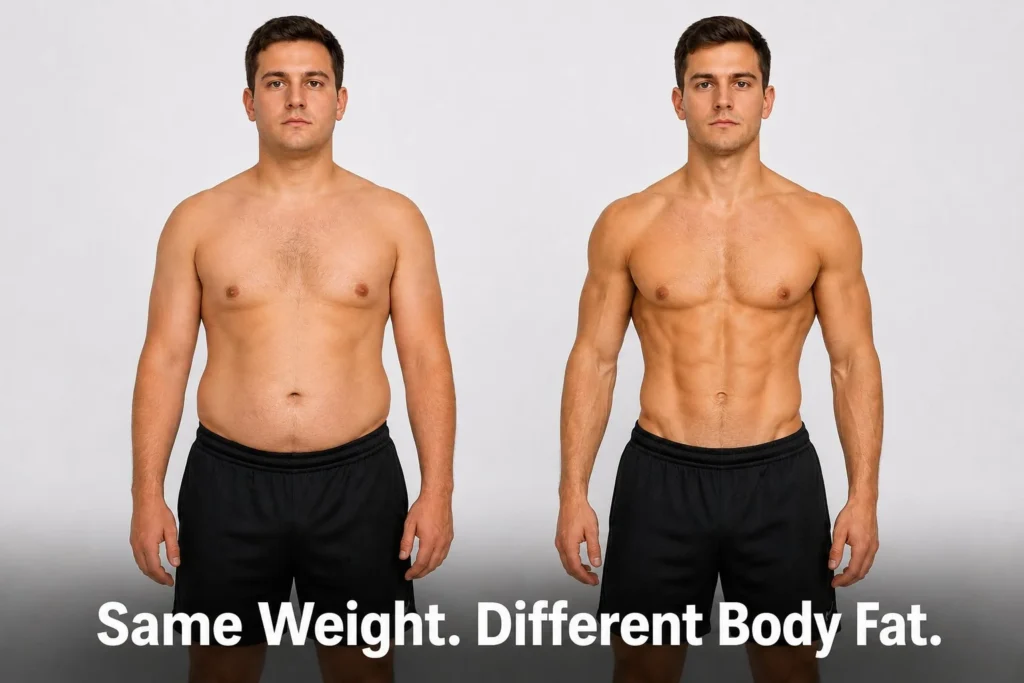
Understanding body fat percentage matters because total body weight alone cannot tell you whether weight gain reflects lean muscle mass or fat mass. Two people can weigh exactly the same while having completely different body compositions and metabolic health profiles.
Don’t know your body fat percentage? Use our Body Fat Calculator to get an instant estimate in under two minutes.
How Do You Calculate Body Fat Percentage?
The body fat percentage formula requires two inputs: total body weight and total fat mass.
Body Fat % = (Fat Mass ÷ Total Body Weight) × 100
If you weigh 80 kg and carry 12 kg of fat mass, your body fat percentage is 15%. The number moves in both directions. Lose adipose tissue and it drops. Build lean muscle mass while keeping fat constant and it drops too, because total weight increased while fat stayed the same.
The challenge is isolating fat mass accurately from total body weight. That is exactly what every method below attempts at different levels of precision, cost, and practical accessibility.
How to Measure Body Fat Percentage
There are several ways to measure body fat percentage, ranging from simple tape measurements you can perform at home to advanced laboratory tests. Each method differs in accuracy, cost, and convenience. The best choice depends on whether you want a quick estimate or the most precise measurement possible.
Method 1: DEXA Scan – The Gold Standard
DEXA stands for Dual-Energy X-ray Absorptiometry. Two low-dose X-ray beams pass through your body and distinguish between fat mass, lean body mass, and bone mineral density in a single scan. The procedure takes 5-10 minutes and produces a full regional body composition breakdown.
Multiple comparison studies confirm DEXA delivers plus or minus 1-2% accuracy for body fat percentage. A 2025 study published in the British Journal of Radiology compared whole-body DEXA with CT scans across 103 adults and found DEXA closely matched CT results for fat mass and lean mass in both limbs and abdomen.
Dr. James Levine, endocrinologist and body composition researcher, describes DEXA as “the only method that simultaneously measures fat, lean tissue, and bone density in a single, fast, non-invasive scan.” Every other body composition assessment method gets validated against DEXA because it remains the most reliable non-invasive option available outside of autopsy analysis.
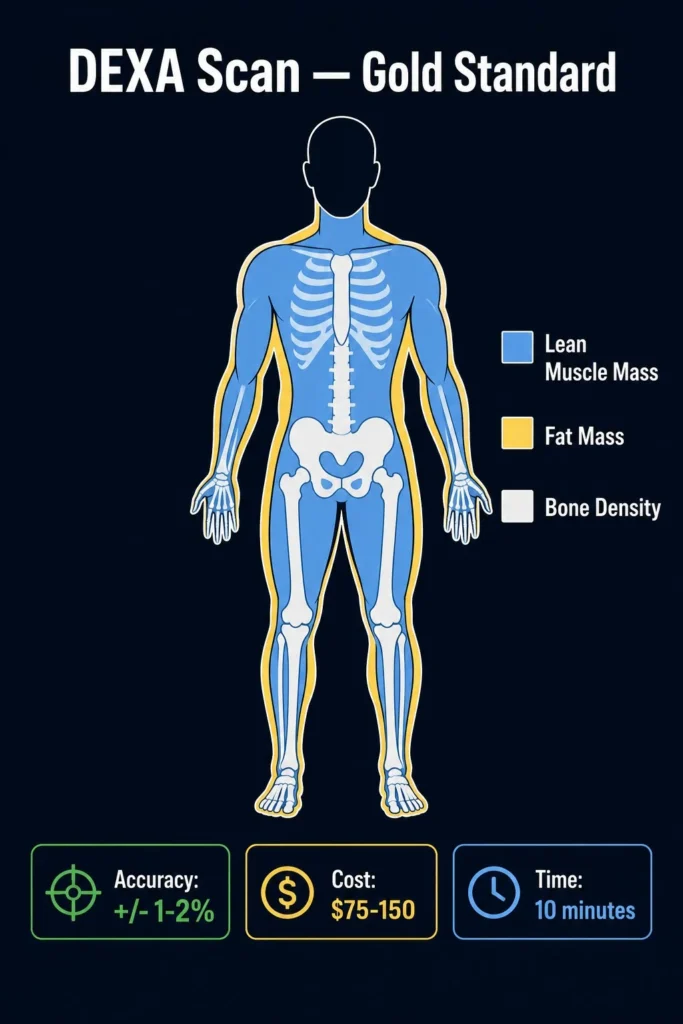
Cost ranges from $75-150 per session depending on location. Most people use DEXA quarterly for body composition benchmarking and track monthly progress with a more accessible method in between.
Method 2: US Navy Method – Best Free Option
The U.S. Navy Method is one of the easiest ways to calculate body fat percentage at home because it only requires a soft measuring tape. If you are wondering how to measure body fat percentage without expensive equipment, this method provides a practical estimate using neck, waist, height, and for women, hip measurements.
Instead of relying on body weight alone, the U.S. Navy Method estimates body fat percentage from body circumference measurements. For men, the required measurements are neck circumference, waist circumference, and height. For women, hip circumference is included to improve accuracy because fat distribution differs between men and women.
The body fat percentage formula used by the U.S. Navy converts these body measurements into an estimated body fat percentage. While it is not as precise as a DEXA scan, it offers a reliable balance of accuracy, convenience, and cost for most people.
Hodgdon and Beckett developed these gender-specific formulas at the Naval Health Research Center in 1984, validated against a large sample of U.S. Navy and Army personnel. The equations use logarithmic relationships between circumference ratios to estimate body density, then convert density to body fat percentage using the Siri equation (495 ÷ Body Density − 450). The Hodgdon Beckett circumference method typically estimates body fat within about 3-4 percentage points of hydrostatic weighing across multiple study populations.
Although you can calculate body fat percentage manually using these equations, the logarithmic calculations are time consuming and easy to get wrong. Most people therefore use an online U.S. Navy Method calculator to apply the formula automatically and receive an instant estimate.
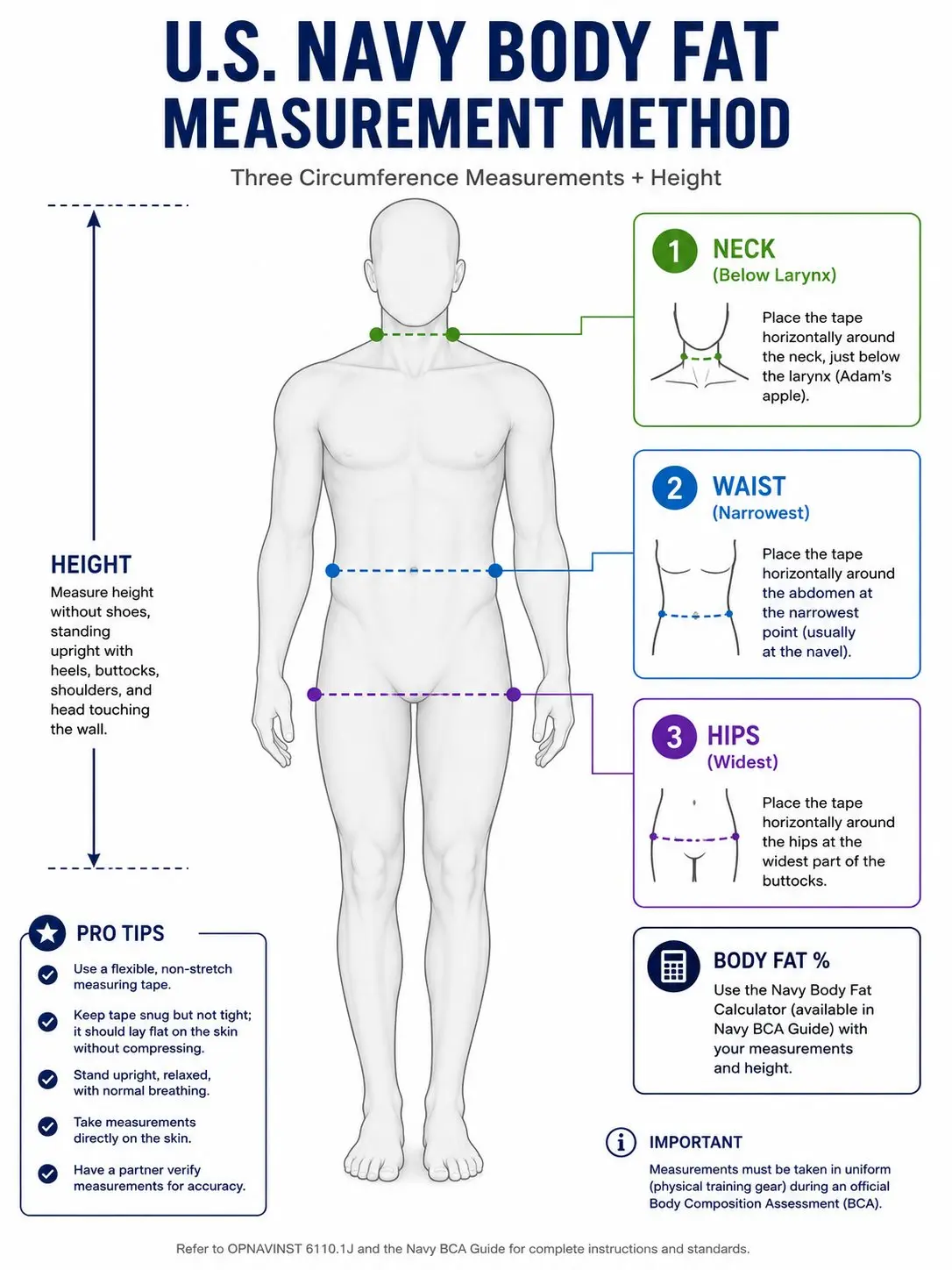
Measurement protocol determines accuracy. Measure your waist at the narrowest point after a normal exhale – not at the navel. Measure your neck just below the larynx with the tape sloping slightly downward at the front. Take two readings at each site and average them. A single sloppy circumference measurement shifts the final body fat estimate meaningfully.
Method 3: Skinfold Calipers – Best for Regular Tracking
Skinfold measurement uses calipers to pinch subcutaneous fat at specific anatomical sites and measure tissue thickness in millimetres. Those skinfold thickness values feed into validated prediction equations to estimate total body fat percentage.
Jackson and Pollock published the foundational generalized body density equations in the British Journal of Nutrition in 1978. Their 3-site skinfold protocol for men uses chest, abdomen, and thigh measurements. For women, the sites are tricep, suprailiac, and thigh. Validation studies report correlation coefficients of 0.85-0.95 against hydrostatic weighing, with standard errors of estimate ranging from 2.5-3.5%.
The Jackson-Pollock 3-site formula for men:
Body Density = 1.10938 − (0.0008267 × sum) + (0.0000016 × sum²) − (0.0002574 × age) Body Fat % = (495 ÷ Body Density) − 450
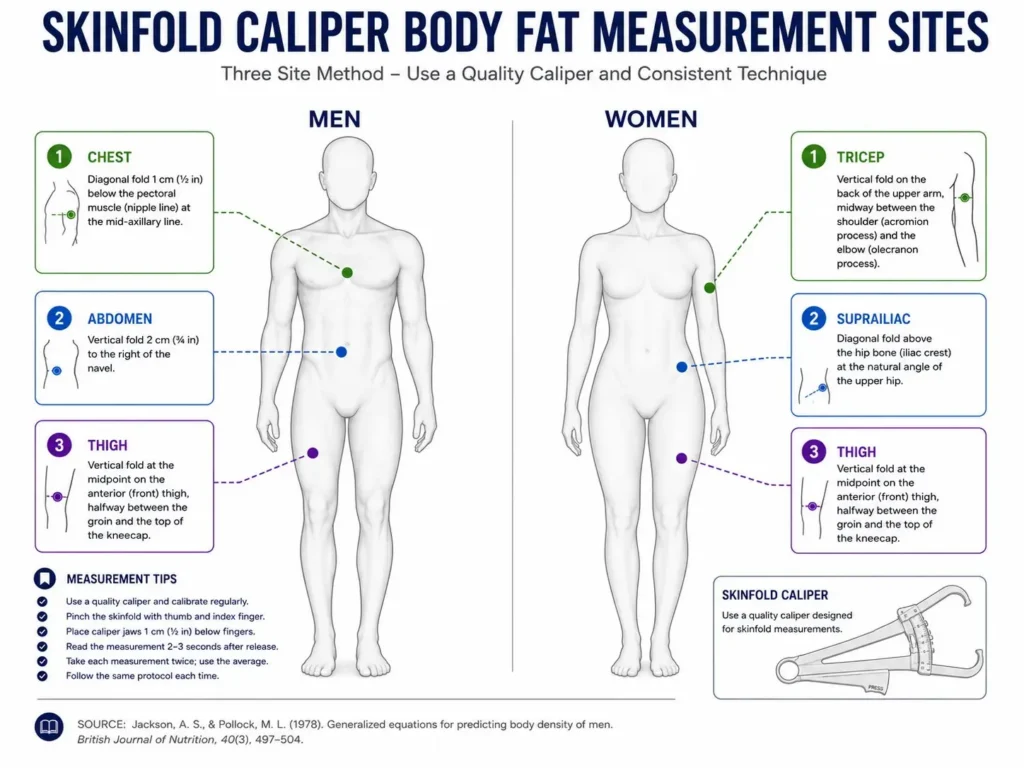
Practitioner consistency drives accuracy more than caliper quality. Self-measuring produces unreliable skinfold thickness readings because you cannot reproduce the exact pinch site and angle each time. One person who performs all your measurements using a documented protocol gives you 2-4% accuracy. Photograph caliper placement during the first session and reference that image every subsequent measurement.
Method 4: BIA Smart Scales – Most Popular, Least Reliable
Bioelectrical Impedance Analysis sends a low-level electrical current through your body to estimate body composition. Adipose tissue and skeletal muscle conduct electricity at different rates, so the impedance reading estimates lean mass and fat mass through proprietary prediction algorithms.
Many people ask about body fat scales accuracy before buying a smart scale. While these devices are convenient for tracking trends over time, hydration, meals, exercise, and even foot placement can significantly affect their readings.
The 2021 JMIR mHealth study by Frija-Masson et al. tested three commercially available BIA devices – Téfal Body Partner, Terraillon DietPack, and Nokia Withings Body Cardio – against DEXA as the reference standard. While all three measured total body weight within 0.3 kg, fat mass errors ranged from 2.2 to 8.0 kg across devices. Fat mass was consistently underestimated. Lean mass showed inconsistent results across all three models.
Hydration status drives most of the measurement error. Water conducts electricity more efficiently than fat tissue does. Research shows eating before a BIA measurement can reduce the body fat reading by 4.2% compared to fasted testing. Exercise raises body temperature and conductivity, producing artificially lower body fat readings post-workout.
A BIA reading of 20% body fat could reflect anywhere from 12% to 28% actual adiposity depending on hydration alone. Use BIA devices to track total body weight. Disregard the body fat percentage reading unless testing conditions are absolutely identical every single time – same time of day, same hydration, same time since last meal, no exercise in the preceding hours.
It’s worth noting that not all BIA devices are equal. A 2025 study published in Military Medicine found that two eight-point, direct segmental multifrequency BIA devices showed strong correlations with DEXA for body fat percentage. The 500-kHz device showed correlations of r = 0.93 in men and r = 0.89 in women, while the 1,000-kHz device showed r = 0.93 and r = 0.84, respectively. Interestingly, increasing the frequency from 500 to 1,000 kHz did not provide an additional improvement in correlation with DEXA (Combest et al., 2025).
Method 5: Hydrostatic Weighing and Bod Pod
Both methods estimate body density through displacement principles and convert density to body fat percentage using the Siri equation.
Hydrostatic weighing, also called underwater weighing, submerges the subject in water and measures water displacement. Adipose tissue is less dense than skeletal muscle and bone, so a person with higher body fat displaces more water at a given body weight. Accuracy sits at approximately plus or minus 2-3%.
Bod Pod uses air displacement plethysmography instead of water immersion. The subject sits inside a sealed chamber and the device calculates body density from the volume of air displaced. Accuracy matches hydrostatic weighing at approximately plus or minus 2-3%, with less discomfort than full submersion.
Both methods rank directly below DEXA in body composition accuracy. Universities, sports science laboratories, and some performance training centers offer access. If available, use either for periodic body composition benchmarking alongside monthly Navy Method tracking for practical progress monitoring.
Which Body Composition Method Should You Actually Use?
This is the question most articles avoid answering directly. Here is the practical framework.
If you want one accurate body composition baseline, book a DEXA scan. Use it as your starting reference point. Track monthly lean mass and fat mass changes using the Navy circumference method for free. Return to DEXA every three to six months to recalibrate.
If cost is a constraint, the Navy Method alone works well for most natural lifters. Lyle McDonald, author of The Rapid Fat Loss Handbook and a researcher in body recomposition, argues that measurement consistency matters more than absolute accuracy. If the Navy Method puts your body fat at 18% today and 15% four months later, that 3% reduction in adiposity reflects genuine change regardless of whether your true baseline was 17% or 19%.
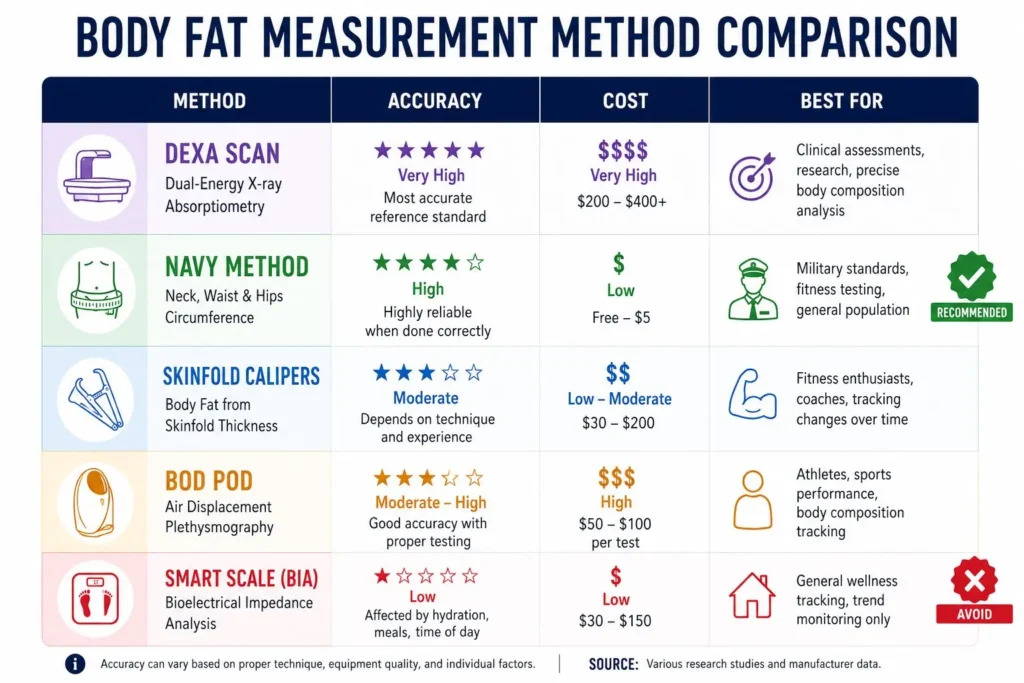
For hands-on monthly tracking, skinfold calipers performed by one consistent practitioner combined with monthly progress photos give you the most complete picture of body composition change. Progress photos cost nothing and detect visual changes that numerical methods sometimes miss.
Avoid using BIA smart scale body fat readings as your primary progress tracking metric. The number shifts based on whether you had coffee this morning.
What Is a Healthy Body Fat Percentage?
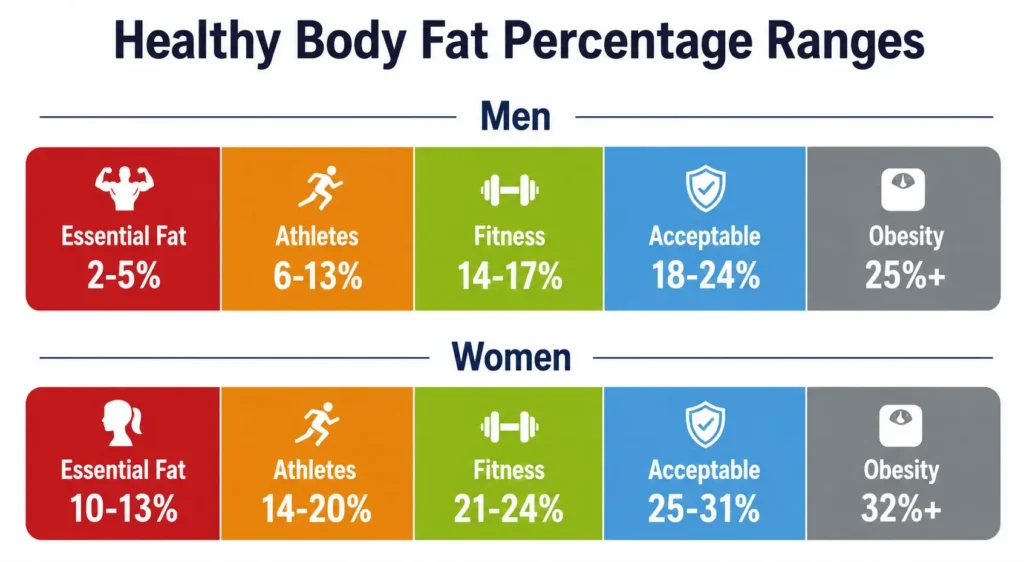
The American Council on Exercise defines the following body fat percentage ranges based on sex:
For men: essential fat 2-5%, athletes 6-13%, fitness 14-17%, acceptable 18-24%, obesity 25%+. For women: essential fat 10-13%, athletes 14-20%, fitness 21-24%, acceptable 25-31%, obesity 32%+.
Age increases acceptable body fat within each category. Older individuals tend to have lower body density for equivalent skinfold measurements, which causes standard prediction equations to slightly underestimate true adiposity. Older athletic individuals may show the reverse pattern.
Body fat percentage also changes with age. As people get older, healthy body fat ranges generally increase because muscle mass naturally declines while fat mass tends to rise. Age-specific reference ranges can therefore provide a more meaningful comparison than using a single standard for everyone
The Fitness Influencer Problem Nobody Talks About
Here is what most body fat percentage articles will not tell you directly. Some fitness influencers intentionally overstate their body fat percentage to mask drug use.
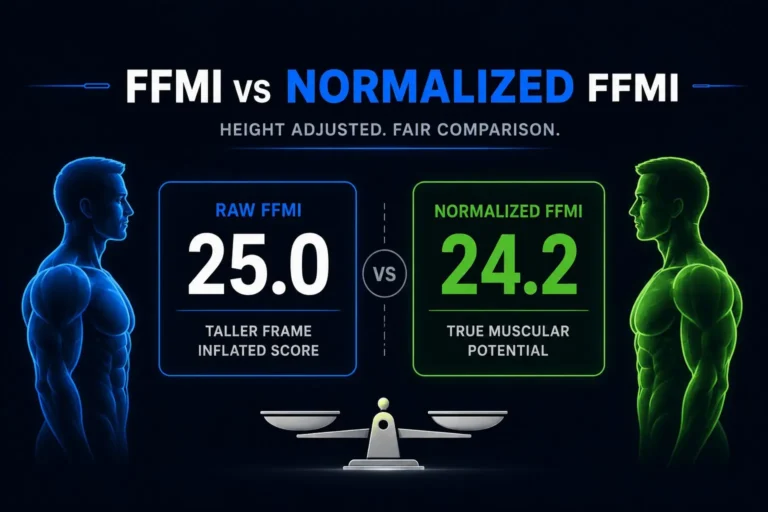
Natural muscular limits are well-documented through FFMI research. A person can only carry so much lean muscle mass at a given height and body fat percentage without performance-enhancing drugs. By claiming a higher body fat percentage and height than their actual measurements reflect, their numbers land closer to what natural body composition limits allow.
When an influencer claims 18% body fat with visible abdominal definition and exceptional lean mass, and your measurements put you at 16% with considerably less muscle, nothing is wrong with your training or nutrition protocol. Their body fat claim is inaccurate.
Your body fat percentage only needs to be accurate enough to track your own composition changes honestly over time. That is all it has ever needed to do.
If you don’t want to calculate body fat manually every time, our Body Fat Calculator does the math instantly using the same measurement method explained above.
FAQ
What is the most accurate way to measure body fat percentage at home?
The US Navy circumference method delivers the most reliable free home measurement. The Hodgdon-Beckett equations validate within 3-4% of hydrostatic weighing when measurements follow the correct anatomical protocol. BIA smart scales carry fat mass errors of 2.2 to 8.0 kg according to the 2021 JMIR study and do not reliably track body composition changes over time.
How do you calculate body fat percentage manually?
Divide your fat mass by your total body weight and multiply by 100. To isolate fat mass, first estimate your body fat percentage using the Navy Method or skinfold calipers, then multiply that percentage by your total weight. This converts body fat percentage into an absolute fat mass figure in kilograms or pounds.
Why does my smart scale give different body fat readings every day?
BIA scales measure electrical impedance, and water conducts electricity. Hydration level, food volume, exercise timing, and skin temperature all shift the impedance reading and therefore the body fat estimate. Research shows eating before testing reduces the reading by 4.2%. Test under identical conditions every time or ignore the body fat reading entirely.
What body fat percentage makes abs visible for men and women?
Most men see initial abdominal definition appear around 12-15% body fat. Clear six-pack definition typically requires dropping below 12%. For women, abdominal definition appears around 18-20% due to higher essential fat requirements, with clear definition emerging below 16-18% depending on genetics and underlying lean muscle development.
How often should I measure my body fat percentage?
Monthly measurement is sufficient for most people tracking body composition. Daily readings create misleading noise from normal hydration and digestive fluctuations. Choose one method, measure on the same day each month under identical conditions, and track directional change over 3-6 months rather than reacting to individual readings.
Is body fat percentage more useful than BMI?
For athletes and strength-trained individuals, yes. BMI cannot distinguish skeletal muscle mass from adipose tissue, making it systematically misleading for people with significant lean mass. A muscular athlete can register as clinically overweight on BMI while maintaining a completely healthy body fat percentage and metabolic profile. Body fat percentage measures actual adiposity rather than total mass relative to height.
How does body fat percentage connect to FFMI?
Body fat percentage is a direct input into FFMI calculation. FFMI uses your lean body mass, which you calculate by removing body fat from total weight, and compares it to your height. The more accurately you measure your body fat percentage, the more reliable your FFMI score becomes. Check our complete guide on FFMI scores to understand natural muscular limits.