
FFMI Calculator – Calculate Your Muscle Potential
Calculate your FFMI score and see where you rank among the natural builders.
Are You Actually Building Muscle or Just Getting Fat? Let’s find out.
“Wondering how your FFMI compares to elite bodybuilders? Check out our Famous Bodybuilders FFMI Score List to see where you stand!”
Most people spend years in the gym without actually knowing their real progress. Your weight fluctuates. Your body fat changes. But one question always stays unanswered. How much actual muscle do you actually have?
I was one of those people. I trained for almost 3 years. I went to the gym almost every day, ate clean, slept on time. But honestly, I had no idea if I was actually building muscle or just getting fat. The scale went up but I never knew what that weight actually was. Muscle or fat?. Here is the thing nobody tells you. Weight alone means nothing. A person can gain 10 pounds and every single pound can be fat. Another person gains the same 10 pounds and it is pure muscle. The scale shows the same number for both. That is exactly why I built this tool.
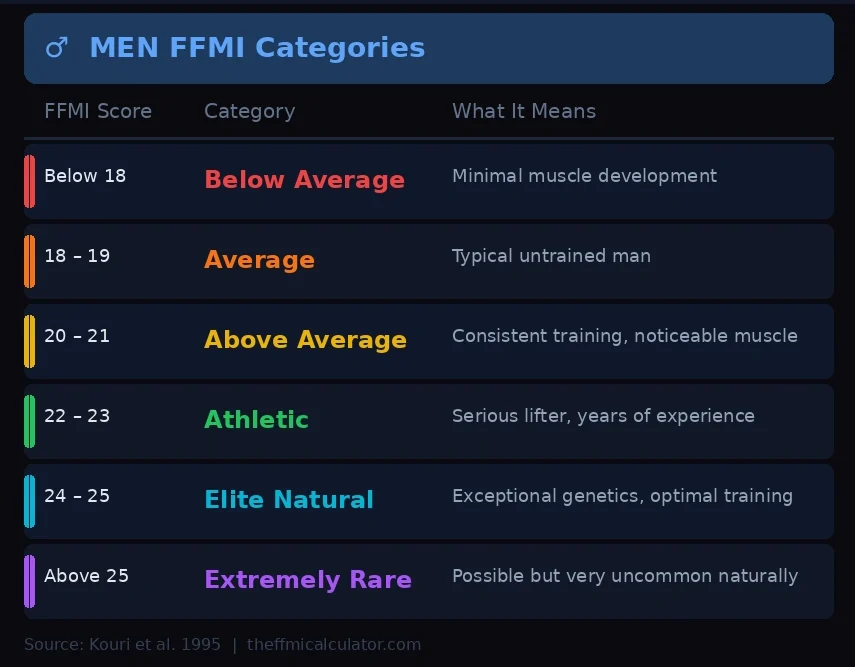
It measures your Fat-Free Mass Index, basically how much lean muscle you have as compared to your height. A study in 1995 on 157 male athletes found that most natural athletes had an average FFMI of around 21.8. And if someone scores above 25? That is extremely rare for a natural lifter almost impossible without steroids.
Unlike BMI, which mixes fat and muscle together, the FFMI Calculator focuses only on your lean mass. That is why athletes, and fitness enthusiasts trust it. For example, if you are 5’9″ tall, weigh 80kg, and have 13% body fat your FFMI would be around 22, that puts you in the athletic range. Not bad at all. This tool shows you exactly what the scale never could.
“Learn how to increase your FFMI naturally“
Key Takeaways
What the science actually says about FFMI
Muscle-only metric
FFMI measures only your lean muscle mass, unlike BMI which counts total body weight.
1995 Kouri Study
157 male athletes studied. Natural lifters averaged 21.8 FFMI — the most-cited baseline in research.
Natural ceiling
Scoring above 25 FFMI is considered extremely rare — almost impossible naturally.
Not definitive proof
A high FFMI score alone does not automatically prove steroid use — genetics matter.
Use normalized FFMI
Always use Normalized FFMI when comparing your score against published research data.
|
Category |
Details |
|
Calculator Name |
FFMI (Fat-Free Mass Index) |
|
Purpose |
Measures muscle mass independent of body fat |
|
Key Inputs |
Height, Weight, Body fat percentage |
|
Popular In |
Bodybuilding, Fitness, and Sport Science |
|
Advantages over BMI |
Distinguishes muscle from fat |
|
Tool Accuracy Depends on |
Correct body fat measurement |
|
Last Updated |
October 24, 2026 |
Loved on Product Hunt
Real reviews from our launch on Product Hunt.
Yeşim Demirel
Finally tried this and the normalized FFMI breakdown actually made sense without me googling every term, which is rare for fitness calculators.
Hülya
honestly this looks super useful, especially for people just getting into lifting and trying to figure out where they stand.
Ayfer Sayhan
Finally a calculator that actually explains what FFMI means instead of just spitting out a number. The lean body mass breakdown was way more useful than I expected.
Hanife Urbay
honestly this looks super useful, especially the normalized FFMI part since that always confused me.
What is FFMI?
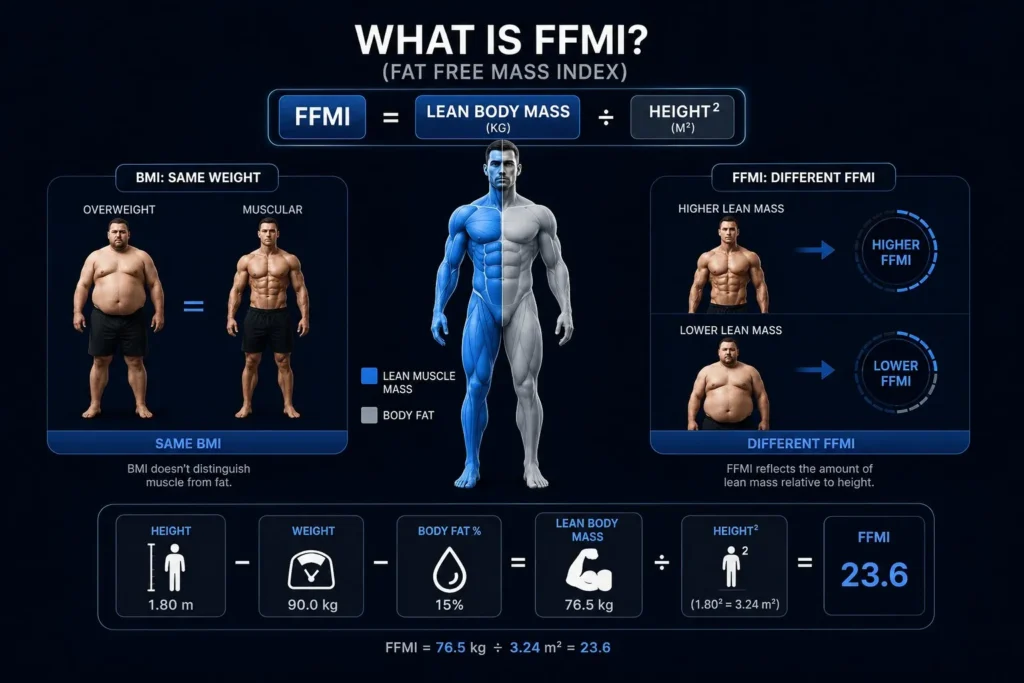
FFMI stands for Fat Free Mass Index. It measures how much lean muscle you carry relative to your height. Lean mass includes your muscles, bones, and organs. Everything except body fat. The FFMI was popularized through research in sports science and bodybuilding to estimate muscular potential.
BMI measures your total weight against your height. It cannot tell the difference between muscle and fat. FFMI solves that problem. It removes body fat from the equation completely and focuses only on lean mass. That is why a muscular athlete can show up as overweight on BMI but score perfectly normal on FFMI. The two tools measure completely different things.
Researchers in sports science started using this online Fat Free Mass Index calculator to study natural muscle limits. Bodybuilders picked it up. Coaches started tracking it. Today it is one of the most reliable ways to measure real muscular development.
Check our detailed guide on FFMI for Women.
Why FFMI Gives You a Better Picture of Muscle Growth
This free online calculator is commonly used to track body composition rather than just body weight. While many people use it to monitor weight or body fat. But one thing to keep in mind is that the weight alone doesn’t reflect muscle quality. This makes the FFMI natural muscle potential calculator a very powerful tool for those who want to track their lean muscle mass accurately.
FFMI helps you to measure your real muscular development. Also you can estimate natural genetic muscle potential, compare your progress over time, and distinguish muscle gain from fat gain. The FFMI natural limit calculator is mostly used in bodybuilding circles and fitness research to determine whether your muscle mass is within natural limits.
How the FFMI Calculator works
The calculator does one simple thing. It removes body fat from your total weight and compares what is left to your height. Say two people both weigh 180 pounds. One carries 20% body fat. The other carries 10% body fat. Their weight is identical but their muscle mass is completely different. FFMI catches that difference instantly. The scale never could.
The calculator takes your total weight, removes the fat portion, and calculates how much lean mass you carry per unit of height. That final number is your FFMI score. The higher your score, the more muscle you carry relative to your size. Simple as that.
FFMI Formula and Calculations
- In this section, we explain the basic formula for calculating FFMI.
- FFMI= Lean Body Mass (kg) ÷ Height² (m²)
- Lean Body Mass = Total Weight × (1 – Body Fat %)
- Example!
- 80 kg × (1 – 0.12) = 70.4 kg lean mass
- 70.4 ÷ (1.8²) = 21.7 FFMI
How to Use This Calculator
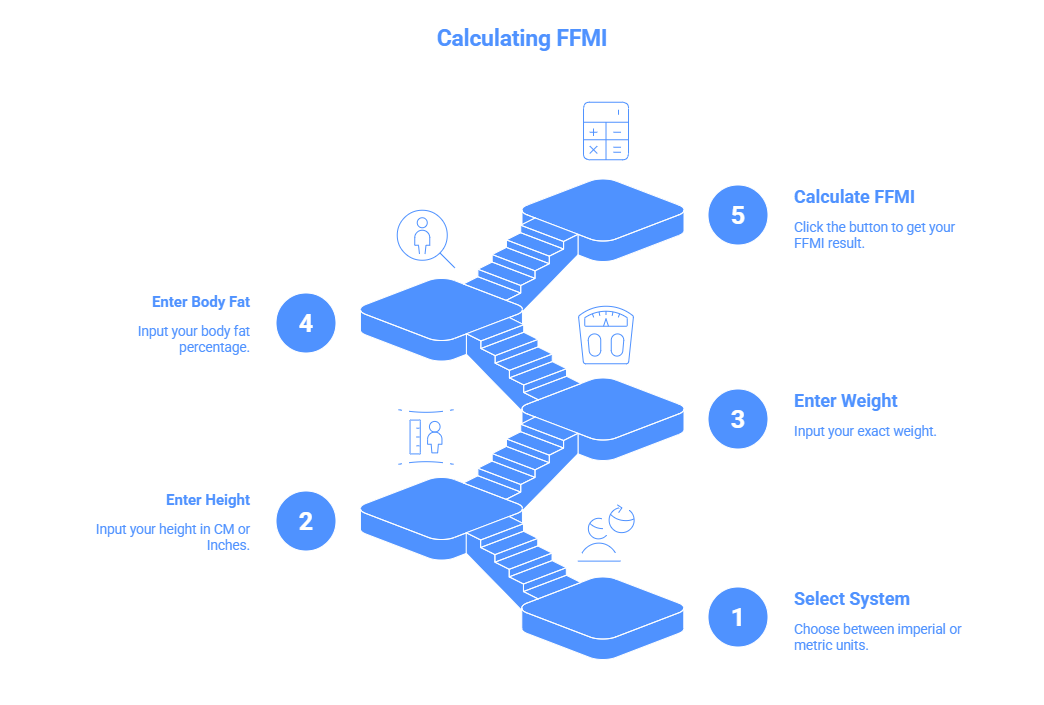
Complete these simple steps to estimate your FFMI within seconds
- In the calculator, first select your measurement system (imperial or metric)
- Enter your height in CM or Inches
- Enter your exact weight
- Enter your body fat percentage
- After all is done now click on the calculate button to know your result.
Required Inputs For An FFMI Calculator
Body Height
Your height is a key factor in the FFMI Calculation because it determines how lean muscle is evaluated relative to your body size. Most of the taller people naturally carry more fat-free mass, so the calculator also adjusts results to allow fair comparison. In our advanced muscle mass calculator, simply enter your height in centimeters or inches, and the tool will do the rest for you.
Body Weight
Your total body weight is a very important input, but by itself it doesn’t reveal your muscle gain or fat gain. Our online free FFMI calculator uses this value to separate your lean mass from body fat, helping you understand whether your weight contributes to muscle development or not.
Body Fat Percentage
Another important factor is body fat percentage because it allows the calculator to separate fat from your lean mass. Simply by entering this value, the muscle potential calculator can accurately measure your true muscle development and also determine where you fall on the muscularity scale or another.
Why These Inputs Matter
Height and weight alone only produce BMI, which cannot distinguish muscle from fat. Adding body fat percentage allows the calculator to isolate lean mass, making FFMI a more accurate measure of true muscularity and physical performance. That’s why all these inputs matter
Don’t Stress The Details
You don’t need perfectly accurate measurements. A simple estimate can provide you with very helpful insights into your muscle development. Also, tracking your FFMI over time helps you see whether your weight gain comes from muscle or fat.
FFMI vs BMI
BMI measures body weight relative to height, while FFMI focuses on fat-free mass. This makes FFMI useful for assessing muscularity, especially in strength trained individuals, whereas BMI remains useful for general weight screening.
For a detailed comparison, read our FFMI vs. BMI: Which One Should You Track? guide.

FFMI Chart
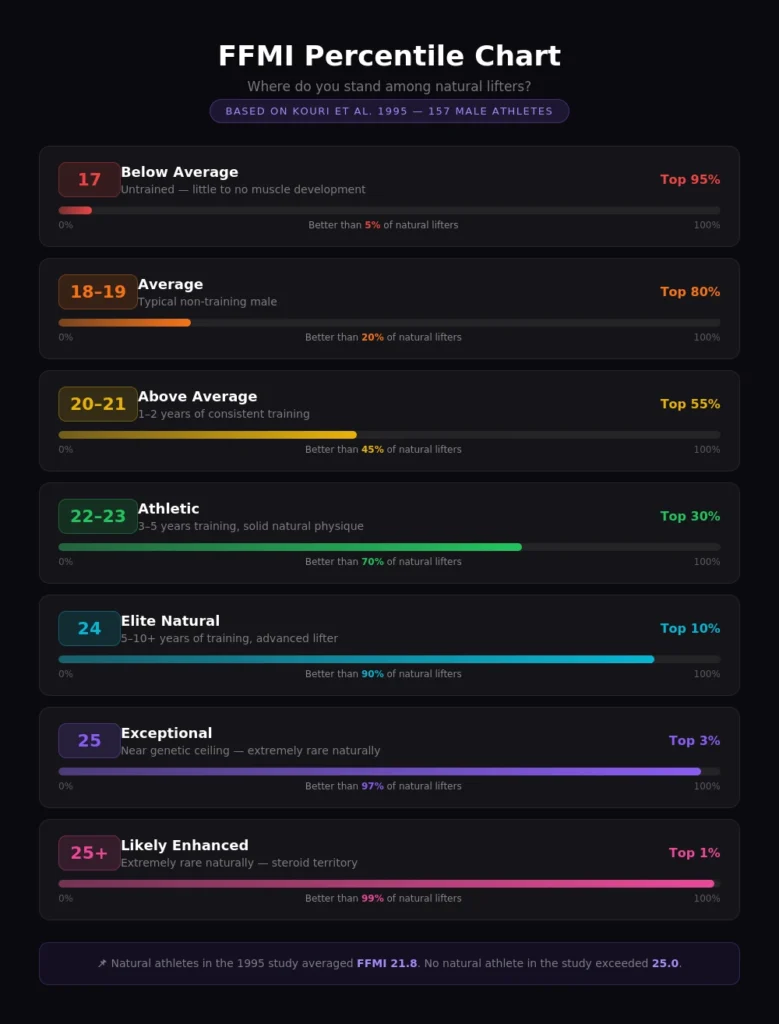
Below is the ffmi score chart for Men.
| FFMI | Score |
| Below 18 | Below Average |
| 18-19 | Average |
| 20-21 | Above Average |
| 22-23 | Athletic |
| 24-25 | Elite Natural |
| 25+ | Extremely Rare |
FFMI Chart Women
| FFMI | Score |
| Below 15 | Below Average |
| 15-16 | Average |
| 17-18 | Athletic |
| 19-20 | Very Muscular |
| Above 21 | Extremely Rare |

FFMI Percentile
FFMI Scale
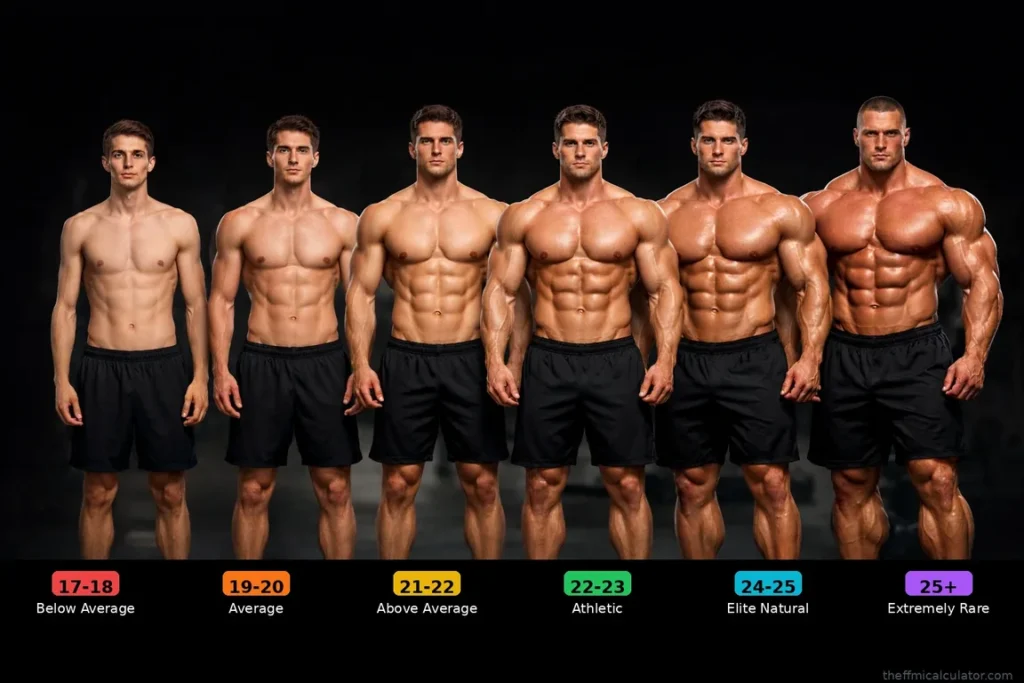
Scientific Research Behind FFMI
FFMI gained popularity from scientific studies that compared natural bodybuilders with enhanced athletes. Also, researchers observed that the most natural bodybuilders rarely exceeded an FFMI of 25, while higher values were more common among those using performance enhancing drugs.
Recent research has provided more detailed reference values for FFMI across different age groups. A 2026 nationally representative study of more than 10,000 Korean adults found that FFMI in men peaked around ages 30-49 before gradually declining at older ages (Kim et al., 2026). The researchers used bioelectrical impedance analysis (BIA) to establish nationally representative FFMI and fat mass index reference values for Korean adults.
This highlights an important point. FFMI changes with age, so tracking your own trend over time can be more useful than focusing on a single fixed benchmark.
In the end, the result is that the FFMI became a practical benchmark for estimating natural genetic muscle potential, although individual results vary due to genetics, training, and nutrition. Now, most people use this genetic potential calculator.
Does High FFMI Always Mean Steroids?
No having an FFMI above 25 does not actually prove that someone is taking steroids yes, It can give a strong hint. But calling it proof is totally wrong. A lot of people on the internet treat 25 FFMI like it’s some kind of lie detector test but that’s not true at all. The original 1995 study by Kouri looked at 157 male athletes. Out of them, 74 were natural lifters and 83 were using steroids. In that group none of the natural lifters had an FFMI above 25, which sounds pretty convincing at first.
But here’s the part most people miss. In the same study, almost half of the steroid users also had an FFMI below 25. So having a low FFMI doesn’t automatically prove someone is natural either.
Even the study itself didn’t present 25 as a final judgment. The researchers described their findings as “preliminary” and suggested the number 25 only as a starting point or a screening guideline not a final verdict about whether someone is natural or not. Simply having an FFMI above 25 doesn’t mean someone is using steroids and having an FFMI below 25 doesn’t automatically make someone natural.
Practical Use Cases of the Fat Free Mass Calculator
- This maximum muscle potential calculator is widely used in natural bodybuilding
- You can track strength training progress
- Also, it is used to monitor your fitness transformation
- Estimating realistic muscle goals
Screening for ager elated muscle loss. FFMI has applications beyond bodybuilding. In a 2025 cohort study of 696 older adults in Japan, lower FFMI was predictive of falls over one year, while FFMI cutoffs of <17.5 kg/m² for men and <14.4 kg/m² for women effectively identified reduced muscle mass Takagi et al., 2025.
Limitations of FFMI
Body Fat Accuracy
The accurate FFMI depends on your inputs. If you put your body fat estimate wrong, the result will be wrong. Put the correct body fat to get good results.
Performance
High FFMI does not indicate strength, endurance, or athletic performance.
Genetics
Genetic factors influence how easily people can build muscle.
Health is Not One Number
FFMI doesn’t assess your cardiovascular health, mobility, or overall fitness.
Misconception about the FFMI Online Tool
- Higher FFMI means a better athlete
- Fat-free mass index guarantees natural stats
- It replaces all health metrics
- It works without accurate body fat
Fat-free body mass is a useful tool, but it should not be considered a final judgment of your overall fitness.
FFMI vs Normalized FFMI. What Is the Difference?
Raw FFMI helps you track your muscle development over time, while normalized FFMI adjusts for height to make comparisons between people more meaningful. Learn how both scores differ, how to calculate them, and what the research says about the natural FFMI limit.
Read our complete guide to FFMI vs. Normalized FFMI →
“Curious about who built this calculator? I trained in the gym for almost 3 years as a natural lifter and created this tool after struggling with the same questions. Learn more about the author.”
Pros and cons
FAQs
Conclusion
This free calculator gives you a clearer view of your muscular development. Now you don’t need to guess or rely only on weight, you can measure your lean mass properly and set your goals. Whether you are a beginner or advanced bodybuilder or lifter tracking FFMI now helps you stay focused and disciplined.
Disclaimer: This FFMI calculator is for educational and tracking purposes only. It is not intended as medical advice, diagnosis or treatment. Always consult a qualified healthcare professional or certified trainer before making any decisions about your health, diet or training program.