FFMI for Women | Natural Limits, Charts & How to Improve Your Score
Most women who calculate their FFMI get a number and then have no idea what to do with it.
Is 18 good? Is 20 suspicious? What does 21 even mean for a woman? The internet gives you male-focused charts with a footnote that says “subtract 3 to 4 points for women.” That is not an answer. That is a dismissal.
Here is what nobody tells you: female FFMI operates on its own framework. The biology is different, the ceiling is different, and the interpretation is different. A woman with FFMI 19 has achieved something that deserves the same respect as a man hitting FFMI 22 to 23. Same relative effort. Same genetic rarity. Completely different absolute number.
This guide gives you everything verified ranges, the real natural limit backed by peer-reviewed research, a step-by-step calculation, and honest examples from female athletes. By the end, you will know exactly where you stand and what is actually possible.
What Is FFMI and How Is It Different for Women?
FFMI stands for Fat-Free Mass Index. It measures how much lean body mass you carry relative to your height – muscle, bone, organs, and water, with body fat removed from the equation entirely.
Think of it as the smarter version of BMI. BMI uses your total weight, which means it cannot tell the difference between a muscular athlete and someone carrying excess body fat. FFMI strips that fat out and looks only at what is left. That is why it matters so much for women who lift seriously.
But here is the thing. Female FFMI is not just a smaller version of the male scale. The biology that creates the difference goes deeper than most people explain.
Women carry more essential body fat than men by biological necessity, 10 to 13% compared to 2 to 5% for men. That essential fat is not removable. It supports hormonal function, reproductive health, and neurological function. It is built into the female body by design. This means a portion of a woman’s total weight will always be fat, regardless of how lean or muscular she becomes. That directly limits how high her FFMI can go.
Women also have testosterone levels 10 to 15 times lower than men typically 15 to 70 ng/dL versus 300 to 1000 ng/dL. Testosterone drives muscle protein synthesis. Less testosterone means a lower ceiling for lean mass accumulation. This is not a training limitation. It is a hormonal one.
Research from Schutz et al. (2002), published in Nature across one of the largest body composition datasets ever compiled, found that untrained women average an FFMI of 15.4, compared to 18.9 for men. That ratio of approximately 0.81 holds remarkably steady across untrained populations, recreational athletes, competitive physique athletes, gymnasts, and elite strength sports. In every single category studied, women average roughly 81% of male FFMI values.
What most articles miss is this: that ratio means female FFMI 19 equals male FFMI 22 to 23 in terms of relative muscular development. Chasing male benchmarks and feeling like you are coming up short is comparing apples to oranges.
Now what about normalized FFMI?
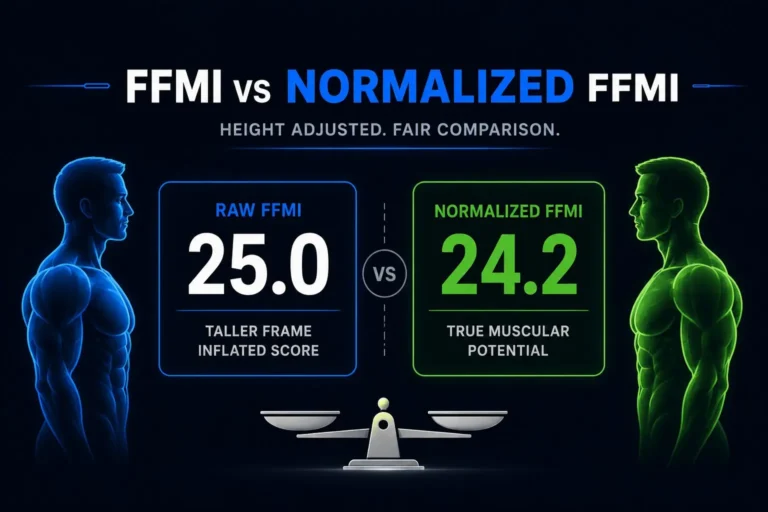
Raw FFMI does not account for height. Taller women naturally carry more lean mass, which inflates their score even if they are no more muscular than a shorter woman. Normalized FFMI fixes this by adjusting all values to a reference height of 1.8 meters using the Kouri et al. (1995) formula:
Normalized FFMI = FFMI + 6.3 x (1.8 minus height in meters)
If you are shorter than 1.8 meters, normalization adds points to your score. If you are taller, it subtracts. At exactly 1.8 meters, both numbers are identical. Always use normalized FFMI when comparing yourself to research data or other people.
FFMI Ranges and Charts for Women
So what does your number actually mean?
Here is the complete female FFMI chart, drawn from peer-reviewed research including Schutz et al. (2002), Chappell et al. (2018), Jagim et al. (2024), and the original Kouri et al. (1995) benchmark data.
Female FFMI Chart (Normalized)
What Does FFMI 18 Mean for a Woman?
FFMI 18 places you in the “very muscular” category, above the average female collegiate athlete and reflecting several years of serious, consistent resistance training. This is not a number most women achieve casually. It represents real effort and a good genetic response to training.
What Does FFMI 20 Mean for a Woman?
FFMI 20 is elite. It sits at the upper end of what is naturally achievable and reflects exceptional genetics combined with years of optimized training and nutrition. Reaching FFMI 20 naturally as a woman puts you in a category that the vast majority of female lifters regardless of effort — will never reach.
What Does FFMI 21 Mean for a Woman?
FFMI 21 is at the very edge of the natural ceiling. A woman maintaining FFMI 21 at 18 to 22% body fat is either a genuine genetic outlier or has had pharmaceutical assistance. At very low body fat below 16% – FFMI 21 becomes almost impossible to explain naturally.
Sport Specific Female FFMI Context
The 2024 Jagim et al. study of 372 female collegiate athletes found average FFMI values of 18.82 across all sports. Rugby athletes scored highest, while gymnasts, cross-country runners, and synchronized swimmers scored lowest. Strength and power sports push FFMI higher. Weight-sensitive and endurance sports push it lower. Knowing your training resembles which category helps you set realistic expectations.
Natural FFMI Limit for Women | Natty or Not?
Here is the honest answer and it is more nuanced than most people will tell you. The natural female FFMI ceiling is approximately 21 to 22.
Why?
Chappell et al. (2018) provided the most rigorous peer-reviewed data specifically on female natural bodybuilders, estimating the maximum natural female FFMI at around 20, representing approximately 80% of the established male ceiling of 25. Menno Henselmans analyzed this alongside Schutz et al. (2002) and multiple other athlete datasets and placed the female natural ceiling between 20 and 22, depending on genetics and measurement accuracy.
Now here is where it gets interesting.
FFMI alone does not prove steroid use. It is a probability tool. The combination of high FFMI and very low body fat is the real red flag — not the number alone. A woman at FFMI 21 with 25% body fat is a very different case from a woman at FFMI 21 with 15% body fat. The latter is nearly impossible to achieve naturally.
What raises the probability of PED use in women:
FFMI consistently above 22 while maintaining body fat below 16 to 18%. Disproportionate trap and shoulder development, these muscle groups have the highest androgen receptor density and respond most dramatically to steroid use. Rapid lean mass gains of 15 or more pounds within a single year. Maintaining extremely lean, vascular, paper-thin skin year-round.
What does NOT automatically mean steroid use:
Having an FFMI between 20 and 22. Exceptional genetics exist. They are rare but real. A woman who has trained optimally for 8 to 12 years with elite level nutrition, recovery, and genetics can legitimately approach FFMI 21 to 22. She is not common. But she exists.
The most honest statement the research supports: FFMI above 22 in women at low body fat raises the probability of PED use to a level that reasonable people should take seriously.
How to Calculate FFMI for Women (Step-by-Step)
You need three numbers: body weight in kilograms, height in meters, and body fat percentage.
Step 1: Calculate lean body mass. Lean Body Mass = Total Weight x (1 minus Body Fat as decimal) Example: 65 kg x (1 minus 0.22) = 65 x 0.78 = 50.7 kg
Step 2: Calculate raw FFMI. FFMI = Lean Body Mass divided by Height squared Example: 50.7 divided by (1.65 x 1.65) = 50.7 divided by 2.7225 = 18.6
Step 3 : Calculate normalized FFMI. Normalized FFMI = FFMI + 6.3 x (1.8 minus Height in meters) Example: 18.6 + 6.3 x (1.8 minus 1.65) = 18.6 + 0.945 = 19.5
A woman who is 5 feet 5 inches tall, weighs 65 kg, and carries 22% body fat has a normalized FFMI of 19.5 – elite natural range.
Now here is the part most people skip.
Body fat measurement accuracy determines everything. If your body fat estimate is 3% too low, your FFMI looks artificially high. If it is 3% too high, you may be underestimating your progress. Use DEXA scan where possible (plus or minus 1 to 2% accuracy) or the US Navy circumference method (plus or minus 3 to 4% and completely free). BIA smart scales carry error margins of 5 to 8% according to the 2021 JMIR mHealth study by Frija-Masson et al. do not use them to track FFMI.
Use our free FFMI Calculator to skip the manual math and get your result in 30 seconds.
How to Increase Your FFMI Naturally as a Woman
Here is what actually moves the number.
Progressive overload is the foundation. Your muscles grow in response to stress they have not already adapted to. If you lift the same weight, same reps, same rest every session – your body has zero reason to add lean tissue. Add weight. Add reps. Reduce rest. Do something that forces adaptation, consistently, over months and years.
Most women I have spoken with stall in their second or third year not because they stopped working hard, but because they stopped making their training harder. Same program, same weights, same result. That plateau is almost always a progressive overload problem, not a nutrition or genetics problem.
Protein intake needs to be higher than you think. Research consistently supports 1.6 to 2.2 grams per kilogram of body weight daily for women pursuing muscle gain. A 65 kg woman needs 104 to 143 grams of protein per day minimum. Most women tracking their intake for the first time find they are hitting 60 to 70 grams. That gap explains a lot.
The 2021 PMC study on progressive energy restriction in concurrent trained women found protein intakes exceeding 2 grams per kilogram per day were most effective at preserving lean body mass during caloric restriction. Getting to that number requires intentional planning — not just eating more chicken.
Sleep is where muscle actually gets built. Growth hormone peaks during deep sleep. Women sleeping 6 hours or fewer per night consistently show lower rates of lean mass accumulation than those sleeping 7 to 9 hours. I know this sounds basic. I also know most serious female lifters still treat sleep as negotiable. It is not.
Realistic FFMI Progress Timelines for Women
Beginner (under 1 year): FFMI increases 1 to 2 points. Hormonal response to new training stimulus is strongest here.
Intermediate (1 to 3 years): Progress slows to 0.5 to 1 point per year. This feels frustrating. It is completely normal.
Advanced (3 to 7 years): Expect 0.2 to 0.5 FFMI points annually. Tenths of a point is genuine progress at this stage.
Elite natural (7 or more years): You are approaching your genetic ceiling. The gains are real. They are just measured in hundredths now.
How Long to Reach Specific FFMI Targets as a Woman
Reaching FFMI 17: Most women with average genetics hit this within 1 to 2 years of consistent training. Reaching FFMI 19: Typically requires 3 to 5 years of optimized training and nutrition with above-average genetics. Reaching FFMI 21: Requires 7 to 12 or more years, elite-level genetics, and near-perfect execution. Most natural women will not reach this number regardless of effort.
That last point is not discouraging. It is honest. Most natural men will never reach FFMI 25 either. Knowing your realistic ceiling helps you train with accurate expectations instead of chasing a goal that was never physiologically available to you.
Famous Female Athletes and Bodybuilders FFMI Examples
This section requires honesty upfront. Verified body composition data for female athletes is harder to confirm than for men. Many numbers online are estimated from visual analysis or self-reported stats. I will only present estimates where the numbers are internally consistent and reasonable given known height, weight, and competition division standards.
Want to see how these numbers compare to male bodybuilders? Check out our Famous Bodybuilders FFMI Score list.
Cydney Gillon —> FFMI approximately 19 to 20
Three-time Figure Olympia Champion. At approximately 5 feet 3 inches and 125 to 130 pounds on stage with estimated 12 to 14% body fat, her FFMI estimate lands between 19 and 20. Figure competition physiques generally fall within plausible natural ranges, though drug testing in the IFBB is minimal. Her development is exceptional. Her numbers sit near but within the upper end of what research considers achievable naturally.
Andrea Shaw —> FFMI approximately 23 to 24
Women’s Bodybuilding Olympia champion. At approximately 5 feet 6 inches and 175 to 185 pounds on stage at sub-12% body fat, her estimated FFMI reaches 23 to 24. This is 2 to 3 points above the established female natural ceiling of 21 to 22. The IFBB Pro Women’s Bodybuilding division conducts no meaningful drug testing. The numbers reflect this reality clearly.
Sarah Villegas —> FFMI approximately 19 to 20
2020 Olympia Women’s Physique champion. Her physique represents the upper end of what Women’s Physique competition looks like. Athletes in this division generally show FFMIs between 18 and 21. Villegas sits at the top of that range its impressive, and not clearly outside what elite natural development could produce.
What the Gap Actually Tells You
The estimated FFMI difference between Figure athletes and Women’s Bodybuilding athletes is roughly 4 to 5 points. That gap does not come from better training, superior discipline, or more favorable genetics. It comes from pharmacology. Seeing this clearly helps you set goals that are grounded in what your biology can actually produce.
Conclusion
Here is what this entire guide comes down to.
Female FFMI is not a lesser version of male FFMI. It is a different measurement on a different scale reflecting different biology. A woman who reaches FFMI 19 has done something genuinely impressive equivalent in relative terms to a man hitting FFMI 22 to 23. That deserves to be understood, not dismissed with a footnote.
The natural ceiling of 21 to 22 is not a limitation to resent. It is a realistic target that most women even dedicated lifters with years of training will never reach. Knowing this helps you train with accurate expectations instead of chasing numbers that were never physiologically available to you.
What actually matters is the direction of your FFMI over time. Are you building real lean mass or just gaining weight? Is your body fat staying in check while your strength increases? FFMI answers those questions better than the scale ever will.
Calculate your number. Use our free FFMI Calculator to get your result in 30 seconds. Track it consistently. Give the process the years it actually requires.
That is the complete picture.
Frequently Asked Questions
What is a good FFMI score for a woman?
For most women, FFMI 17 to 18 is athletic and reflects consistent training over 1 to 3 years. Scores of 19 to 21 represent elite natural development requiring exceptional genetics and years of dedicated work. According to Legion Athletics, a normalized FFMI of 18 to 18.9 is considered excellent for female natural weightlifters. Most recreational female lifters will plateau between FFMI 17 and 19 with optimal training.
Not sure what these numbers mean for men? Our complete guide on what is a good FFMI score breaks down male ranges in the same detail.
What is the natural FFMI limit for women?
Chappell et al. (2018) estimated the maximum natural female FFMI at approximately 20. Menno Henselmans’ analysis of multiple athlete datasets places the ceiling between 20 and 22 depending on genetics and measurement accuracy. Women consistently above 22 at low body fat levels are almost certainly using performance-enhancing drugs. A 2019 analysis of 400-plus athletes established the female natural ceiling at 21 to 22.
Is FFMI 18 good for a woman?
Yes. FFMI 18 places you above the average female collegiate athlete and reflects several years of serious, consistent resistance training. The 2024 Jagim et al. study of 372 female collegiate athletes found an average of 18.82 across all sports. Reaching FFMI 18 as a recreational lifter means you have built a genuinely above-average physique.
Is FFMI 20 or 21 possible naturally for a woman?
Possible, but rare. FFMI 20 sits at the upper end of what research considers naturally achievable for women with elite genetics and many years of optimized training. FFMI 21 is at the very edge of the natural ceiling. A woman maintaining this score at body fat below 16 to 18% is either a genuine genetic outlier which exist but are rare or has had pharmaceutical assistance.
How is female FFMI different from male FFMI?
Women’s FFMI scores are approximately 3 to 4 points lower than men’s for equivalent relative muscularity. The primary reasons are testosterone levels 10 to 15 times lower than men, higher essential fat requirements of 10 to 13% versus 2 to 5% for men, and differences in muscle fiber cross-sectional area. Female FFMI 19 reflects the same relative development as male FFMI 22 to 23. Always use sex specific ranges when interpreting female FFMI, comparing to male benchmarks gives you a misleading picture.
How long does it take to improve FFMI as a woman?
Beginners gain 1 to 2 FFMI points in the first year. Intermediate lifters gain 0.5 to 1 point annually. Advanced natural women see 0.2 to 0.5 points per year. Most natural women reach their genetic FFMI ceiling typically between 19 and 21 after 7 to 12 years of optimal training and nutrition. Progress at the advanced level is real even when the numbers look small.
What body fat percentage gives the most accurate FFMI for women?
DEXA scan gives plus or minus 1 to 2% accuracy and is the gold standard. The US Navy circumference method gives plus or minus 3 to 4% and is free. BIA smart scales carry error margins of 5 to 8% according to Frija-Masson et al. (2021) and should not be used for tracking FFMI progress. Use the same method consistently every time to make meaningful comparisons over time.
Your FFMI is a tool not a verdict. Use it to understand where you are, set goals that respect your biology, and measure progress that is actually real.
References
- Kouri EM, Pope HG Jr, Katz DL, Oliva P. Fat-free mass index in users and nonusers of anabolic-androgenic steroids. Clinical Journal of Sport Medicine. 1995;5(4):223-228.
- Schutz Y, Kyle UG, Pichard C. Fat-free mass index and fat mass index percentiles in Caucasians aged 18 to 98 years. International Journal of Obesity. 2002;26:953-960.
- Chappell AJ, Simper T, Barker ME. Nutritional strategies of high level natural bodybuilders during competition preparation. Journal of the International Society of Sports Nutrition. 2018;15:4.
- Jagim AR, Harty PS, Jones MT, Fields JB, Magee M, Smith-Ryan AE, Luedke J, Kerksick CM. Fat-free mass index in sport: normative profiles and applications for collegiate athletes. Journal of Strength and Conditioning Research. 2024.
- Frija-Masson J, Mullaert J, Vidal-Petiot E, et al. Accuracy of Smart Scales on Weight and Body Composition: Observational Study. JMIR mHealth and uHealth. 2021;9(4):e22487.
- Ritson AJ, McDonald L, Agu J, Bannock LG. From semi-starvation to the stage: indicators of low energy availability in a drug-free bodybuilder. Frontiers in Nutrition. 2024. PMC11601077.
- American Council on Exercise. Body Fat Percentage Categories. ACE Fitness. https://www.acefitness.org
- Staron RS, Hikida RS, Murray TF, et al. Assessment of skeletal muscle composition in young women. Journal of Applied Physiology. 1989;66(1):41-46.