

Muscle Soreness After a Workout | Is It Actually a Good Sign?
Elite bodybuilders rarely limp out of the gym sore. Most beginners do, after almost every session. If soreness proved muscle growth, that pattern would be backward.
Muscle soreness is neither necessary nor sufficient for muscle growth. You can get substantially sore from an unfamiliar workout that produces little long term benefit, and experienced lifters can keep making progress with almost no soreness at all. Here is what the research actually supports, and where it stays genuinely uncertain.
Muscle soreness is not a reliable measure of muscle growth. In fact, soreness often decreases as your body adapts to repeated training even when strength and muscle development continue. A related example of training adaptation is muscle memory, which helps explain why previously trained muscles can regain size and strength after a period of detraining.
Key Takeaways
- Muscle soreness comes in two forms, and only one of them is delayed onset muscle soreness
- Soreness involves muscle damage, inflammation, and changes in pain sensitivity together. The exact mechanism is still not fully settled
- Soreness fades with repeated exposure to the same exercise, even while strength keeps improving
- Chasing soreness on purpose is a poor training strategy and raises injury risk
- Some pain signals are not soreness at all. They mean you need a doctor, not a foam roller
What Is Muscle Soreness? Acute Pain vs. DOMS
Muscle soreness is the pain, tenderness, stiffness, or discomfort you feel in a muscle during or after exercise. It is especially common after a workout that is harder, longer, or different from what your body is used to. The sensation can vary from a temporary burning feeling during exercise to soreness that develops hours later.
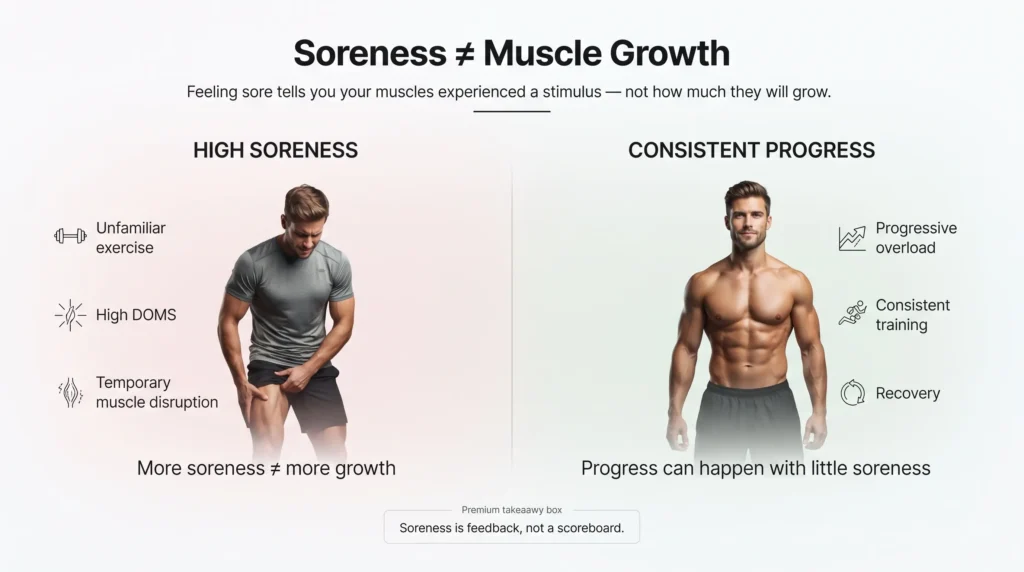
There are two main types of exercise related muscle soreness.
Acute soreness is the burning or discomfort you feel during or immediately after a hard set. It is different from DOMS and is related to the immediate metabolic and mechanical demands of the exercise itself, and it fades relatively quickly once you stop.
Delayed onset muscle soreness, or DOMS, is different. It develops several hours after unfamiliar or demanding exercise, especially exercise involving a lot of eccentric loading, and usually peaks between 24 and 72 hours later. It rarely lasts more than five to seven days.
These two are not interchangeable, and neither is the same thing as muscle damage in general or muscle growth. Muscle damage refers to the broader structural and biochemical disruption that can follow hard exercise. Muscle growth refers to an actual increase in muscle size over time, driven by training and nutrition. Soreness is only one, imperfect window into what is happening underneath.
When people say “I’m sore two days after leg day,” they mean DOMS. That is the soreness this article focuses on.
Read our complete guide on how long muscle actually takes to grow.
Why Does DOMS Happen After Exercise?
Hard or unfamiliar training, especially with a lot of eccentric loading, creates temporary structural disruption in muscle tissue. That triggers a repair and inflammatory response, along with changes in how sensitive your local pain receptors become. Together, this combination produces the ache you feel as DOMS.
This is more accurate than the old “micro-tears cause inflammation causes pain” explanation you’ll see everywhere. Muscle researchers still describe the exact mechanism as complex, and it is not fully settled.
Novelty is one of the biggest drivers of DOMS.
It’s also the reason your muscles hurt so much the first time you try a new workout or exercise. A workout can be relatively light and still leave you sore if it uses movements your body isn’t accustomed to. Intensity, volume, how much eccentric loading is involved, and how used to the exercise you are can all shape how sore you get. This is also why a light, unfamiliar activity, like a long hike for someone who never hikes, can cause real soreness even without heavy weights involved.
Certain movements carry more of this eccentric component than others:
- The lowering phase of a bicep curl
- The lowering phase of a pull-up
- Walking or running downhill
- Lunges
- Landing after a jump
Your body adapts fast, even before your muscles do.
This is called the repeated bout effect. A 2023 systematic review and meta-analysis in the Journal of Strength and Conditioning Research compared soreness and creatine kinase, a blood marker of muscle damage, after a first and second bout of similar exercise. Both measures were consistently lower after the second bout (Doma et al., 2023). Your body genuinely becomes less sore from a repeated stimulus well before your strength or muscle size stops improving from it.
Soreness also varies a lot between individuals, and even between muscle groups in the same person. Some lifters get sore legs every single session for months and almost never feel it in their chest. Neither pattern is a red flag on its own. It reflects normal variation in how different people and different muscles respond and adapt, not a sign that something is wrong.
Does Muscle Soreness Mean You’re Building Muscle?
No. Soreness tells you that a stimulus was new, intense, or unfamiliar enough to disrupt your muscle tissue. It does not tell you how productive that disruption will be for long term growth. A novel activity can leave you very sore without being an effective long term training method, and a well designed, familiar program can produce very little soreness once your body has adapted to it, all while strength keeps climbing.
I made this exact mistake early in my own training. I judged every session by how sore I felt walking out of the gym. If I felt fine, I assumed I had wasted the day. That assumption was wrong, and it took a real strength plateau, despite plenty of soreness, to make me question it.
If you trained hard and get sore afterward, that soreness tells you the session produced a noticeable response from the muscle, but it still doesn’t tell you how productive that stimulus will be for long term growth. Knowing you trained close to failure and then got sore is a somewhat stronger combined signal than soreness by itself, but it’s still not proof of an optimal growth stimulus. Soreness in an unusual location, say your triceps after a biceps-focused session, is sometimes worth paying attention to, but it isn’t a reliable stand alone diagnostic for bad form. Plenty of ordinary factors, like how synergist muscles get recruited or your individual joint mechanics, can explain it too.
What Should You Track Instead of Soreness?
Since soreness is such an unreliable signal, base your sense of progress on things that are actually measurable the weight on the bar, your reps at a given load, how consistently you’re training, and changes in your body composition over months, not days.
If body composition is one of your goals, a tool like FFMI can be a useful part of that longer term picture, alongside strength numbers and training consistency, though it isn’t a perfect direct measure of muscle growth on its own since things like hydration and body fat estimation can shift it slightly.
Chasing soreness on purpose is a poor training strategy. It can encourage unnecessary volume, intensity, or exercise variation, adding fatigue without necessarily producing more muscle growth. As your body adapts to a training stimulus, deliberately trying to recreate high levels of soreness can lead you to add more training stress than you actually need. Over time, that extra fatigue can interfere with recovery and may increase the risk of overuse problems.
Is It Safe to Train Through Sore Muscles?
Light movement on a sore muscle is generally fine and can even help you feel better. Training that same muscle hard again before it’s recovered is a different situation.
Significant DOMS can temporarily reduce strength output and range of motion in the affected muscle, though how much varies a lot by exercise and by person. Soreness also tends to change how you move without you noticing, shifting load onto joints that weren’t built to absorb it, which raises injury risk if you push through with compromised form.
The practical rule: if the soreness is dull and diffuse, light training elsewhere is fine. If it’s sharp, localized, or bad enough to change how you walk, give that specific muscle another day.
If the soreness is severe enough that normal movement is genuinely difficult, don’t try to train through it. Scale back to light movement, use one or two of the recovery methods below, and treat it as a sign to ease into your next session rather than repeat the same intensity.
What Actually Helps Sore Muscles After a Workout
This is where a lot of fitness content either says too little or recommends things the evidence doesn’t back up. Below is what the research actually supports, organized by how strong that evidence is. A few of the citations here are older, foundational papers where nothing more recent has meaningfully overturned the finding, not because newer research on the topic doesn’t exist.
Better-supported recovery options
Light movement.
Light activity can reduce the feeling of stiffness and soreness without adding much training stress. An easy walk or bike ride the day after leg day is reasonable if it feels comfortable.
Massage.
A 2017 systematic review and meta-analysis in Frontiers in Physiology found that massage performed within 24 hours of strenuous exercise measurably reduced soreness (Guo et al., 2017). A smaller 2025 randomized trial comparing several recovery methods, including massage, vibration therapy, electrical stimulation, and cold-water immersion, again found massage among the more effective options, though that particular study only had five participants per group, so treat it as supporting evidence rather than the main proof (Wei et al., 2025). The likely mechanism is straightforward: massage increases local blood flow and appears to interrupt some of the pain signaling coming from the muscle, which is why it tends to feel like immediate relief even before any real repair has happened.
Recovery basics that support training
Nutrition and hydration, taken broadly.
Total protein intake across the day matters more than hitting some rigid post-workout window. A protein-rich meal or shake around your training supports repair, but you don’t need to panic about a specific number of minutes after your last set. Staying reasonably hydrated also supports the recovery process and helps prevent cramping that can make soreness feel worse than it is. Soreness on its own usually isn’t a sign you’re deficient in some specific nutrient. It’s more often just a normal response to a new or demanding stimulus, though getting enough protein and water genuinely helps the repair process along.
Reasonable, with more mixed or limited evidence
Heat.
A 2013 study in the Journal of Clinical Medical Research found moist heat applied soon after a workout reduced DOMS more effectively than no treatment, and worked better than dry heat (Petrofsky et al., 2013). A warm shower or heating pad covers this without special equipment.
Compression garments.
A 2016 systematic review and meta-analysis in Physiology & Behavior found that compression garments may reduce perceived soreness and support recovery of muscle function, though the included studies were fairly inconsistent with each other and the authors called for more confirmation (Marqués-Jiménez et al., 2016).
Topical menthol and capsaicin creams.
A 2020 study in the Journal of Strength and Conditioning Research found that menthol-based creams sped up recovery from exercise-induced muscle damage (Gillis et al., 2020). It’s a cheap, accessible option worth trying.
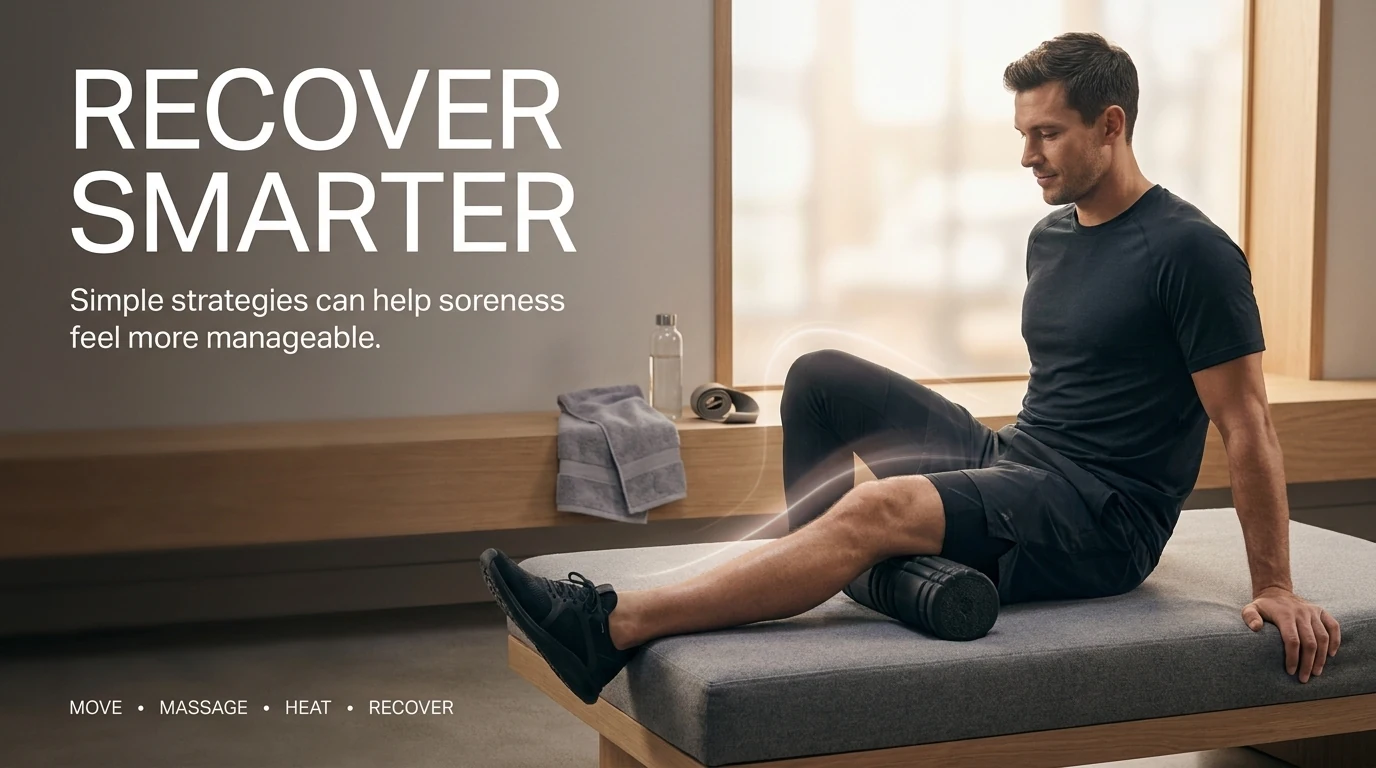
Foam rolling.
Research here is thinner than for massage generally, but the small number of studies that have directly tested it mostly found a positive effect on soreness and next-session performance. Around ten minutes on the muscles you trained that day is a reasonable protocol.
Magnesium.
A 2024 systematic review in the Journal of Translational Medicine found that magnesium supplementation may reduce muscle soreness and support recovery in physically active people, but only four eligible trials met the review’s criteria, so the evidence base remains limited (Tarsitano et al., 2024). A 2025 randomized trial found no benefit from a topical magnesium gel compared with placebo (Coates et al., 2025). That doesn’t rule out oral magnesium, but it’s a reminder not to assume every delivery method works the same way.
Caffeine.
A small 2024 study of 12 male kickboxing athletes, published in Current Developments in Nutrition, found that a dose of about 6 mg per kilogram of bodyweight reduced perceived soreness two hours after exercise, more than a lower 3 mg/kg dose (Saremi et al., 2024). That’s interesting and points toward a more realistic dose than older estimates, but it’s one small study in a specific athlete population, not proof caffeine is a general DOMS treatment.
Omega-3 fatty acids.
Older meta-analyses found doses of roughly 1 to 3 grams daily reduced DOMS. A 2024 systematic review of randomized controlled trials, after reviewing the newer literature, found the evidence on omega-3 supplementation and post-exercise soreness remains mixed rather than clearly positive (Fernández-Lázaro et al., 2024). Reasonable to try given the other health benefits of omega-3s, but don’t expect a dramatic effect specifically for soreness.
Don’t rely on these
Full ice bath immersion.
If maximizing muscle growth is a priority, routinely using cold water immersion right after resistance training may not be ideal, since some evidence suggests it can blunt aspects of the training adaptation you’re working for. Using cold exposure occasionally for comfort, or when you need to recover quickly between events, is a different situation with different priorities.
Stretching, for soreness specifically.
This one surprises people. A Cochrane systematic review and a more recent 2021 systematic review and meta analysis both found that stretching, whether done before or after exercise, has no meaningful effect on DOMS (Herbert et al., 2022; Afonso et al., 2021). Stretch if you want to maintain flexibility or if it feels good, but don’t expect it to meaningfully reduce next-day soreness.
Regular NSAID use.
Don’t reach for ibuprofen or similar drugs routinely just to make soreness disappear. Their benefit for DOMS isn’t well established, and a randomized trial in ultramarathon runners found regular NSAID use during prolonged exercise raised the risk of acute kidney injury (Lipman et al., 2017). Occasional, appropriate use is a personal decision, but if you find yourself needing pain medication after most workouts, that’s worth a conversation with a healthcare professional rather than a bigger dose.
How to Avoid Getting Too Sore in the First Place
The biggest lever here has nothing to do with supplements or recovery tools.
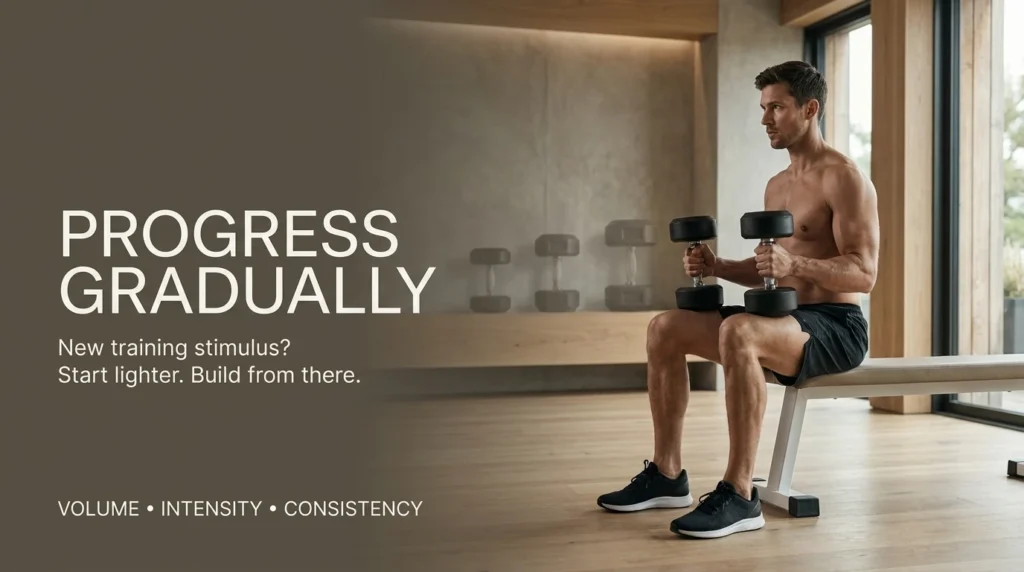
Ease into new training gradually.
If you’re starting a new program, coming back after time off, or trying something unfamiliar, holding back on volume and intensity for the first couple of weeks prevents more soreness than any recovery tool on this list.
A light cardio warm up helps prepare your body for the loads coming up, and a gradual cool down is a comfortable way to transition back to rest. Neither should be treated as a guaranteed way to prevent DOMS, since the evidence for that specific claim is weak, but both are reasonable habits regardless.
When Soreness Isn’t Normal Anymore
Typical DOMS is uncomfortable but generally harmless. It should improve steadily over a few days and rarely lasts beyond a week.
See a doctor if you notice:
- Pain that lasts more than a week without improving
- Pain that feels sharp and constant, rather than a dull ache
- Severe swelling around a muscle
- Dark-colored or bloody urine
- Dizziness or trouble breathing
- Pain concentrated in a joint, over a bone, or in a tendon, rather than the muscle itself
- Soreness after nearly every workout, with no sign of it easing over time
That last combination, intense pain, swelling, profound weakness, and dark urine together, can point to rhabdomyolysis, a rare but genuine medical emergency where damaged muscle tissue overwhelms the kidneys. The CDC is clear that this requires immediate medical attention, not home remedies.
If a doctor suspects rhabdomyolysis or significant muscle damage, they may check creatine kinase (CK) through blood tests. CK can rise after strenuous exercise and muscle damage, so suspected rhabdomyolysis is assessed using CK levels alongside the clinical picture and repeat testing when needed.
FAQ
What is muscle soreness?
It’s the discomfort that follows physical exertion. It comes in two forms, acute soreness during or right after exercise, and delayed onset muscle soreness, or DOMS, which builds over the following day from muscle damage and the repair process that follows it.
Does muscle soreness mean I’m building muscle?
Not reliably. Soreness signals that a stimulus was new or intense enough to disrupt muscle tissue, which is not the same as proof of growth. Trained muscles often stop getting sore even while they keep getting stronger.
How long does DOMS normally last?
It typically peaks between 24 and 72 hours after training and resolves within about a week. Pain lasting longer than that may not be ordinary DOMS.
Can I train while sore?
Light activity is usually fine. Heavy training of the same muscle while it’s still significantly sore can reduce your strength output and raise injury risk, so it’s often better to train a different muscle group or keep the intensity low.
What’s the fastest way to reduce soreness?
There’s no genuine overnight fix. Options with some evidence include light movement and massage, heat and foam rolling may also help with perceived soreness.
How can I tell DOMS from an injury?
Normal soreness is a dull, diffuse ache in the muscle itself that improves a little each day. Injury pain tends to be sharp, localized to a joint or tendon, and doesn’t improve, or gets worse, over the following days.
What should I do for extremely sore muscles?
If normal movement is genuinely difficult, don’t push through it. Scale back to light activity, try massage, foam rolling, or heat, and treat it as a signal to ease into your next session rather than repeat the same intensity.
What is my body lacking if my muscles are sore?
Usually nothing specific. Soreness is more often a normal response to a new or demanding workout than a sign of a deficiency, though staying hydrated and getting enough protein does support the recovery process.
Why does massaging sore muscles feel better?
Massage increases blood flow to the area and appears to interrupt some of the pain signaling coming from the muscle. This is backed by research directly, including a 2017 meta analysis showing reduced soreness from massage performed within 24 hours of exercise.
When should I see a doctor about muscle soreness?
If the pain lasts more than a week, feels sharp rather than achy, comes with significant swelling, or is accompanied by dark urine, dizziness, or trouble breathing, treat it as a reason to get checked rather than waiting it out.
The Real Takeaway
Soreness is feedback, not a scoreboard. Some of the most productive stretches of my three years lifting came with almost no soreness at all, just steady strength gains and a slowly climbing FFMI.
Stop grading your workouts by how much they hurt the next day. Grade them by whether the numbers are moving.
References
Doma, K., Matoso, B., Protzen, G., Singh, U., & Boullosa, D. (2023). The Repeated Bout Effect of Multiarticular Exercises on Muscle Damage Markers and Physical Performances: A Systematic Review and Meta-Analyses. Journal of Strength and Conditioning Research, 37(12), 2504-2515.
Guo, J., Li, L., Gong, Y., Zhu, R., Xu, J., Zou, J., & Chen, X. (2017). Massage Alleviates Delayed Onset Muscle Soreness after Strenuous Exercise: A Systematic Review and Meta-Analysis. Frontiers in Physiology, 8.
Wei, M., Liu, X., & Wang, S. (2025). The impact of various post-exercise interventions on the relief of delayed-onset muscle soreness: a randomized controlled trial. Frontiers in Physiology.
Petrofsky, J., Berk, L., Bains, G., Khowailed, I. A., Hui, T., Granado, M., Laymon, M., & Lee, H. (2013). Moist Heat or Dry Heat for Delayed Onset Muscle Soreness. Journal of Clinical Medical Research, 5(6), 416-425.
Marqués-Jiménez, D., Calleja-González, J., Arratibel, I., Delextrat, A., & Terrados, N. (2016). Are compression garments effective for the recovery of exercise-induced muscle damage? A systematic review with meta-analysis. Physiology & Behavior, 153, 133-148.
Gillis, D. J., Vellante, A., Gallo, J. A., & D’Amico, A. P. (2020). Influence of Menthol on Recovery From Exercise-Induced Muscle Damage. Journal of Strength and Conditioning Research, 34(2), 451-462.
Tarsitano, M. G., Quinzi, F., Folino, K., et al. (2024). Effects of magnesium supplementation on muscle soreness in different type of physical activities: a systematic review. Journal of Translational Medicine, 22, 629.
Coates, A. M., Patel, D. V., Binet, E. R., & Gibala, M. J. (2025). No Effect of Topical Application of a Commercial Magnesium Gel on Exercise Recovery in Active Individuals. International Journal of Sport Nutrition and Exercise Metabolism, 35(5), 416-423.
Saremi, M., Shahriari, F., Hemmatinafar, M., Rezaei, R., Niknam, A., Nordvall, M., Wong, A., & Bagheri, R. (2024). Low-Dose Caffeine Supplementation Is a Valuable Strategy for Increasing Time to Exhaustion, Explosive Power, and Reducing Muscle Soreness in Professional Male Kickboxers. Current Developments in Nutrition, 9(1), 104538.
Fernández-Lázaro, D., Arribalzaga, S., Gutiérrez-Abejón, E., Azarbayjani, M. A., Mielgo-Ayuso, J., & Roche, E. (2024). Omega-3 Fatty Acid Supplementation on Post-Exercise Inflammation, Muscle Damage, Oxidative Response, and Sports Performance in Physically Healthy Adults: A Systematic Review of Randomized Controlled Trials. Nutrients, 16(13), 2044.
Herbert, R. D., de Noronha, M., & Kamper, S. J. (2022). Stretching to prevent or reduce muscle soreness after exercise. Cochrane Database of Systematic Reviews, (4), CD004577.
Afonso, J., et al. (2021). The Effectiveness of Post-exercise Stretching in Short-Term and Delayed Recovery of Strength, Range of Motion and Delayed Onset Muscle Soreness: A Systematic Review and Meta-Analysis of Randomized Controlled Trials. Frontiers in Physiology.
Lipman, G. S., Shea, K., Christensen, M., et al. (2017). Ibuprofen versus placebo effect on acute kidney injury in ultramarathons: a randomised controlled trial. Emergency Medicine Journal, 34(10), 637-642.
Centers for Disease Control and Prevention. (2025). Signs and Symptoms of Rhabdomyolysis.


