Muscle Memory: Is It Real, How Does It Work, and How Long Does It Last?
Have you ever stopped training for months, watched your muscle size and strength drop, and then been surprised by how quickly they started coming back when you returned to the gym?
Maybe your first few sessions felt rough. Your old weights suddenly seemed heavy. Your muscles looked smaller. Then, after a few weeks, movements that once felt unfamiliar started feeling natural again and your strength began climbing much faster than it did when you first started lifting.
That phenomenon is commonly called muscle memory. But there is a problem with the term: muscle memory is not one single biological process.
Sometimes people use it to describe how the nervous system remembers a practiced movement, such as a squat, bench press, tennis swing or musical instrument. In bodybuilding, the same phrase is used for the apparent ability to regain lost muscle and strength faster after a period of detraining.
Those two phenomena are related, but they are not identical.
Human research now provides evidence for several layers of this process, including persistent neural adaptations, retained myonuclei, long lasting gene-regulation changes and, more recently, retained protein level changes in skeletal muscle. But the evidence does not support the popular idea that your muscles simply “remember” everything forever, or that one mechanism such as myonuclei explains every comeback.
So what is actually happening when a former lifter returns to the gym?
What Is Muscle Memory?
The term muscle memory is used for the ability to perform a previously learned movement or regain previously developed physical adaptations more easily after a period without practice or training.
In everyday life, motor memory can explain why you may still know how to ride a bicycle after years away from it, type without consciously thinking about every key, play a familiar instrument, or perform a practiced movement pattern automatically.
Cleveland Clinic describes this form of muscle memory as an automatic movement that develops through repetition, with the memory stored in the brain rather than literally inside the muscle.
In bodybuilding and strength training, however, people usually mean something different: You built muscle and strength, stopped training, lost some of those adaptations, and then regained them unusually quickly after returning.
That second phenomenon is the focus of this article.
Is Muscle Memory Real or a Myth?
Yes, there is good evidence for muscle memory but the mechanism is more complicated than social media usually makes it sound.
Controlled human studies show that previous training can influence what happens when training resumes.
For example, a 2024 randomized trial compared continuous resistance training with a program involving:
10 weeks of resistance training -> 10 weeks of detraining -> 10 weeks of retraining.
During the break, participants lost some of the strength and muscle size adaptations they had gained. But during the first five weeks of retraining, the previously trained group regained leg press strength and muscle cross-sectional area rapidly. By the end, the periodic and continuous groups had achieved similar overall adaptations.
Other human studies have found persistent myonuclei, altered gene expression, epigenetic changes and retained protein level signatures after detraining.
At the same time, some studies have not found a clearly superior hypertrophy response during retraining.
That is why the best scientific conclusion is:
Muscle memory is real, but it is not one mechanism and it does not guarantee a faster or larger response in every person or every study.
Motor Memory vs Physiological Muscle Memory
This distinction clears up much of the confusion surrounding the subject.
Motor memory
Motor memory is the retention of learned movement skills. If you practiced a squat, bench press, deadlift, tennis serve or musical instrument for years, your nervous system becomes highly familiar with the movement.
That familiarity can survive periods of inactivity.
Stanford Medicine’s research on motor memory has shown how learned skills can involve persistent changes in neural networks. In animal research, researchers observed changes involving the motor cortex and dorsolateral striatum and found that previously learned movement activated related neural networks again weeks later.
This helps explain why a returning lifter can sometimes regain movement efficiency and coordination quickly.
Physiological muscle memory
Physiological muscle memory refers to changes within skeletal muscle itself.
Potential contributors include:
- myonuclei
- satellite cells
- DNA methylation
- gene expression
- molecular signaling
- retained proteins
- other cellular adaptations
These mechanisms can persist for different lengths of time and may not all produce the same functional outcome.
So when someone says:
“My muscle memory kicked in” they could actually be describing several different processes happening at once.
How Does Motor Memory Work?
Motor skills are built through repetition. Early in learning, a movement requires considerable conscious attention. With practice, the nervous system becomes more efficient at coordinating the movement.
Eventually, parts of the movement can become highly automatic. That is why someone who has spent years lifting may return after a long break and still recognize:
- how to brace for a squat
- how to set up a bench press
- how to hinge during a deadlift
- how to stabilize a dumbbell
- how to coordinate a familiar exercise
The skill may feel rusty, but the movement pattern isn’t necessarily gone. This is not the same thing as having all your old muscle back.
A person can remember how to perform a 120kg bench press technically while currently being nowhere near capable of safely lifting 120 kg.
That distinction becomes extremely important when returning to training.
Where Is Muscle Memory Stored?
For motor memory, the answer is primarily the nervous system, not the muscle itself. Motor learning involves several brain regions and neural circuits, including areas involved in movement planning, execution, coordination and habitual behavior.
The exact neural representation is complex rather than being a single “muscle memory center.” Cleveland Clinic similarly explains that the brain stores motor memories even though the muscles execute the movement.
Physiological muscle memory is different. That involves adaptations within skeletal muscle tissue itself, including changes in myonuclei, gene regulation and protein expression. So
Motor memory -> nervous system
Physiological muscle memory -> skeletal muscle adaptations
They overlap in real world performance, but they are not the same biological phenomenon.
What Happens to Your Muscles When You Stop Training?
When resistance training stops, the body no longer receives the same stimulus to maintain all of the adaptations it built for that workload.
Depending on the duration and circumstances of the break, you can experience reductions in:
- muscle size
- strength
- power
- work capacity
- exercise-specific conditioning
- some cellular adaptations
The extent varies considerably. A short break is not equivalent to years of complete inactivity and detraining does not necessarily erase every adaptation at the same rate.
For example, in one human study, muscle thickness and cross-sectional area returned toward baseline during detraining while strength remained substantially elevated. The authors suggested that persistent motor learning could help explain some of that retained strength.
This is one reason you shouldn’t interpret a smaller looking muscle as proof that every aspect of your previous training adaptation has disappeared.
Does a Training Break Put You Back at Zero?
No. One of the clearest demonstrations comes from the 2024 periodic training trial.
Fifty five previously untrained adults were assigned to either continuous resistance training or a program containing a 10 week training period, a 10 week detraining period and another 10 week training period.
The detraining period reduced strength and muscle size.
But during retraining, the previously trained participants regained those adaptations rapidly. In the first five weeks of retraining, increases in leg-press strength and muscle cross sectional area were greater than the comparable period in the continuous training group. By the end of the study, the overall adaptations were similar.
The practical message is encouraging: A temporary interruption can cost you progress without permanently deleting your training history.
Why Does Previously Built Muscle Come Back Faster?
There probably isn’t one answer. Current research points toward several overlapping mechanisms.
1. Neural adaptations
Strength isn’t just muscle size. Your nervous system becomes better at recruiting and coordinating the muscles required for a particular movement.
When you return to a familiar exercise, some of that skill can come back quickly. This is one reason strength may rebound before visible muscle size completely returns.
2. Myonuclei
Skeletal muscle fibers are unusual because individual fibers contain multiple nuclei called myonuclei.
As muscle fibers grow, satellite cells can contribute additional nuclei to the muscle fiber. One proposed muscle memory model suggests that these additional myonuclei may provide greater transcriptional capacity if the muscle needs to grow again.
This idea became especially influential because animal studies found evidence that myonuclei acquired during hypertrophy could remain after muscle size declined.
But human evidence is more complicated.
3. Satellite cells
Satellite cells are muscle stem cells located around muscle fibers. They participate in muscle repair and can contribute additional myonuclei during muscle growth.
Their behavior changes with training, detraining and aging, making them another possible component of muscle memory.
Importantly, satellite cells don’t mean that every returning lifter has a permanent reserve of “growth cells” waiting to rebuild their old physique.
Their role is more complicated and depends on the physiological environment.
Do Myonuclei Stay After You Stop Training?
This is one of the most debated questions in muscle memory research.
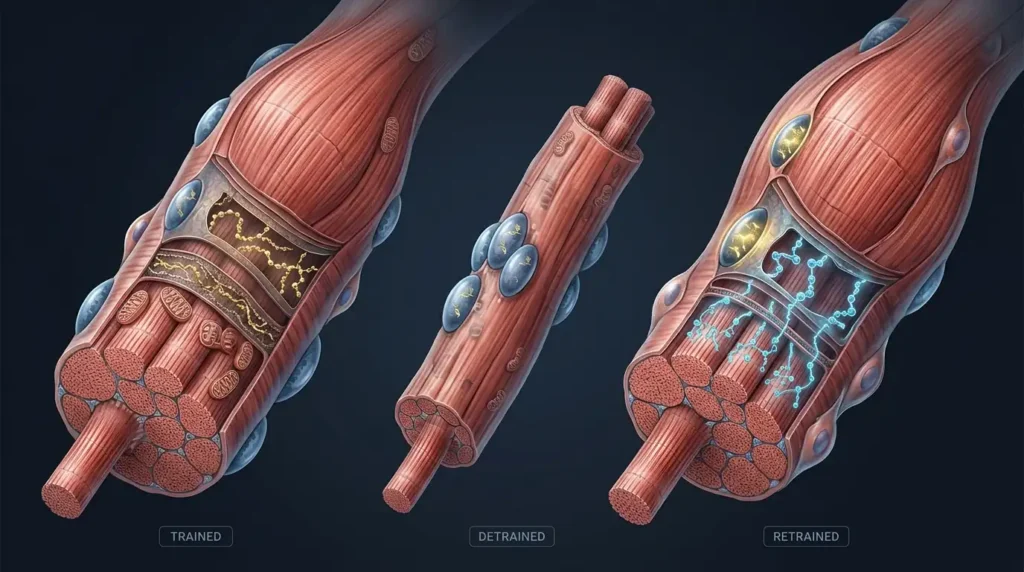
Early enthusiasm came largely from animal studies suggesting that myonuclei added during hypertrophy could persist during subsequent atrophy.
A 2020 review noted that the myonuclear permanence theory was based heavily on rodent research and that whether the same mechanism clearly applies to humans remained ambiguous.
Then came conflicting human evidence.
The 2019 human study
Researchers had participants complete:
10 weeks unilateral strength training -> 20 weeks detraining -> 5 weeks retraining.
Muscle size and strength increased during the first training period. During detraining, muscle size returned toward baseline, but strength remained around 60% above baseline.
During retraining, the previously trained and control legs showed similar increases in muscle thickness and strength.
The study did not find the predicted increase in myonuclear number during initial training and did not show a clearly enhanced hypertrophy response during retraining.
That study is important because it prevents a simplistic conclusion that:
previous training -> permanent myonuclei -> automatically faster hypertrophy.
The 2022 meta-analysis
A systematic review and meta-analysis examined 147 peer-reviewed studies across five analyses of human and animal muscle adaptation.
The researchers found stronger evidence for myonuclear retention in rodents than in humans. In humans, myonuclear and satellite cell content could decline during atrophy.
The authors concluded that the findings did not support myonuclear permanence as the sole explanation for skeletal-muscle memory and suggested that other mechanisms, including epigenetics, may play an important role.
The 2024 human study
A newer study provided stronger evidence in the other direction.
Twelve previously untrained men and women completed:
10 weeks unilateral elbow-flexor training -> 16 weeks detraining -> 10 weeks retraining.
During initial training, myonuclei increased in both type I and type II fibers.
After detraining, muscle fiber cross-sectional area decreased, but the myonuclei were maintained. Previously trained muscle therefore had a higher type II myonuclear number than the control muscle.
During retraining, previously trained muscle had larger type II fibers than control muscle, but the change in fiber size was not significantly greater between the two conditions.
The study therefore supports human myonuclear permanence while still leaving the size of its functional advantage uncertain.
That distinction is crucial.
Myonuclei may persist without automatically producing dramatically faster hypertrophy.
Epigenetic Memory: Another Layer of Muscle Memory
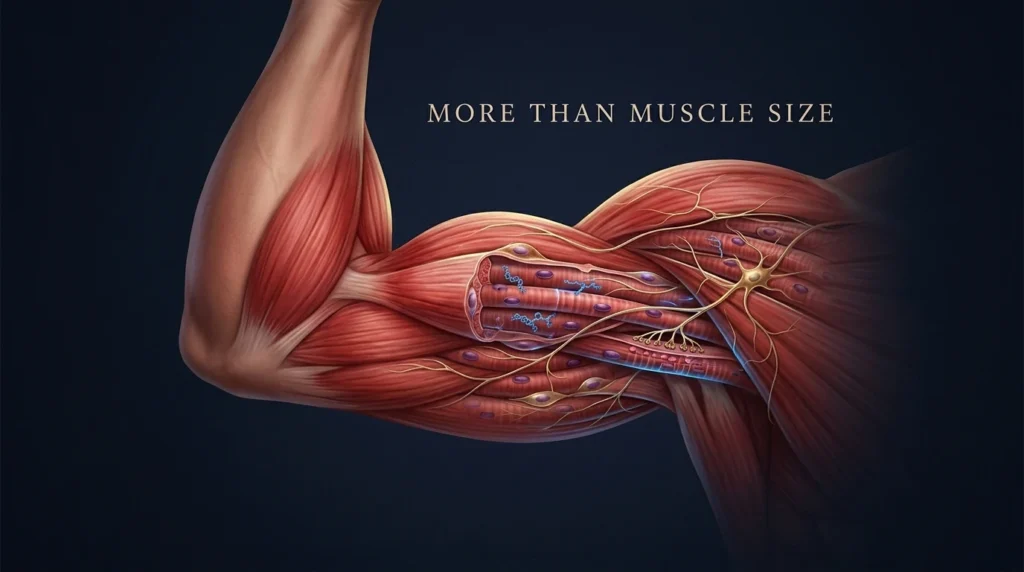
One of the strongest arguments against reducing muscle memory to myonuclei alone is epigenetics.
Epigenetics refers to changes that influence how genes are regulated without changing the underlying DNA sequence.
A landmark 2018 human study examined:
7 weeks of loading -> 7 weeks of unloading -> 7 weeks of reloading.
Researchers analyzed approximately 850,000 CpG sites across the genome.
They found:
- 9,153 CpG sites became hypomethylated after the initial loading period
- 18,816 showed hypomethylation after reloading
- several genes retained altered methylation patterns during unloading
- AXIN1, GRIK2, CAMK4 and TRAF1 retained hypomethylation associated with the earlier training period
- UBR5, RPL35a, HEG1, PLA2G16 and SETD3 showed particularly strong responses during reloading
The researchers also observed greater changes in muscle mass during the later loading period for some of these molecular signatures.
This provided evidence that human skeletal muscle can retain an epigenetic memory of previous hypertrophy.
But again, an epigenetic signature is not automatically the same thing as a guaranteed functional advantage.
It is evidence that the muscle can retain molecular information about previous training.
Previous Training Can Change the Muscle’s Molecular Response
Another human study provides an important piece of the puzzle. Nineteen previously untrained participants completed:
10 weeks unilateral leg training -> 20 weeks detraining -> acute resistance exercise.
Researchers then compared the previously trained leg with the previously untrained leg. The previously trained muscle showed different signaling and gene-expression responses.
For example:
- AMPK phosphorylation was higher
- eEF2 phosphorylation was higher
- post-exercise 4E-BP1 phosphorylation was higher
- PGC-1α responses differed
- several myogenesis-related genes showed different expression patterns
The authors concluded that previous training history altered several regulatory genes and proteins involved in the muscle’s response to exercise, supporting the idea of a molecular muscle memory.
The significance is not that AMPK or eEF2 is a “memory switch.”
It’s that the same exercise can produce a different molecular response in muscle that has been trained before.
What About Proteomic Memory?
The newest research pushes the idea even further.
A 2025 human study examined resistance training, detraining and retraining while measuring the muscle proteome, the collection of proteins present in the tissue.
Participants underwent:
10 weeks resistance training -> 10 weeks detraining -> 10 weeks retraining.
Researchers found 150 proteins altered after the first training period, with most increasing. Many moved back toward baseline during detraining and increased again during retraining.
But some proteins remained elevated even after 2.5 months without training. Among the retained proteins was CAPN2, a protein that has also been discussed in relation to epigenetic muscle memory.
This suggests another layer:
muscle may retain a protein level signature of previous resistance training.
It does not prove that these proteins are responsible for faster muscle growth. It shows that previous training can leave measurable information behind in human skeletal muscle.
Does Muscle Memory Work Without Producing a Bigger Growth Response?
Yes.
This is one of the most important distinctions in the research. A 2025 study examined epigenetic memory after high-intensity interval training.
Twenty healthy participants completed:
2 months HIIT -> 3 months detraining -> 2 months retraining.
Researchers found thousands of DNA-methylation changes that remained detectable during detraining and retraining. Five genes ADAM19, INPP5A, MTHFD1L, CAPN2 and SLC16A3 showed retained hypomethylation and increased gene expression.
But VO₂max improved during both training periods without a significant difference between the initial training and retraining responses.
That gives us a broader lesson:
A biological memory can persist without necessarily producing a larger measurable performance response.
So when studying muscle memory, researchers need to distinguish: molecular memory from functional advantage.
What the Latest Evidence Really Suggests
Taken together, the evidence points toward a stack of adaptations, rather than a single muscle memory mechanism.
Previous training can potentially leave behind:
- movement skill
- neural adaptations
- myonuclear changes
- satellite-cell adaptations
- DNA-methylation changes
- altered gene expression
- altered signaling responses
- retained proteins
These layers do not necessarily disappear at the same rate and they don’t necessarily produce the same outcome.
That’s why two people can both experience “muscle memory” even though the biological explanation for their rapid comeback may differ.
Why Can Strength Come Back Before Muscle Size?
Because strength is not determined by muscle size alone.
It also depends on:
- neural recruitment
- coordination
- technique
- movement efficiency
- familiarity with the exercise
- confidence under load
The 2019 detraining study is a useful example: muscle thickness and cross-sectional area returned toward baseline, while strength remained substantially elevated.
So when you return to the gym and your old numbers start climbing quickly, that doesn’t necessarily mean all your lost muscle has already returned.
You may be regaining: neural skill + coordination + strength + muscle tissue at different speeds.
This is why:
motor retention ≠ strength reacquisition ≠ hypertrophy reacquisition. That distinction is one of the most important ideas in understanding muscle memory.
Can You Really Regain Muscle Faster Than a Beginner?
Often, yes but don’t interpret that as a universal rule. A beginner is building the relevant adaptations for the first time. A returning lifter may be rebuilding adaptations that were previously developed.
Controlled research supports relatively rapid recovery after detraining. The 2024 periodic training study found rapid recovery of strength and muscle size during retraining, while the older adult study also demonstrated rapid restoration of previously gained strength.
But the magnitude of the advantage depends on:
- how long you trained before the break
- how long you stopped
- your age
- how much muscle you originally built
- how much muscle you retained
- your nutrition
- your health
- your current training program
- why you stopped training
There is no universal “muscle memory multiplier.”
How Long Does Muscle Memory Last?
There is no scientifically established expiration date that is because different forms of memory can have different timelines.
Motor skill, strength, muscle size, myonuclear characteristics, epigenetic changes and protein level changes are not interchangeable measurements.
Research has demonstrated retained molecular or protein-level changes after months without training, while other studies show that some physical adaptations decline substantially during detraining.
So asking:
“How many years does muscle memory last?” is actually less precise than asking:
“Which form of muscle memory are we measuring, and what outcome are we trying to regain?”
Does Muscle Memory Last 10 Years?
There is no good human evidence establishing a precise 10 year muscle memory timeline that doesn’t mean a person cannot regain muscle after being away from training for 10 years it means science does not currently have enough controlled evidence to say:
“Muscle memory lasts exactly 10 years.” Long-term comeback stories can be real, but they contain many variables.
Someone returning after a decade may experience:
- regained muscle
- restored glycogen
- increased muscle fullness
- changes in body fat
- improved nutrition
- improved physical activity
- improved sleep
- renewed motivation
Those factors can all contribute to a dramatic transformation.
What About Muscle Memory After Decades?
Even longer comeback stories exist. But an individual case, even an impressive one, is not proof of a biological expiration date.
A person who returns to training after several decades may regain muscle rapidly because of previous training history, but the improvement could also reflect changes in body fat, activity, nutrition, health and many other factors.
So decades-long comeback stories are interesting illustrations, not controlled evidence of permanent muscle memory.
The responsible conclusion remains:
There is no established maximum duration for physiological muscle memory.
Why You May Look Muscular Again Quickly
This is another reason people sometimes think muscle memory is even faster than it really is. When you return to resistance training after a break, muscles can regain:
- glycogen
- associated water
- training-related fullness
- normal muscle tone
very quickly. Your muscles can therefore look noticeably fuller before you have rebuilt all the muscle tissue you previously lost.
That early visual change is not necessarily fake but it isn’t equivalent to complete hypertrophy recovery.
So:
looking fuller quickly ≠ rebuilding all previous muscle tissue instantly.
Does Muscle Memory Work After Injury or Illness?
This requires more caution.
Most detraining/retraining studies involve relatively healthy people who voluntarily stop training.
That’s different from muscle loss caused by:
- prolonged immobilization
- neurological injury
- major surgery
- severe illness
- hospitalization
- cachexia
- nerve damage
These conditions can affect muscle through mechanisms that are not equivalent to ordinary detraining.
Therefore, research showing rapid muscle regain after a normal training break should not be used to promise the same recovery timeline after serious illness or injury.
Previous training history may still matter, but the biological situation is different.
Does Muscle Memory Work as You Get Older?
Yes, older adults can still regain strength and muscle after detraining but aging changes the environment in which muscle adaptation occurs. A study of older men used:
12 weeks resistance training -> 12 weeks detraining -> 12 weeks retraining.
Detraining caused modest losses in strength and power. Less than eight weeks of retraining were needed to regain the post training one repetition maximum strength level.
After 12 weeks of retraining, type II muscle fibers had increased in size, alongside increases in satellite cells and myonuclei.
This is encouraging but it does not mean age becomes irrelevant. Older lifters may need more attention to:
- recovery
- joint tolerance
- training load
- sleep
- injury history
- gradual progression
Muscle memory can help a comeback, but it doesn’t eliminate the biological effects of aging.
Does Muscle Memory Apply to Steroid-Gained Muscle?
This is a more complicated and more controversial question.
Anabolic-androgenic steroids can produce adaptations that may potentially persist beyond the period of drug use.
A 2024 human study examined:
- 8 current AAS users
- 7 former AAS users
- 10 non-user controls
The former users had stopped AAS use for a geometric mean of approximately 4 years.
Researchers found that type II muscle fibers in former AAS users had higher myonuclei density and a higher DNA-to-cytoplasm ratio than controls. Longer accumulated AAS exposure was also associated with smaller myonuclear domains.
That is interesting because higher myonuclear density could theoretically provide greater transcriptional capacity during future hypertrophy.
However, this was a small, cross-sectional observational study. It did not directly prove that former AAS users will regain muscle faster after retraining.
A 2024/2025 narrative review similarly discusses myonuclei, satellite cells, protein turnover, epigenetics and AAS-related muscle memory while emphasizing the complexity of the evidence.
So the scientifically responsible conclusion is:
Former AAS users may retain cellular characteristics consistent with a long-lasting muscle memory effect, but current evidence does not justify claiming a guaranteed permanent advantage for every former user.
This is also an important distinction between what has been observed biologically and what has been proven functionally.
Why You Shouldn’t Chase Your Old PRs
This is one of the biggest practical mistakes returning lifters make. Your brain may remember your old numbers. Your current tissues may not be ready for them. A useful way to think about it is:
Your old PR is historical data, not a current prescription. Movement familiarity can return faster than your:
- tendons
- connective tissues
- work capacity
- joint tolerance
- recovery capacity
NASM makes this same practical distinction in its discussion of returning lifters: the nervous system can remember old movement patterns and numbers while connective tissue, tendons and work capacity adapt more slowly.
Tendons in particular adapt more slowly than muscle, which is another reason sudden load spikes after a long break can create problems.
So don’t ask:
“What did I used to lift?”
Ask:
“What can I safely and confidently lift today?”
Then build from there.
How to Regain Lost Muscle Without Rushing
The goal isn’t to recreate your old training immediately. The goal is to rebuild the capacity that allowed you to train hard in the first place.
Start below your historical limits
Your first sessions should feel easier than your ego wants them to. Use loads that allow controlled technique and leave room for progression.
Rebuild movement quality
Your nervous system may remember the movement, but being familiar with an exercise doesn’t mean you’re immediately ready for maximal loading.
Practice clean repetitions.
Increase training stress gradually
Let strength and muscle return rather than trying to force them back. Rapid early progress can be motivating but it can also encourage unnecessary load jumps.
Give connective tissue time
Muscle can regain capacity faster than tendons and other tissues. That mismatch is one reason aggressive comeback programs can go wrong.
Eat normally for muscle growth
There is no established “muscle memory protein dose.”
Previous training history doesn’t create a scientifically proven requirement for a special amount of protein.
The fundamentals remain:
- adequate protein
- adequate energy intake
- progressive resistance training
- sufficient recovery
Muscle memory may influence how you respond to retraining, but it doesn’t require a special nutritional switch.
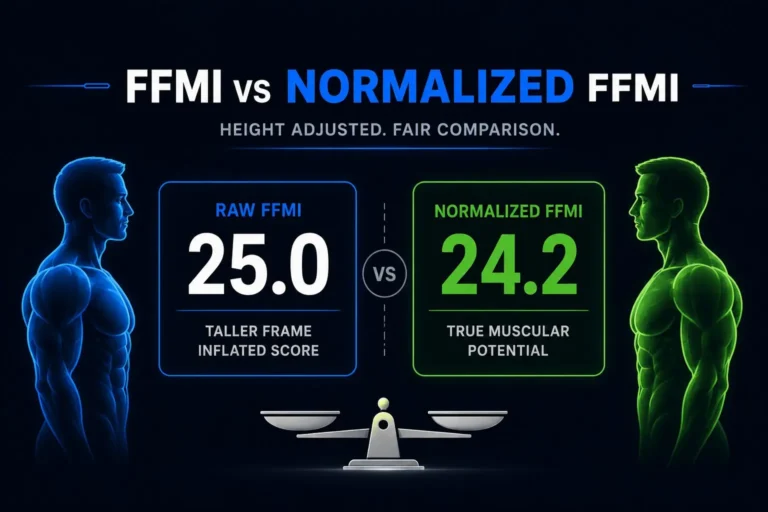
If you are trying to rebuild lost muscle and gradually increase your muscularity, see our guide on how to increase FFMI naturally.

Does Muscle Memory Affect FFMI?
It can but FFMI does not measure muscle memory. FFMI estimates fat-free mass relative to height.
If you lose muscle during a long training break and later regain it, your FFMI can move back toward your previous level.
For example, if someone previously maintained an FFMI of 23, detrained and dropped to 20.5, then rebuilt lean mass during retraining, their FFMI could eventually move toward 23 again.
But that doesn’t mean FFMI itself detected “muscle memory.” FFMI can also be affected by:
- body-fat estimation
- hydration
- glycogen
- measurement error
- changes in lean mass unrelated to skeletal muscle
So:
Regaining your old FFMI can be evidence that you regained lean mass, not a direct measurement of muscle memory.
And if you look noticeably more muscular during the first few weeks of retraining, some of that change may be restored glycogen and water rather than entirely new muscle tissue.
Because muscle regain changes your lean mass, it’s also useful to understand the difference between FFMI and lean body mass.
Can You Regain Exactly the Same Physique?
Not necessarily.
You may regain a large amount of your previous muscularity, but there is no guarantee that your body will return to exactly the same appearance.
Your:
- age
- body-fat level
- training history
- health
- nutrition
- recovery
- hormonal environment
- reason for detraining
may all be different.
Even if your FFMI eventually approaches its previous level, your physique may still look somewhat different.
Muscle memory helps explain how previous training can influence the comeback. It does not guarantee a perfect restoration of every aspect of your old body.
Muscle Memory Examples
The phrase “muscle memory” can refer to several different situations.
Everyday motor-memory examples
- riding a bicycle after years away
- typing without consciously thinking about each key
- playing a familiar musical instrument
- dancing a previously learned routine
- driving a familiar vehicle
- performing a practiced movement automatically
These are primarily motor-memory examples.
Gym related examples
- returning to a squat pattern after years away
- regaining bench-press technique quickly
- recovering strength faster than you initially built it
- rebuilding previously developed muscle after detraining
- regaining coordination on familiar exercises
These can involve both motor memory and physiological muscle memory.
Muscle Memory Isn’t the Same as Muscle Regain
This distinction deserves its own simple framework.
Motor retention
You remember how to perform the movement.
Strength reacquisition
You regain the ability to produce force quickly.
Hypertrophy reacquisition
You regain muscle tissue and fiber size. These can happen at different speeds.
You can therefore:
- remember the movement without having your old strength
- regain strength before regaining all your old muscle
- regain muscle without perfectly reproducing your old physique
That’s why saying “muscle memory” as though it represents one single process is scientifically incomplete.
Muscle Memory Is Not Perfect Memory
Motor skills are durable, but they aren’t immune to decay. A 2025 meta-analysis examined 1,344 effect sizes from 457 reports on procedural skill retention.
Longer periods of nonuse were associated with greater skill decay. The researchers estimated that approximately half of initial skill gains were lost after around:
- 6.5 months for accuracy-based skills
- 13 months for speed-based skills
- 11 months for mixed skills
But task type, complexity and intermittent practice all influenced the rate of decline. These numbers should not be applied directly to bodybuilding. They are evidence about procedural skill retention, not a countdown timer for muscle mass.
The useful lesson is simply:
Memory can persist without being perfect.
Muscle Memory Myths
Myth 1: Muscle memory means my muscles literally remember my workouts.
Not literally. Motor memory involves the nervous system, while physiological muscle memory involves adaptations within skeletal muscle.
Myth 2: Myonuclei stay forever, so muscle will always come back.
Human evidence does not support that certainty. Some studies show myonuclear persistence, while other research and meta-analysis have challenged the idea that myonuclei are universally permanent in humans.
Myth 3: If you had muscle once, you can regain all of it instantly.
No. Muscle memory can accelerate the comeback, but recovery still takes time.
Myth 4: Everyone gets “newbie gains” again.
Not necessarily. A returning lifter may progress quickly, but that doesn’t mean the physiology is identical to someone experiencing resistance training for the first time.
Myth 5: Fast strength gains prove that all your old muscle has returned.
No. Neural coordination and movement skill can return faster than muscle size.
Myth 6: Muscle memory has a fixed expiration date.
There is no established number of years after which physiological muscle memory simply disappears.
Myth 7: Molecular memory guarantees faster hypertrophy.
No. Persistent DNA-methylation, gene-expression or protein changes can exist without producing a clearly superior functional response during retraining.
Myth 8: A former steroid user is guaranteed to regain all previous muscle faster.
The evidence is much more limited.
Former AAS users have shown persistent myonuclear characteristics in a small human study, but that does not prove a universal or permanent retraining advantage.
Bottom Line
Muscle memory is real but it is not one thing.
When you return to training after a break, several forms of memory may be involved:
Motor memory can help you recover familiar movement patterns.
Neural adaptations can help strength return quickly.
Myonuclear changes may persist in some circumstances.
Satellite cells contribute to muscle remodeling and growth.
Epigenetic changes can preserve information about previous training.
Molecular signaling can respond differently because of previous training history.
Proteomic changes can remain detectable after detraining.
But these mechanisms do not all behave the same way, and persistent molecular changes do not automatically guarantee faster hypertrophy. That’s why the best modern description of muscle memory is:
Muscle memory is a collection of neural, cellular and molecular adaptations that can influence how the body responds when a previously experienced training stimulus returns.
The practical takeaway is much simpler: A training break does not necessarily erase your history.
You may lose strength and muscle but when you return, you are not necessarily starting from zero. Just don’t confuse remembering your old performance with being physically ready to perform it. Your old PR is a reference point. Your current capacity is the starting point.
Frequently Asked Questions
What is muscle memory?
Muscle memory describes the ability to regain previously learned movement skills or previously developed physical adaptations more efficiently after a period without practice or training. In bodybuilding, it usually refers to the relatively rapid return of lost strength and muscle after detraining.
What does muscle memory mean?
In fitness, muscle memory usually means that previously trained muscle and the nervous system can retain adaptations that help you regain performance after a training break. The term can refer to both motor memory and physiological muscle memory.
Is muscle memory real?
Yes. Human studies show that previous training can influence later muscle responses, including strength recovery, myonuclear characteristics, gene expression, epigenetic patterns and protein-level changes. However, the exact mechanisms and functional benefits remain an active research area.
What is muscle memory in bodybuilding?
In bodybuilding, muscle memory usually refers to regaining muscle and strength faster after losing them through detraining. It may involve neural adaptations as well as cellular and molecular changes within skeletal muscle.
How long does muscle memory last?
There is no scientifically established expiration date. Different forms of muscle memory can persist for different periods, and the duration likely depends on the type of adaptation, length of detraining and individual factors.
Does muscle memory last 10 years?
There is no controlled human evidence establishing a specific 10-year duration. Someone may regain muscle after a decade away from training, but science cannot currently say that physiological muscle memory lasts exactly 10 years.
Can muscle memory last for decades?
Possibly, but there is not enough controlled human evidence to establish a precise maximum duration. Long-term comeback stories are interesting but cannot determine the biological lifespan of muscle memory.
Does muscle memory mean I get newbie gains again?
Not necessarily. Returning lifters can regain strength and muscle quickly, but that doesn’t mean their physiology is identical to a complete beginner.
Why does strength come back before muscle size?
Strength depends on neural coordination, technique and movement familiarity as well as muscle size. These factors can return quickly after a training break, so strength may improve before all lost muscle mass has been rebuilt.
Why do I look muscular again so quickly after returning to the gym?
Early changes can include restored muscle glycogen, associated water and muscle fullness, in addition to actual muscle regain. Looking fuller quickly doesn’t necessarily mean all previously lost muscle tissue has already returned.
How much protein do I need for muscle memory?
There is no established special protein requirement unique to muscle memory. Normal evidence-based nutrition for resistance training remains appropriate, with adequate protein, sufficient energy and progressive training.
Can you regain exactly the same physique?
Not necessarily. You may regain much of your previous muscularity, but age, body-fat level, health, nutrition, training history and other factors can change the final result.
Does muscle memory affect FFMI?
It can indirectly. If you regain lost lean mass, your FFMI may move toward its previous value. But FFMI does not measure muscle memory itself.
Does muscle memory work after injury?
Previous training history may help recovery in some circumstances, but ordinary detraining research should not be directly applied to neurological injury, severe illness, immobilization or other medical conditions.
Does muscle memory work as you get older?
Yes, older adults can regain strength and muscle after detraining. However, recovery, joint tolerance and progressive loading become increasingly important with age.
Does muscle memory apply to steroid-gained muscle?
Possibly, but the evidence is limited. A small human study found higher myonuclei density in type II fibers of former AAS users several years after cessation, but this does not prove that every former user has a permanent or guaranteed muscle-regain advantage.
Does muscle memory mean my brain stores my muscles?
No. Your brain stores learned movement patterns involved in motor memory. Physiological muscle memory refers to adaptations within skeletal muscle.
Should I immediately return to my old PRs?
No. Your movement skill may return faster than your current tissue tolerance and work capacity. Start from your current ability and progressively rebuild your old numbers.
References
- Seaborne RA, et al. Human Skeletal Muscle Possesses an Epigenetic Memory of Hypertrophy. Scientific Reports. 2018. PubMed Central
- Psilander N, et al. Effects of Training, Detraining, and Retraining on Strength, Hypertrophy, and Myonuclear Number in Human Skeletal Muscle. Journal of Applied Physiology. 2019. PubMed
- Moberg M, et al. Exercise Induces Different Molecular Responses in Trained and Untrained Human Muscle. Medicine & Science in Sports & Exercise. 2020. PubMed
- The Concept of Skeletal Muscle Memory: Evidence From Animal and Human Studies. Acta Physiologica. 2020. PubMed
- The Effect of Resistance Training, Detraining and Retraining on Muscle Strength and Power, Myofibre Size, Satellite Cells and Myonuclei in Older Men. 2020. PubMed
- Myonuclear Permanence in Skeletal Muscle Memory: A Systematic Review and Meta-analysis of Human and Animal Studies. 2022. PubMed
- Cumming KT, et al. Muscle Memory in Humans: Evidence for Myonuclear Permanence and Long-Term Transcriptional Regulation After Strength Training. The Journal of Physiology. 2024. PubMed
- Halonen EJ, et al. Does Taking a Break Matter—Adaptations in Muscle Strength and Size Between Continuous and Periodic Resistance Training. Scandinavian Journal of Medicine & Science in Sports. 2024. PubMed
- Skeletal Muscle Memory: An Update From the Antidoping Perspective. 2024. PubMed
- Nielsen JL, et al. Higher Myonuclei Density in Muscle Fibers Persists Among Former Users of Anabolic Androgenic Steroids. The Journal of Clinical Endocrinology & Metabolism. 2024. Oxford Academic
- Human Skeletal Muscle Possesses an Epigenetic Memory of High-Intensity Interval Training. 2025. PubMed
- Hulmi JJ, et al. Human Skeletal Muscle Possesses Both Reversible Proteomic Signatures and a Retained Proteomic Memory After Repeated Resistance Training. The Journal of Physiology. 2025. PubMed
- Procedural Skill Retention and Decay: A Meta-Analytic Review. 2025. PubMed
- Cleveland Clinic. Muscle Memory. Medically reviewed; updated February 19, 2025. Cleveland Clinic
- Stanford Medicine. The Science Behind Muscle Memory. 2022. Stanford Medicine