

How Long Does It Take to Build Muscle? A Complete Guide to Realistic Timelines by Experience, Age, and Sex
If you started lifting weights and want to know how long does it take to build muscle, here is the short answer: your nervous system adapts within the first one to two weeks, your muscles show early growth within three to six weeks, and most people see their first visible muscle changes within six to twelve weeks of consistent training.
By three to six months, that change is usually obvious to people around you. Full, noticeable muscle building takes about a year of steady work, and it keeps going for several years after that, just more slowly.
The exact number of weeks depends on your training experience, your age, your sex, your diet, and how well you recover. Below, we break down each stage of the muscle building timeline using real exercise science, so you know exactly what to expect and how to speed things up, whether your goal is general fitness or a specific number of lbs of muscle.
Key Takeaways
- Strength gains often show up before you can see any muscle growth, usually in the first two to four weeks.
- Visible muscle definition typically appears between six weeks and three months for beginners.
- A beginner can realistically gain about 1 to 2 pounds of muscle per month in the first year, according to widely used coaching estimates rather than a single controlled study. That rate slows down every year after.
- Diet, sleep, and consistent training matter as much as your workout program.
- You do not need supplements to build muscle. Whole foods and resistance training do the job.
The Muscle Building Timeline at a Glance
| Time Frame | What Happens |
|---|---|
| Week 1 | Your nervous system starts adapting. You may feel stronger and stand taller, but muscles have not grown yet. |
| Weeks 2 to 6 | Early muscle growth begins at the cell level. Strength keeps climbing faster than size. |
| Weeks 6 to 12 | The first visible changes appear, especially if you started lean. |
| Months 3 to 6 | Muscle definition becomes obvious to people around you. |
| First year | For most natural lifters, this tends to be the fastest period of muscle gain. |
| Year 2 and beyond | Growth continues but slows down every year, especially once you get closer to your genetic potential. |
How Long Does It Take to Notice Muscle Growth?
Think of building muscle as climbing a ladder, one rung at a time. Each rung takes a bit longer to climb than the one before it, but each one also gets you closer to real, visible change.
Rung 1: The first week. Nothing has grown yet, but your body is already changing. Your nervous system is learning how to fire your muscles more efficiently. This is called neurological adaptation, and it is why beginners often feel noticeably stronger within days, even though their muscles have not gotten bigger.
Rung 2: Several weeks in. Around week two to six, your muscle fibers start to grow at a cellular level. This stage is sometimes called early hypertrophy. You probably will not see it in the mirror yet, but it is happening.
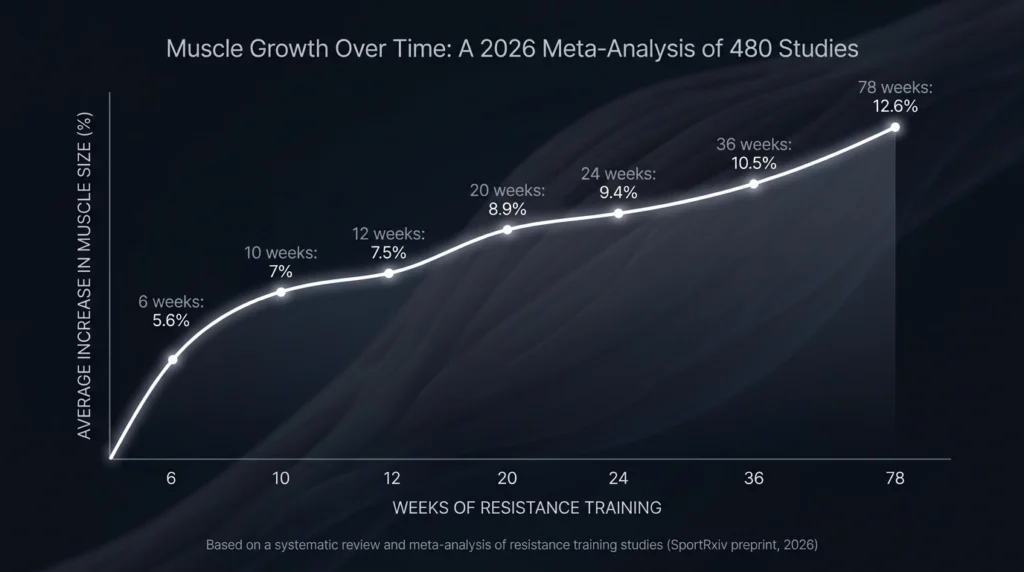
Rung 3: Six to twelve weeks. This is usually when the first real, visible changes show up. A 2026 research review that pooled data from 480 resistance training studies and more than 3,200 measurements found that muscle size increased by an average of about 7 percent after 10 weeks of consistent training. Note that this research is currently a preprint, meaning it has not yet completed formal peer review, but it draws on a very large body of existing studies.
Rung 4: Six months to a year. This is when most people, including friends and family, start to notice the change without you having to point it out. For many lifters, this is the point where the change feels like a real, visible transformation rather than a small improvement.
Why You Notice Changes Before Anyone Else Does
Many lifters notice small changes in their own body weeks before other people say anything. This makes sense. You see yourself every day and can spot subtle shifts in how your clothes fit or how a muscle looks when you flex it.
Other people only see you occasionally, so the change has to be bigger before it registers. If you feel like nothing is happening just because no one has commented on it, that is not a reliable sign. Track your own measurements instead.
The “Two Week Transformation” Myth
You may have seen social media claims about gaining serious muscle in two weeks. This is not realistic for a natural lifter. Meaningful muscle growth takes weeks to months, not days.
Anything that looks like a two week transformation usually reflects changes in water retention, glycogen, bloating, lighting, or posing, rather than a large amount of newly built muscle.
How Long Does It Take for a Muscle to Grow? What Happens Inside Your Muscle Fibers
To understand the timeline, it helps to know what is actually happening inside your body.
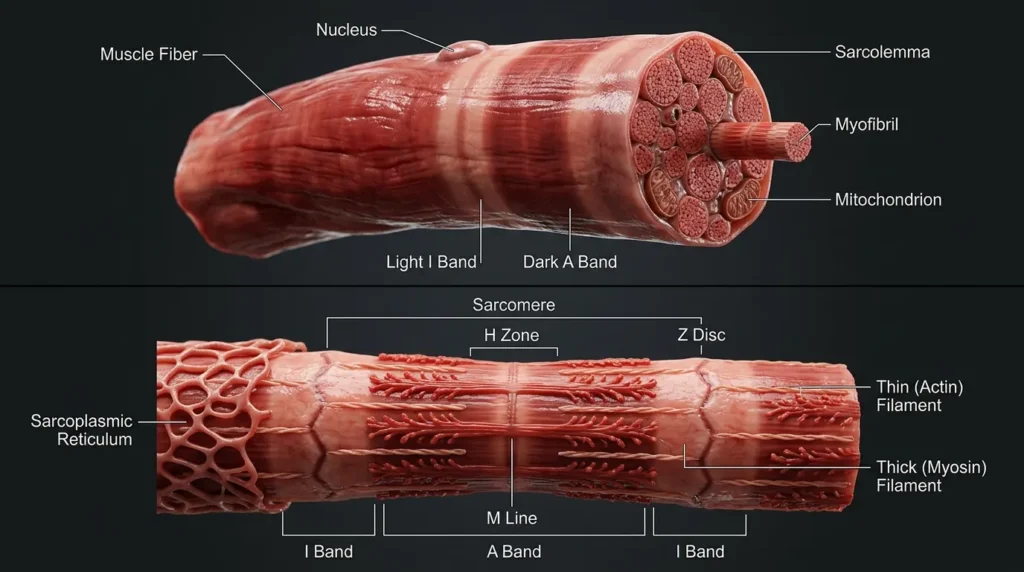
The Muscle Protein Synthesis Window
After a workout, your body ramps up something called muscle protein synthesis. This is simply the process your body uses to repair and build muscle tissue. Research indicates this process can stay elevated for roughly 24 to 72 hours after a workout, though the exact duration varies with training status and how hard the session was.
Elevated muscle protein synthesis is not the same thing as guaranteed muscle growth. Whether you actually gain muscle depends on the balance between this building process and the natural breakdown process over time, along with your overall training and nutrition.
This is part of why some people find training each muscle group two or three times a week a practical way to distribute their weekly volume, rather than proof that more frequent training directly causes more growth on its own.
Mechanical Tension, Not Soreness, Drives Growth
For years, many lifters believed that if a workout did not leave you sore, it did not work. Research does not support this idea. A well known 2010 paper by researcher Brad Schoenfeld proposed three mechanisms that can trigger muscle growth: mechanical tension, muscle damage, and metabolic stress. Of these three, mechanical tension, meaning the actual force placed on the muscle during a lift, is generally viewed as the most consistently supported driver of growth, though research on the exact role of each mechanism has continued to develop since that paper. What is fairly clear is that muscle soreness is not a reliable proxy for how much muscle a workout will build. Some of the most effective training programs cause very little soreness at all.
From Signal to New Tissue
Here is a simple version of what happens after a hard set. Your muscle fibers sense the tension from the lift. That signal activates a pathway inside your cells sometimes nicknamed the growth switch, known scientifically as mTORC1. Activating this pathway helps ramp up the machinery your cells use to build and repair muscle proteins.
Eating enough protein, especially getting enough of an amino acid called leucine, helps activate this same pathway alongside training, which is why exercise and nutrition work together rather than separately.
Why You Do Not Need Heavy Weights to Grow
A well established idea in muscle science, called the size principle, explains that your body recruits muscle fibers in order, starting with the ones that are easiest to use and moving up to the hardest to reach ones as a set gets more difficult. Research supports a broad range of effective loads, roughly 30 to 80 percent of your one-rep max, as long as sets are taken close enough to failure.
This is a practical range rather than an exact scientific cutoff. This means you do not have to lift extremely heavy weights to build muscle. What matters more is how close to muscular failure your sets are, not the exact number on the bar.
How Long Does It Take to Gain Muscle Mass? Realistic Rates for Beginners and Natural Lifters
Everyone wants a number, so here is the most honest one available.
It’s important to separate two different types of measurement here. The 2026 meta-analysis mentioned earlier measured muscle size directly, using MRI, ultrasound, and other imaging, across 480 studies.
It found a nonlinear increase in muscle size over time, with the estimated effect reaching about 7 percent at 10 weeks. This percentage refers specifically to the measured muscle size outcome used in that analysis. It should not be read as gaining 7 percent of your total body weight or 7 percent of your total muscle mass, and it is not a direct measurement of pounds gained.
For a practical pounds-per-month estimate, there is no single, universally agreed research number that applies to every individual. What exists instead are well known coaching models, developed by people like researcher and coach Lyle McDonald and nutrition researcher Alan Aragon, who translated broader training and physiology research into practical estimates.
These are useful planning tools, not direct findings from a controlled study. Both models estimate that a natural beginner can gain roughly 1.5 to 2.25 pounds of muscle per month in year one, which works out to about 18 to 27 pounds over a full year.
That estimate drops to roughly 0.85 to 1.7 pounds per month in year two, and down to about 0.5 to 1 pound per month once you reach an advanced training level. These figures are rough guides, not guarantees, since individual results vary based on genetics, consistency, and starting point.
Returning to the measured muscle-size data, the table below shows how that nonlinear curve unfolds over time. Growth is faster in the early months and gradually levels off.
| Weeks of Consistent Training | Average Increase in Muscle Size |
|---|---|
| 6 weeks | About 5.6% |
| 10 weeks | About 7% |
| 12 weeks | About 7.5% |
| 20 weeks | About 8.9% |
| 24 weeks | About 9.4% |
| 36 weeks | About 10.5% |
| 78 weeks (about 1.5 years) | About 12.6% |
Notice how the curve slows down. You gain a large share of your total muscle in the first few months, and each additional month after that adds a smaller amount. Interestingly, this research found no strong evidence that age or prior training experience changes the shape of this curve, and the percentage gains were similar between men and women, even though men typically start with more total muscle mass.
The First Year vs. Year Two and Beyond
The first year of consistent training tends to be the fastest period of progress for most natural lifters. This is sometimes called the beginner advantage. Each year after that, the rate of muscle gain generally slows down, partly because you are getting closer to what your body can naturally build, and partly because early gains include a boost from neurological adaptation that does not repeat itself the same way in later years. This is a general pattern, not a fixed rule. Someone who improves their nutrition, training, sleep, or consistency after a rough first year can still have a strong year two.
Does It Take Years to Build Muscle?
Yes and no. You will see real, visible muscle within months, but building a fully developed, muscular physique realistically takes several years of consistent training, not weeks or even one year. Think of the first year as building the foundation. The years after that are about refining and adding to it.
Men, Women, and Age: Who Builds Muscle Faster?
How Long Does It Take to Build Noticeable Muscle for Males?
Men generally carry more total muscle mass and higher natural testosterone levels than women, which allows them to build a larger absolute amount of muscle over time. This is different from the percentage rate of growth.
The research above found that muscle size increased by a similar percentage in men and women relative to their own starting point. In simple terms, a man and a woman doing the same program can both see similar relative progress, but the man will typically end up with more total pounds of new muscle, because he started with more muscle to begin with.
In practical terms, a man following a good program can expect visible changes within the same six to twelve week window described earlier.
For Women
Women can build muscle just as effectively as men on a percentage basis relative to their own starting point. The idea that women need a completely different approach to build muscle is not well supported.
The same principles, resistance training, adequate protein, and a calorie surplus, apply. Women typically notice visible changes in the same general timeframe as men, though the total pounds of muscle mass gained is usually lower, due to naturally lower testosterone levels and generally lower starting muscle mass.
Starting After 40
It is common to wonder whether age closes the door on building muscle. It does not. People in their 40s, 50s, and beyond can and do build muscle through consistent strength training.
The process may be somewhat slower due to changes in hormones and recovery, but the same adaptation ladder still applies. Muscle mass naturally declines with age if you do nothing, which makes strength training especially valuable later in life, not less useful.
Is It Too Late to Start Building Muscle?
No. There is no age where it becomes physically impossible to build muscle through resistance training. A 2011 meta-analysis published in Medicine & Science in Sports & Exercise, which reviewed studies in adults over 50, found that resistance training produced significant strength improvements even into the eighth and ninth decades of life, meaning people in their 70s and 80s.
The earlier you start, the more time you have to build, but starting later still produces real, measurable benefits.
What Speeds Up Muscle Growth: Training Variables That Matter
Once you understand the timeline, the next question is how to make the most of it. A few training variables make a real difference.
Progressive Overload, Explained Simply
Progressive overload just means gradually asking your muscles to do a little more over time. This could mean adding a small amount of weight, adding one more rep, or adding one more set every few weeks.
Without this gradual increase, the training stimulus may eventually become too small to drive further adaptation, which is a common reason progress stalls even when workouts still feel hard.
How Long Should You Work Out Every Day to Gain Muscle?
You do not need to train every single day. Research comparing training a muscle group once, twice, or three times a week found only small differences in muscle growth when the total weekly workload was kept the same.
Training each muscle group about twice a week is a practical and reasonable approach for most people, and session length can vary depending on how much work you need to fit in and how well you recover.
What matters more than daily frequency or session length is doing enough total quality work across the week and allowing muscles time to recover between sessions.
How Much Training Volume Do You Need?
Volume refers to the total number of hard sets you do for a muscle group each week. Beginners can often make real progress with a relatively modest amount of weekly volume, while more experienced lifters may need more work to keep seeing results.
Somewhere around 10 to 20 hard sets per muscle group per week is a commonly discussed practical range, but more is not automatically better. Past a certain point, adding extra sets stops helping and can even work against recovery. The right number varies from person to person and exercise to exercise.
Do You Need Heavy Weights?
No. As mentioned earlier, a broad range of loads, from fairly light to fairly heavy, can build muscle effectively as long as the effort is high enough. Research suggests that rep ranges anywhere from roughly 3 reps to 30 reps per set can build a similar amount of muscle, as long as the set is taken close to failure, though this is a general finding rather than a fixed rule for every case.
So a heavy, low rep set on the bench press and a lighter, high rep set of the same exercise can both work, provided the effort is there. Very light loads, well below your one-rep max, tend to become less practical and may be less effective if they are not taken sufficiently close to failure.
What matters most is training within about two to three reps of failure on most sets, meaning you stop just short of the point where you could not complete another rep with good form.
What About Advanced Techniques?
Once the basics above are in place, a few smaller techniques are sometimes used for a modest extra edge, though they are far less important than progressive overload, sufficient volume, effort, and recovery.
Flexing or squeezing the target muscle hard between sets is one example some lifters use, with limited research suggesting a small possible benefit, though it can reduce how much weight you lift on your next set. Pre exhaustion, doing an isolation exercise right before a bigger compound lift, is another.
Neither technique is necessary. A beginner following the basics, consistent training, adequate protein, and progressive overload, will get the vast majority of their results without either one.
Does Your Training Split Matter?
Many beginners use a split where each muscle group is trained only once a week, sometimes called a bro split. As covered above, frequency itself appears to matter less when weekly training volume is similar.
In practice, though, training a muscle group about twice a week can be a useful and practical way to distribute your weekly sets, especially if it is hard to fit all your volume for a muscle group into one long session.
So the benefit of a twice weekly split is less about frequency being magic on its own, and more about it being an easier way to get enough total volume in without one workout becoming too long.
Free Weights, Machines, or Bodyweight Training
The type of equipment you use, whether it is free weights, machines, resistance bands, or your own bodyweight, matters far less than whether you are applying progressive overload and training close to failure.
A well designed bodyweight or home gym program can build muscle effectively, provided the exercise gives your muscles enough resistance and the difficulty increases over time.
Protein, Calories, and Nutrition: The Fuel Behind Muscle Building
Training creates the signal for your muscles to grow. Nutrition provides the materials to actually build new tissue.
How Much Protein Do You Need?
Most research supports a protein intake of about 1.6 to 2.2 grams per kilogram of body weight per day, which works out to roughly 0.7 to 1 gram per pound. For a 165 pound person, that is about 120 to 165 grams of protein daily. It also helps to get a good dose of leucine, a specific amino acid found in protein, with each meal, roughly 700 to 3000 milligrams, since leucine plays a key role in triggering muscle protein synthesis.
Most meals containing a solid portion of meat, fish, eggs, or dairy already hit this range. Spreading your protein across three to four meals a day, rather than eating it all at once, appears to support muscle building slightly better, though hitting your daily total matters more than perfect timing.
This protein can come from whole foods like chicken, fish, eggs, dairy, beans, and lentils, or from a protein powder if it helps you hit your daily target more easily. A protein powder is simply a convenient food source, not a requirement, and it does not build muscle any faster than the same amount of protein from a meal.
Along with protein, staying hydrated and getting enough electrolytes, mainly sodium, potassium, and magnesium, supports how well your nerves signal your muscles to contract during a workout. This is a small but often overlooked piece of performance, especially if you train in a hot environment or sweat heavily.
Calories: Why a Small Surplus Works Best
To build new muscle tissue, your body generally needs more energy coming in than going out. A moderate surplus of around 250 to 500 extra calories per day, sustained over 12 to 16 weeks, is a common approach that tends to produce about half a pound to one pound of body weight gain per week for most beginners.
It is important to understand that this is total body weight gain, not muscle gain specifically. Some of that weight will be new muscle, and some will typically be a small amount of new body fat, since eating in any surplus makes some fat gain likely alongside muscle growth. Eating far beyond this surplus does not speed up muscle growth. It mostly adds extra body fat instead, without meaningfully building more muscle.
How Long Does It Take to Build Muscle for Skinny Guys?
If you are naturally thin and struggle to gain weight, the biggest factor working against you is usually simple: you are not eating enough to stay in a consistent calorie surplus.
Naturally lean, skinny individuals often need to be more deliberate about hitting their daily calorie and protein targets every single day, since it is easy to underestimate how much food is actually needed.
With consistent eating and training, skinny beginners typically follow the same six to twelve week timeline for first visible results as anyone else, but tracking your food intake matters even more for this body type, since guessing tends to lead to under-eating.
Can You Build Muscle Without Supplements?
Yes. Whole foods can fully supply everything your body needs to build muscle, including protein and the amino acids inside it. Supplements are not required, and no pill or powder replaces consistent strength training and adequate food.
That said, a few supplements have solid research behind them if you choose to use them. Creatine is one of the most studied supplements in sports nutrition, with dozens of controlled studies showing it can modestly increase strength and power output, generally somewhere in the range of a few percent up to about 20 percent depending on the activity.
A typical dose scales with body size, roughly 3 to 5 grams per day for an average sized adult, and somewhat more for a larger person. There is no need to “load” it with a large dose first. Beta alanine, usually taken at 2 to 5 grams per day, may help with sets or efforts that last 60 to 240 seconds, such as higher rep training or interval style cardio.
These supplements can offer a small edge, not a shortcut, and whole food nutrition remains the foundation either way. As with any supplement, it is worth talking to your doctor first, especially if you take other medications.
Common Mistakes That Slow Down Muscle Growth
If your training has stalled, work through this short checklist before assuming something is wrong with your genetics or your program:
- Are you changing your program often enough to keep applying progressive overload, or repeating the exact same weights and reps for months?
- Are you actually gaining weight or strength over time, or has your training log been flat for several weeks?
- Is your training genuinely hard, close to failure, or is your phone or a long rest period cutting into your effort?
- Are you eating enough protein and enough total calories for your body weight and goal?
- Are you sleeping seven to nine hours a night, most nights?
- Are you giving each muscle group enough rest between sessions, rather than training it again while it is still very sore or fatigued?
Most stalled progress traces back to one of these basics, not to some rare or advanced fix.
Can You Build Muscle and Lose Fat at the Same Time?
This is possible and is often called body recomposition. It tends to work best for beginners, people returning to training after a break, or those carrying extra body fat to begin with.
It generally involves eating at or slightly below maintenance calories while keeping protein high and training consistently. Progress is usually slower than a dedicated muscle building phase, but it avoids the fat gain that comes with a larger calorie surplus.
How Long Should a Bulk Last?
If you choose to eat in a surplus specifically to maximize muscle gain, a bulking phase of about 12 to 16 weeks is a reasonable length before reassessing your progress and body composition. Shorter bulks may not give your body enough time to show meaningful results, while very long bulks tend to add more fat than necessary.
Why Your Muscles Might Not Be Showing Yet
If you have been training for months and still cannot see much definition, the issue is often body fat covering the muscle, not a lack of muscle growth. Muscle can be growing underneath a layer of fat that has not been reduced.
This is especially true if you started at a higher body fat percentage, since visible definition simply takes longer to show up under a thicker fat layer, even while real muscle is being built underneath.
This is also why some people mistake fat loss for sudden muscle gain, or muscle gain for weight gain, when scale weight alone does not tell the full story. Tracking measurements and progress photos, not just the scale, gives a clearer picture.
Sleep, Rest, and Recovery: Where Muscle Actually Rebuilds
Muscle does not do most of its growing during your workout. The workout provides the stimulus, while much of the actual tissue repair and adaptation happens afterward, while you rest.
Sleep and Recovery
Most adults need somewhere between seven and nine hours of sleep per night to recover well. Poor sleep can negatively affect recovery, training performance, and body composition, so consistently getting enough sleep is an important part of any muscle building plan, alongside training and nutrition.
A few simple active recovery habits also support the muscle repair process between hard sessions: light movement like walking on rest days, keeping stress in check, and getting enough omega-3 fats, vitamin D, and magnesium through diet or supplements, all of which are linked to healthy inflammation levels.
Muscle soreness itself is not required for growth. Some of the best training programs cause very little soreness at all, so do not judge a workout’s effectiveness by how sore you feel the next day.
Some research has looked at whether common medications affect the muscle-building response to training. A few studies suggest that regular use of certain NSAID painkillers around workout times may modestly blunt some training adaptations, though this research is not fully settled and should never be a reason to stop a medication your doctor has prescribed for a real medical need.
If you take NSAIDs regularly and are concerned about this, it is worth a conversation with your doctor rather than stopping on your own. The evidence on antihistamines and exercise adaptation is less established, so no firm practical advice is offered here beyond talking to your doctor about any medication you take regularly.
Does Cardio Slow Muscle Growth?
Moderate amounts of cardio do not meaningfully interfere with muscle growth for most people, and can support recovery and overall health. Very high volumes of intense cardio, especially when combined with limited calories, can start to compete with muscle building, but the average person doing cardio a few times a week alongside resistance training has little to worry about.
How Do You Know You Are Recovered?
Some lifters track morning grip strength or heart rate variability, a measurement offered by many fitness watches and rings, as personal recovery signals. Rather than relying on any fixed cutoff, it is more useful to watch for a meaningful change from your own normal baseline.
A noticeably weaker grip or a lower than usual heart rate variability reading, especially combined with poor sleep, ongoing soreness, or declining workout performance, can be a signal to consider an easier session or an extra rest day. Neither measurement can diagnose recovery on its own, but tracking your own baseline over time makes them more useful.
Does Cold Therapy or Ice Baths Slow Muscle Growth?
This is a detail most articles on this topic miss entirely. Some research has found that cold exposure, such as an ice bath or cold shower, taken soon after a resistance training workout, roughly within the first few hours, may blunt some of the muscle building signals your body is trying to send, possibly including the same growth pathway mentioned earlier.
This research area is still developing and the exact time window is not precisely settled. As a cautious approach, if your main goal is muscle and strength, it may be worth saving ice baths for a different time of day, or at least not immediately after a hard resistance workout. If your main goal is endurance performance, this concern matters less.
Deload Weeks
After several weeks of hard, consistent training, many lifters benefit from a deload, a planned week of lighter training or extra rest. A deload can be especially useful once accumulated fatigue starts affecting your performance, recovery, sleep, or motivation.
Some lifters schedule one every four to eight weeks as a general guideline, while others simply wait until their performance or recovery signals suggest it is needed. Either approach is reasonable, and a deload is not a step backward. It allows your body to fully catch up on recovery before the next block of harder training.
How to Know It’s Working: Track Real Progress
Building muscle is a slow process, which makes tracking progress essential. Relying on the mirror alone can be misleading day to day.
| What to Track | How Often | What Progress Looks Like |
|---|---|---|
| Strength log (weights and reps) | Every workout | Gradual increases in weight or reps over weeks |
| Body measurements (arms, chest, waist, thighs) | Every 2 to 4 weeks | Small but steady increases in muscle areas |
| Progress photos | Every 4 weeks, same lighting and pose | Visible changes over months, not days |
| Body composition or FFMI | Every 1 to 3 months | A rising number that reflects added lean mass |
If you want a more precise, actionable benchmark than the scale or a photo, a fat free mass index, or FFMI calculation can help you understand how much muscle you are carrying relative to your height, and how that compares to typical natural muscle building limits. You can calculate your own FFMI here: [https://theffmicalculator.com/].
Stuck? Plateaus, Natural Limits, and Your FFMI Benchmark
Every natural lifter eventually reaches a point where progress slows dramatically, no matter how well they train and eat. This is not a program failure. It usually reflects your body getting closer to its natural genetic potential for muscle mass, though where that ceiling sits varies a lot from person to person based on genetics, bone structure, and training history.
An FFMI score, short for fat free mass index, is a useful reference tool here, not an exact prediction. It combines your height and your lean body mass into a single number, which lets you compare your muscle mass to your height in a more meaningful way than body weight alone.
There are a few things worth understanding before treating any FFMI number as a hard rule. First, calculating FFMI depends on an accurate body fat percentage estimate, and most home methods for estimating body fat have a real margin of error, which carries through into the FFMI result. Second, you may see both a raw FFMI and a normalized FFMI, which adjusts slightly for height.
These can differ, so it matters which version you are looking at. Third, the well known idea of a natural FFMI ceiling around 25 is a useful reference point based on observed data, not a strict biological wall. Some natural lifters with favorable genetics sit a bit above it, and plenty of natural lifters plateau well below it.
Used the right way, FFMI is a helpful benchmark for tracking your own lean mass over time and getting a rough sense of how your muscle mass compares to general natural lifting ranges, rather than a precise genetic test. Once you are close to your own natural range, the goal often shifts from adding size to refining shape, improving weak points, and maintaining what you have built. That shift is a sign of real progress, not a stall.
How Fast Do You Lose Muscle, and What Is Muscle Memory?
Muscle loss, called atrophy, happens much faster than muscle gain when you stop training completely, though it does not happen overnight. The exact rate varies quite a bit from person to person, depending on your age, how long you trained before stopping, your diet, and how completely you stop moving. As a general pattern, strength tends to hold up longer than visible size in the early weeks off.
The good news is a real phenomenon known as muscle memory: people who have built muscle before and then lost it during a break tend to regain it faster the second time than they built it the first time. Scientists are still studying exactly why this happens, and no single mechanism fully explains it.
A few possible explanations are being researched. One idea, first observed in animal studies, is that muscle fibers keep extra nuclei gained during earlier muscle growth even after the muscle shrinks back down, and that this could make it easier for the fiber to grow again later. Human research on this exact question has produced mixed results.
A 2022 systematic review and meta-analysis found that, unlike in rodents, increases in nuclei from training were not clearly maintained in humans after a period of detraining, which means this explanation alone does not fully settle the question. A newer 2025 human study added another layer to the picture, finding that some protein level changes inside trained muscle remained detectable even after about two and a half months without training, and shifted again once training resumed, suggesting a kind of molecular memory beyond nuclei alone.
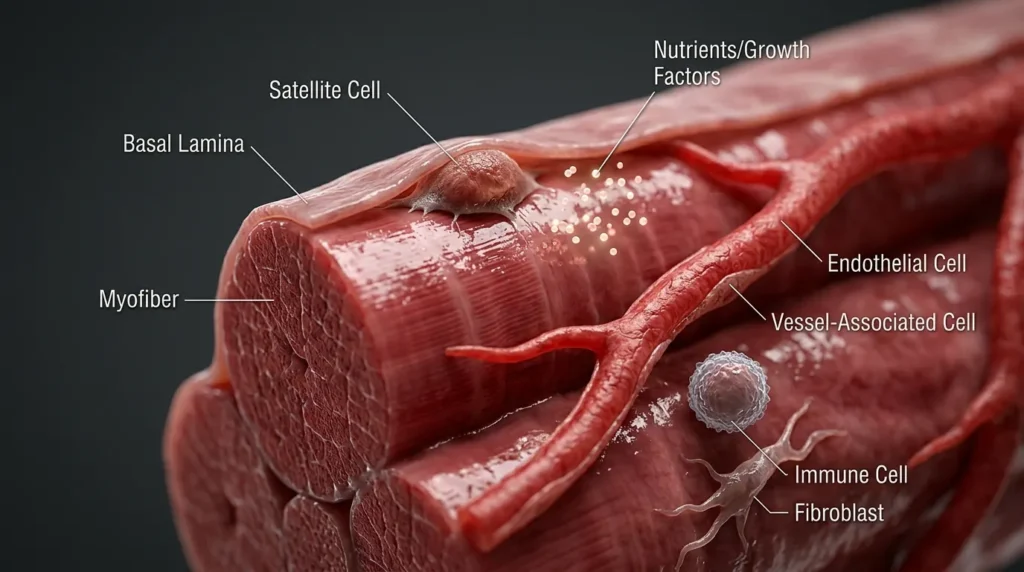
Beyond the muscle tissue itself, part of muscle memory is also simply neurological. Your nervous system does not fully forget the motor skills and movement patterns from before, which helps you get back into good form and effective training faster the second time around.
Regaining Muscle vs. Building From Zero
If you are getting back into training after a break, expect a faster timeline than the one described earlier for complete beginners. Early strength often returns within a few weeks, and visible muscle can reappear noticeably faster than it took to build the first time, likely thanks to a combination of the mechanisms described above.
This pattern has also been observed in older adults returning to training after time off, which is encouraging if you built some muscle earlier in life and are now getting back into it later.
A Simple First Year Plan for Beginners
If you are just starting out, keep it simple: train each major muscle group about twice a week using a mix of compound and isolation exercises, apply progressive overload by slowly adding weight or reps, eat enough protein and a modest calorie surplus, sleep seven to nine hours a night, and track your progress every few weeks rather than every day.
Consistent training over a full year, following these basics, will get you further than any advanced technique applied inconsistently. If you want more personalized guidance, working with a certified personal trainer for even a few sessions can help you learn proper form early on.
Frequently Asked Questions
How long does it take to notice muscle growth?
Most people notice early strength gains within one to two weeks, with visible muscle changes typically appearing between six and twelve weeks of consistent training.
How long does it take for a muscle to grow after a workout?
Muscle protein synthesis, the repair process that builds new tissue, can stay elevated for roughly 24 to 72 hours after a workout, though the exact duration depends on your training status and how hard the session was.
How long does it take to build noticeable muscle for males and females?
Both typically see visible changes in the same six to twelve week window, though men usually add more total muscle mass due to higher natural testosterone.
How long does it take to gain muscle mass as a beginner?
Beginners can realistically gain about 1 to 2 pounds of muscle per month during the first year, with the fastest progress happening early on.
How long should you work out every day to gain muscle?
Daily training is not necessary. Research suggests frequency matters less than total weekly training volume, so hitting each muscle group about twice a week is often a practical way to fit in enough work, with proper recovery in between.
Can you build muscle and lose fat at the same time, and how long does it take?
Yes, through a process called body recomposition, though it tends to be slower than a dedicated muscle building phase and works best for beginners or those returning to training.
How long does it take to build muscle for skinny guys?
The general timeline is similar, but naturally lean individuals need to focus closely on eating enough calories and protein every day to see consistent results.
Does it take years to build muscle?
Visible changes appear within months, but building a fully developed physique realistically takes several years of consistent, progressive training.
How long does it take to lose muscle if you stop training?
Some strength and size can be lost within a few weeks of stopping training entirely, though thanks to muscle memory, regaining it later is typically faster than building it the first time.
Can you regain muscle faster after a long break?
Yes. Most lifters find that muscle and strength come back noticeably faster the second time around compared to how long it took to build originally, even after breaks lasting months or longer.
Can women build muscle as fast as men?
On a percentage basis relative to their own starting point, yes. Men typically end up with more total pounds of muscle because they generally start with more muscle mass and higher testosterone, not because their muscles respond less efficiently to training.
Why am I not seeing muscle growth?
The most common reasons are not applying progressive overload consistently, not eating enough protein or total calories, not training close enough to failure, and not getting enough sleep or recovery between sessions.
Does body fat affect how quickly muscle becomes visible?
Yes. Muscle can be growing even if you cannot see it clearly, especially if it is covered by a higher level of body fat. Reducing body fat, alongside continued training, is often what reveals muscle that has already been built.
The Bottom Line
Building muscle is not instant, but it is predictable. Expect early strength gains within weeks, visible changes within a few months, and your fastest period of growth typically within your first twelve months of consistent training. After that, progress continues for years, just at a steadier, slower pace. Consistent training, enough protein, good sleep, and patience matter more than any single trick or technique.
References
- Roberts, M.D., et al. (2026). Modeling the Trajectory of Skeletal Muscle Hypertrophy During Resistance Training: A Systematic Review and Meta-Analysis. SportRxiv preprint (PROSPERO CRD42024498510).
- Schoenfeld, B.J. (2010). The Mechanisms of Muscle Hypertrophy and Their Application to Resistance Training. Journal of Strength and Conditioning Research, 24(10), 2857-2872.
- Peterson, M.D., Sen, A., & Gordon, P.M. (2011). Influence of Resistance Exercise on Lean Body Mass in Aging Adults: A Meta-Analysis. Medicine & Science in Sports & Exercise, 43(2), 249-258.
- Bruusgaard, J.C., et al. (2010). Myonuclei Acquired by Overload Exercise Precede Hypertrophy and Are Not Lost on Detraining. Proceedings of the National Academy of Sciences, 107(34), 15111-15116. (Animal study.)
- Rahmati, M., McCarthy, J.J., & Malakoutinia, F. (2022). Myonuclear Permanence in Skeletal Muscle Memory: A Systematic Review and Meta-Analysis of Human and Animal Studies. Journal of Cachexia, Sarcopenia and Muscle, 13(5), 2276-2297.
- Hulmi, J.J., Halonen, E.J., Sharples, A.P., et al. (2025). Human Skeletal Muscle Possesses Both Reversible Proteomic Signatures and a Retained Proteomic Memory After Repeated Resistance Training. The Journal of Physiology, 603(9), 2655-2673.
- McDonald, L. Natural muscle gain rate model for beginner, intermediate, and advanced lifters (coaching estimate, not a controlled study).
- Aragon, A. Percentage-of-bodyweight muscle gain rate model for natural lifters (coaching estimate, not a controlled study).
- StrengthLog. Muscle protein synthesis and training frequency research summaries. strengthlog.com
Items 7 and 8 are widely used coaching models rather than peer-reviewed studies, and are labeled as such throughout this article.
“This article is for informational purposes only and is not a substitute for advice from your doctor or a qualified personal trainer.”


