How to Increase FFMI Naturally | The Complete Evidence Based Guide
Most people trying to improve their FFMI are following generic fitness advice eat more protein, train harder, sleep better. That advice is not wrong. But it is incomplete in a way that costs you years of progress.
FFMI has its own math. Building lean mass while keeping body fat in check requires a strategy that is different from just “getting bigger.” Before understanding your FFMI properly, it helps to know your Lean Body Mass (LBM), because that is the base of your muscle calculation. You can quickly calculate it using our LBM Calculator.
This guide gives you that strategy, backed by the research that actually matters.
Key Takeaways
- FFMI increases only when lean body mass goes up and body fat stays the same or drops — tracking weight alone tells you nothing
- Natural lifters gain 0.5 to 1 FFMI point per year in the first 3 to 5 years, slowing to 0.2 to 0.5 points annually at the intermediate stage
- Protein intake of 1.6 to 2.2 grams per kilogram of body weight daily is the most consistently supported range across muscle hypertrophy research
- A caloric surplus of 200 to 500 calories above TDEE drives lean mass gain without excessive fat accumulation
- A 2021 study published in Physiological Reports found one night of total sleep deprivation reduces muscle protein synthesis by 18% — this single factor can stall FFMI progress significantly
- Most natural men reach FFMI 20 to 22 within 3 to 5 years of optimal training — reaching 25 requires 7 to 10 or more years and elite genetics
“Not sure what your current FFMI is? Use our free FFMI Calculator to get your number in 30 seconds before reading further.”
Why Is FFMI Different from Just Building Muscle?
Here is what most people miss.
Your FFMI is not just a measure of how much muscle you have. It is a ratio — lean body mass relative to your height squared. That means two things affect it simultaneously: the lean mass in the numerator and the body fat percentage that determines how much lean mass you actually have.
Gaining 10 pounds of muscle while also gaining 10 pounds of fat? Your FFMI barely moves. Gaining 5 pounds of muscle while keeping body fat flat? Your FFMI jumps noticeably.
This is why the generic advice to “just eat more and train harder” produces disappointing FFMI results for most people. Eating aggressively in a caloric surplus builds muscle, but it also builds fat. And fat dilutes your FFMI.
The goal is not maximum muscle gain. The goal is maximum lean mass gain at the lowest possible body fat accumulation rate. Those are related but they are not the same thing. Keeping that distinction clear is what separates people who improve their FFMI consistently from people who spin their wheels for years.
How Much FFMI Can You Gain Naturally Per Year?
Let me give you the honest numbers, because most sources either bury this information or sugarcoat it.
According to Lyle McDonald’s muscle gain model — a widely cited practitioner framework based on decades of work with natural bodybuilders and consistent with Alan Aragon’s independently derived estimates — natural male lifters gain approximately:
Year 1: 20 to 25 pounds of lean mass (roughly 1 to 1.5 FFMI points) Year 2: 10 to 12 pounds (roughly 0.5 to 0.7 FFMI points) Year 3: 5 to 6 pounds (roughly 0.3 to 0.5 FFMI points) Year 4 and beyond: 2 to 3 pounds annually (roughly 0.1 to 0.3 FFMI points)
For women, research including a 2024 meta-analysis of 36 resistance training studies published in PMC found that women gain muscle at a similar relative rate to men, with absolute gains approximately 50 to 60% of male values due to lower baseline testosterone.
Why do gains slow down this dramatically?
The practical takeaway: if you are in your first year, expect meaningful FFMI jumps. If you have been training seriously for 4 or more years, a gain of 0.3 FFMI points in a year represents genuine progress. Do not compare your current rate of improvement to what it was in year one.
“Not sure if your current score is good or not? Our complete guide on what is a good FFMI score breaks down exactly where you stand by training level.”
The Training Strategy That Actually Moves FFMI
Progressive overload is the only mechanism that forces your body to build new muscle tissue. Not variety. Not confusion. Not switching programs every month.
You also don’t need to judge whether a workout was effective by how sore you feel afterward. Muscle soreness can happen without meaningful long term growth, while productive training often becomes less sore as your body adapts. Learn more about what muscle soreness actually means after a workout ->.
Progressive overload means your muscles face more demand than they did last session, more weight, more reps, more sets, or shorter rest with the same load. Without that progression, your body has no reason to add lean tissue, and your FFMI stays exactly where it is.
Here is what the research actually supports for natural muscle hypertrophy, according to multiple meta-analyses in the Journal of Strength and Conditioning Research:
Training frequency: 2 to 3 sessions per muscle group per week produces significantly better hypertrophy than once-per-week training. Higher frequency gives you more opportunities to trigger protein synthesis per week.
Training volume: 15 to 20 hard sets per muscle group per week is the evidence-based range for intermediate to advanced natural lifters. Below 10 sets per muscle per week, you are leaving gains on the table. Above 25 sets, you risk recovery debt that actually impairs growth.
Rep range: 6 to 12 reps per set hits the sweet spot for hypertrophy, though research from Brad Schoenfeld’s lab published in the Journal of Strength and Conditioning Research (2017) confirms muscle growth occurs across a broad rep range as long as sets are taken close to failure.
Now here is what most people get wrong.
They switch programs every 4 to 6 weeks before progressive overload has had time to work. Lyle McDonald’s research recommendation is to run a program for at least 8 to 12 weeks before evaluating its effectiveness. Switching programs is almost always a way to feel like you are doing something without actually doing the hard work of adding weight to the bar week after week.
Compound movements — squats, deadlifts, bench press, rows, overhead press — remain the most effective tools for increasing FFMI because they allow the heaviest loads and recruit the most muscle tissue per session. Isolation exercises have their place for addressing weak points, but they should not dominate your program if FFMI improvement is the primary goal.
The Nutrition Protocol for Increasing FFMI
Training creates the stimulus for muscle growth. Nutrition is what actually builds the muscle.
Here is what the evidence says about each variable.
Protein intake. Research consistently supports 1.6 to 2.2 grams per kilogram of body weight daily for individuals pursuing muscle hypertrophy. A 2018 meta-analysis by Morton et al. published in the British Journal of Sports Medicine analyzed 49 studies and 1,863 participants and found no additional benefit beyond 1.62 grams per kilogram — meaning more protein past that threshold does not accelerate muscle growth. The practical target for most people: hit 1.6 to 2.2 grams per kilogram consistently. Spread intake across 3 to 5 meals to maximize muscle protein synthesis.
Caloric surplus. Building muscle requires a positive energy balance. Research supports a surplus of 200 to 500 calories above your Total Daily Energy Expenditure for lean muscle gain, consistent with Helms et al. (2014) evidence-based recommendations for natural bodybuilders published in the Journal of the International Society of Sports Nutrition.
Carbohydrates. They are not optional for serious FFMI improvement. Carbohydrates fuel training performance and spare protein from being burned as energy. A 2022 study published in Nutrients confirmed that carbohydrate availability during resistance training directly affects training volume capacity — the variable most strongly linked to hypertrophy.
Creatine monohydrate. This is the one supplement with the strongest evidence base for increasing lean body mass. A 2017 meta-analysis by Lanhers et al. in the European Journal of Sport Science found creatine supplementation significantly increased upper and lower body strength across multiple studies. 3 to 5 grams daily is the evidence-backed dose. It works, the research is clear, and it is cheap. Start here before anything else.
Although creatine can support strength and lean-mass gains, some people also experience stomach discomfort or changes in body water. Learn more about creatine and water retention.
Recovery: The Factor Most Lifters Underestimate
Here is an uncomfortable truth.
You can have a perfect training program and optimal nutrition and still see your FFMI stall — if your recovery is insufficient.
Sleep is where muscle protein synthesis peaks. Growth hormone secretion reaches its highest point during slow-wave deep sleep. A 2021 study by Lamon et al. published in Physiological Reports found that a single night of total sleep deprivation reduced muscle protein synthesis by 18% in healthy young adults, while also increasing cortisol by 21% and decreasing testosterone by 24%. The study used a small but well-controlled crossover design of 13 participants — the findings are directionally consistent with broader sleep and recovery research. For natural lifters already working near the ceiling of what their hormonal environment allows, even an 18% reduction in protein synthesis meaningfully impairs FFMI progress over time.
7 to 9 hours of quality sleep per night is not a suggestion. It is a requirement.
Stress compounds the problem. Chronically elevated cortisol from psychological stress, excessive training volume, or inadequate sleep suppresses testosterone and directly impairs the anabolic signaling pathways responsible for muscle growth. Most people address training and nutrition meticulously while ignoring the fact that their lifestyle is chronically cortisol-elevated.
Deload weeks are another area where most natural lifters resist doing what the evidence supports. Reducing training volume by 40 to 50% every 4 to 6 weeks allows accumulated fatigue to dissipate and lets you return to training with restored performance capacity. This is not weakness. It is periodization and elite natural bodybuilders have used it systematically for decades.
How to Use Bulking and Cutting Cycles to Maximize FFMI
This is the strategic layer that most “how to increase FFMI” articles skip entirely.
FFMI increases most effectively through deliberate bulking and cutting phases rather than attempting to maintain a lean physique year-round while gaining muscle simultaneously.
Here is why.
Body recomposition — simultaneously gaining muscle and losing fat, works well for beginners and detrained individuals. For intermediate and advanced natural lifters, the caloric surplus needed to drive meaningful muscle growth also produces some fat gain. Trying to maintain 10% body fat while gaining significant lean mass simply does not work at the rate advanced lifters need.
The effective approach:
Bulking phase: Run a controlled caloric surplus of 200 to 400 calories above TDEE for 12 to 20 weeks. Accept that body fat will increase by 2 to 4 percentage points during this phase. Track FFMI monthly using a consistent body fat measurement method.
Cutting phase: Reduce calories to a deficit of 300 to 500 below TDEE and maintain training intensity to preserve lean mass. Aim to return to starting body fat levels before the next bulk. The goal is to finish each cut with more lean mass than you started the previous bulk with.
Each bulk-cut cycle should result in a net FFMI gain of 0.3 to 0.7 points for intermediate lifters and 0.1 to 0.3 points for advanced lifters. Small numbers that compound meaningfully over 5 to 10 years.
Can You Reach FFMI 25 Naturally?
The honest answer is: possibly, but probably not, and here is what the research actually says.
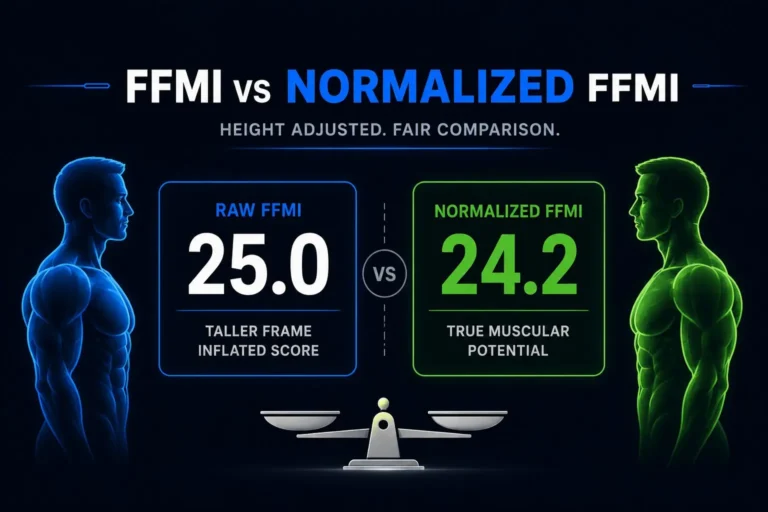
The Kouri et al. 1995 study analyzed 157 male athletes and found that no natural lifter in their sample exceeded a normalized FFMI of 25. Pre-steroid era Mr. America winners from 1939 to 1959 averaged FFMI 24.2, with a maximum of 25.4. Modern drug-tested bodybuilding champions consistently measure between FFMI 23.5 and 25.0 at stage weight.
Reaching FFMI 25 requires three things to align simultaneously: elite genetics (top 1 to 5% of the population for muscle-building response), 7 to 10 or more years of optimal training and nutrition, and exceptional consistency throughout that entire window.
Most natural men with serious, consistent training will peak between FFMI 21 and 24. Reaching 25 is not impossible, but assuming you will get there is not a reasonable planning assumption for the vast majority of lifters.
What does this mean practically?
Set your target 2 to 3 FFMI points above your current score as your 2 to 3 year goal. Do not plan your entire training life around reaching a number that may be outside your genetic ceiling. Build the best physique your biology allows with the process you can actually sustain.
Before setting FFMI 25 as your goal, understand whether it is actually the natural ceiling. Our FFMI 25 natty or juicy guide gives you the full research-backed answer.
Why Your FFMI Has Stopped Increasing (And How to Fix It)
If your FFMI has been flat for 3 or more months despite consistent training and eating, one of these is almost certainly the cause.
Insufficient caloric surplus. The most common reason FFMI stalls in intermediate to advanced lifters is under-eating during the muscle building phase. Many people claim to be eating in a surplus while their weight stays flat for weeks. If your body weight is not increasing during a bulk, you are not in a caloric surplus regardless of what your calorie calculator says. Track actual intake for 2 full weeks and compare to your weight trend.
Inadequate protein. Many lifters who track calories still under-hit protein. Hitting 160 grams of protein per day on a 100 kg body weight is not enough. You need 160 to 220 grams to maximize muscle protein synthesis at that body weight. Review your actual protein intake, not your estimated intake.
No progressive overload. If you are using the same weights for the same reps as you were 3 months ago, your muscles have adapted and have no stimulus to grow. Audit your training logs. Are the numbers actually going up? If not, you do not have a recovery problem or a nutrition problem. You have a training problem.
Inaccurate body fat measurement. This one is overlooked entirely. If you are using a BIA smart scale to track body fat, your FFMI calculation is potentially off by 4 to 8 percentage points depending on hydration. The 2021 JMIR mHealth study by Frija-Masson et al. found fat mass errors of 2.2 to 8.0 kg in three popular smart scales tested against DEXA. Muscle you actually built may not show up in your FFMI because the body fat measurement is masking it. Get a DEXA scan if you are serious about tracking FFMI accurately.
Approaching genetic ceiling. If you have been training optimally for 5 or more years and every other variable is dialed in, your slow FFMI progress may simply be biology. Gaining 0.2 FFMI points in a year after 7 years of serious training is not failure. It is what advanced natural progress looks like.
“Inaccurate body fat measurement is one of the most common hidden reasons FFMI appears stalled. Learn exactly which method is most reliable in our guide on how to calculate body fat percentage.“
FAQ
How long does it take to increase FFMI naturally?
Most natural lifters gain 0.5 to 1 FFMI point per year in the first 3 to 5 years of optimal training and nutrition. Reaching FFMI 20 from an untrained starting point typically takes 1 to 2 years. Reaching FFMI 22 to 23 takes 3 to 5 years. The rate slows significantly with each year of training experience as you approach your genetic ceiling.
How much FFMI can you gain naturally?
The natural ceiling is approximately 25 for men and 21 to 22 for women, based on the Kouri et al. 1995 study of 157 athletes and pre-steroid era bodybuilding data. Most natural men will peak between FFMI 21 and 24 after 7 to 10 years of serious training. Most natural women will peak between 18 and 21. Genetics determine where in those ranges you land.
Does creatine increase FFMI?
Yes. Creatine monohydrate increases lean body mass through two mechanisms. First, it increases intramuscular water retention, which shows up as lean mass in FFMI calculations. Second, it improves training performance over time, which drives greater muscle hypertrophy. A 2017 meta-analysis by Lanhers et al. confirmed creatine’s significant effect on upper and lower body strength. 3 to 5 grams daily is the evidence-backed dose.
Should I bulk or cut to improve FFMI?
If you are above 18% body fat for men or 28% for women, cut first. High body fat blunts anabolic hormone sensitivity and impairs muscle gain. If you are below those levels, start a controlled bulk with a 200 to 400 calorie surplus above TDEE. Alternating deliberate bulking and cutting phases produces more net FFMI gain over time than attempting to stay lean while building muscle simultaneously.
Why is my FFMI not increasing despite training hard?
The most common causes are insufficient caloric surplus (weight not increasing during bulk), inadequate protein below 1.6 grams per kilogram of body weight, no progressive overload in training, inaccurate body fat measurement from BIA scales, or simply approaching your genetic ceiling after several years of serious training. Audit each variable systematically before assuming you have hit your limit.
How does body fat percentage affect FFMI?
Body fat percentage is a direct input in the FFMI calculation. FFMI equals lean body mass divided by height squared, and lean body mass equals total weight multiplied by one minus body fat percentage. If your body fat measurement is inaccurate, your FFMI is inaccurate. A 3% overestimate of body fat makes your FFMI look lower than it actually is. Use DEXA or the Navy Method for reliable measurements.
Is FFMI 22 good for a natural lifter?
Yes. FFMI 22 places you in the top 10 to 15% of natural male lifters and reflects 3 to 5 years of consistent, optimized training. It is a genuinely impressive natural achievement. Reaching FFMI 23 to 24 puts you at the level of advanced natural bodybuilding competitors. These numbers take years of serious work and should not be compared to enhanced physiques on social media.
Your FFMI will increase if you follow the math. Build lean mass, manage body fat, measure accurately, and give the process the years it actually requires.
The physique is built in the accumulation of consistent, unremarkable training sessions not in a single breakthrough moment.
References
- Kouri EM, Pope HG Jr, Katz DL, Oliva P. Fat-free mass index in users and nonusers of anabolic-androgenic steroids. Clinical Journal of Sport Medicine. 1995;5(4):223-228.
- Morton RW, Murphy KT, McKellar SR, et al. A systematic review, meta-analysis and meta-regression of the effect of protein supplementation on resistance training-induced gains in muscle mass and strength in healthy adults. British Journal of Sports Medicine. 2018;52(6):376-384.
- Schoenfeld BJ, Ogborn D, Krieger JW. Dose-response relationship between weekly resistance training volume and increases in muscle mass: a systematic review and meta-analysis. Journal of Strength and Conditioning Research. 2017;31(12):3508-3523.
- Lanhers C, Pereira B, Naughton G, Trousselard M, Lesage FX, Dutheil F. Creatine supplementation and upper limb strength performance: a systematic review and meta-analysis. Sports Medicine. 2017;47(1):163-173.
- Frija-Masson J, Mullaert J, Vidal-Petiot E, et al. Accuracy of Smart Scales on Weight and Body Composition: Observational Study. JMIR mHealth and uHealth. 2021;9(4):e22487.
- Trexler ET, Smith-Ryan AE, Mann JB, et al. Fat-free mass index in NCAA Division I and II collegiate American football players. Journal of Strength and Conditioning Research. 2017;31(10):2719-2727.
- Helms ER, Aragon AA, Fitschen PJ. Evidence-based recommendations for natural bodybuilding contest preparation: nutrition and supplementation. Journal of the International Society of Sports Nutrition. 2014;11:20.
- Lamon S, Morabito A, Arentson-Lantz E, et al. The effect of acute sleep deprivation on skeletal muscle protein synthesis and the hormonal environment. Physiological Reports. 2021;9(1):e14660. doi:10.14814/phy2.14660.
- Chaillou T. Skeletal muscle fiber type in hypoxia: adaptation to high-altitude exposure and under conditions of pathological hypoxia. Frontiers in Physiology. 2018;9:1450.