
Lean Body Mass (LBM) Calculator
Calculate your estimated lean body mass using proven formulas based on your height, weight, and gender.
Your Result
0.0
kg
Lean Body Mass
Formula Used
Boer Formula
Gender
Male
Weight
70 kg
Height
175 cm
What Does This Mean?
Your lean body mass represents the weight of your muscles, bones, organs, and body water, excluding body fat.
Your Details
About Lean Body Mass
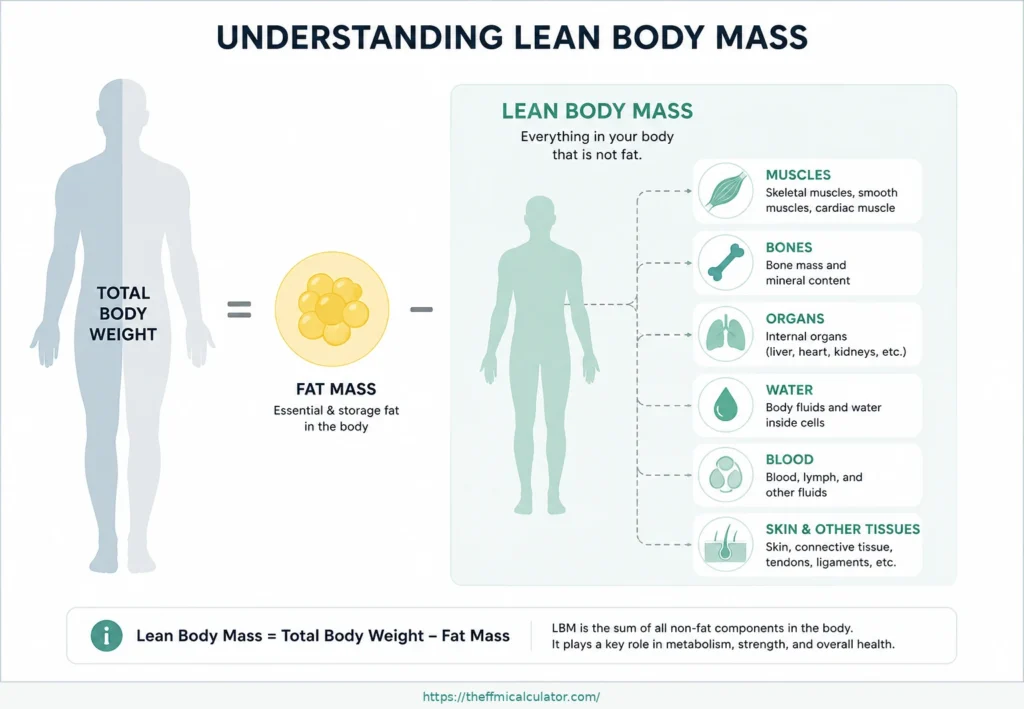
Lean Body Mass (LBM) includes everything in your body except fat.
It includes muscle, bone, organs, water, and other non-fat tissues.
Your data is used only for calculation and is never stored.
A 180 lb man at 15% body fat is carrying 153 lbs of lean body mass. That single number tells you more about his health than the bathroom scale ever will.
Use the LBM calculator above to get your number in 10 seconds. Then come back here, because the number alone means nothing without context. This guide gives you that context.
Key Takeaways
- Lean body mass (LBM) is your total weight minus fat. It includes muscle, bone, organs, blood, and water.
- Most men carry 75% to 88% of their body weight as lean mass. Most women carry 68% to 78%.
- The three most used formulas (Boer, James, and Hume) usually land within 2 to 3 kg of each other for the same person.
- LBM is not the same as muscle mass. Skeletal muscle typically makes up only 30% to 40% of total body weight, even in lean, active adults.
- You lose 3% to 8% of muscle mass per decade after age 30, according to Harvard Medical School and WebMD data. Resistance training and protein intake slow this down.
What Is Lean Body Mass?
Lean body mass is everything in your body that is not fat. That includes your muscles, bones, organs, blood, skin, and the water inside all of it.
The lean body mass meaning is simpler than most articles make it sound: take your total body weight, subtract your fat weight, and what is left is your lean body mass. A 70 kg person carrying 14 kg of fat has 56 kg of lean body mass. Simple math, but the implications run deep.
Doctors first started using this number for a practical reason, not a fitness one. Anesthesiologists dose certain water soluble drugs based on LBM, not total body weight, because fat tissue does not absorb those medications the same way muscle and organ tissue does. Two people who weigh the same can need very different drug doses if their body composition differs. That medical origin is why LBM still matters more than most fitness articles admit.
Lean body mass includes your muscles, bones, organs, and body water. It does not include body fat. To see how much of your body weight comes from fat, use our Body Fat Calculator. Two people can weigh exactly the same but have completely different lean body mass because body composition matters more than scale weight.
Why Lean Body Mass Matters
Lean body mass drives your metabolism. Muscle, organs, and other lean tissue burn far more calories at rest than fat does. Here is what nobody tells you: two people with the same body weight and the same height can have completely different calorie needs. The one with more lean mass burns more calories doing nothing. This is why bodybuilders eat 3,000+ calories without gaining fat, while someone with low lean mass gains weight on far less.
LBM also predicts health risk better than weight alone. A 2023 study in Frontiers in Nutrition (Kuang et al.), a secondary analysis of the NAGALA cohort of over 14,000 adults, found that every 1 kg increase in predicted lean body mass reduced the risk of non-alcoholic fatty liver disease by 4% in men and 19% in women. Fat mass moved the risk in the opposite direction.
Doctors also use LBM to:
- Set safe drug dosages, especially for anesthesia and chemotherapy
- Track muscle loss in older adults (sarcopenia screening)
- Monitor recovery in patients who are bedridden or critically ill
- Calculate more accurate resting metabolic rate than BMI allows
BMI cannot tell the difference between a 220 lb bodybuilder and a 220 lb sedentary man with high body fat. LBM can.
How Do I Calculate My Lean Body Mass?
You calculate lean body mass using your weight, height, and gender in a validated formula. The fastest way is the LBM calculator at the top of this page. It runs three different formulas instantly and shows you the result in kg or lbs.
If you want to do it by hand, here is the process:
- Get an accurate weight in kg or lbs.
- Get an accurate height in cm or feet and inches.
- Pick a formula (Boer is the most commonly recommended).
- Plug your numbers into the equation.
- Compare your result against the normal range for your gender.
Here is the thing nobody mentions, the three formulas do not always agree. Run the same person’s numbers through Boer and James, and you can see a gap of 1 to 3 kg, simply because James factors in a weight-squared-to-height-squared ratio that penalizes higher body weights more aggressively than Boer does.
That gap matters if you are tracking small changes over months. Pick one formula and stick with it. Comparing your result against itself over time is far more useful than jumping between formulas and mistaking the difference for real progress or loss.
This skepticism shows up constantly in fitness forums and Quora threads, where people regularly complain that online body composition calculators give wildly inconsistent results depending on which one they use. They are not wrong. The fix is not finding the one “correct” calculator. It is understanding that every formula here is an estimate, then using it consistently enough to spot a real trend.
Lean Body Mass Formula
Three formulas dominate this space. Each one comes from a real published study, not a marketing team.
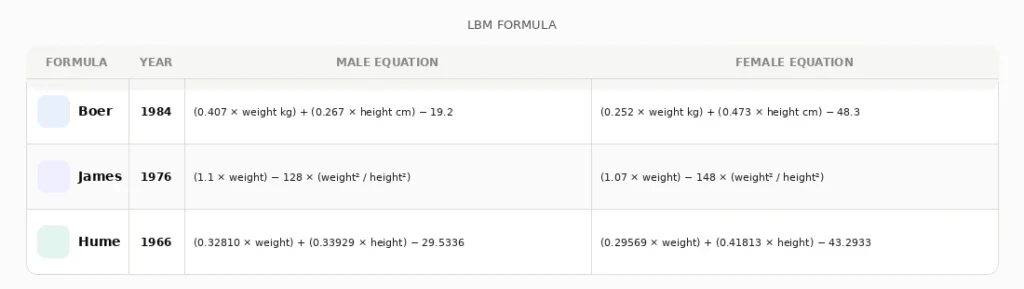
Weight goes in kilograms. Height goes in centimeters. Mix up the units and your result will be wrong by a wide margin, so the calculator above handles the conversion for you automatically.
Boer’s formula (published in the American Journal of Physiology) was originally built to normalize body fluid volumes in medical patients, and it remains the default formula in most modern LBM calculators, including this one.
James’ formula came out of a 1976 obesity research report for the UK’s Department of Health and Social Security. It tends to run lower for heavier individuals.
Hume’s formula is the oldest of the three, published in the Journal of Clinical Pathology in 1966, and it laid the groundwork for the LBM-based drug-dosing approach still used in anesthesiology today.
None of these formulas is “the most accurate” in every case. A 2017 study in the British Journal of Nutrition (Lee et al.), built on NHANES data from over 14,000 US adults, found that simple equations using age, height, weight, and waist circumference explained 91% of the variation in DEXA-measured lean body mass in men and 85% in women. Adding more anthropometric measurements only pushed accuracy up by a small margin beyond that.
In plain terms, a basic formula gets you most of the way there. The remaining gap requires lab equipment most people will never use.
How to Measure Lean Body Mass
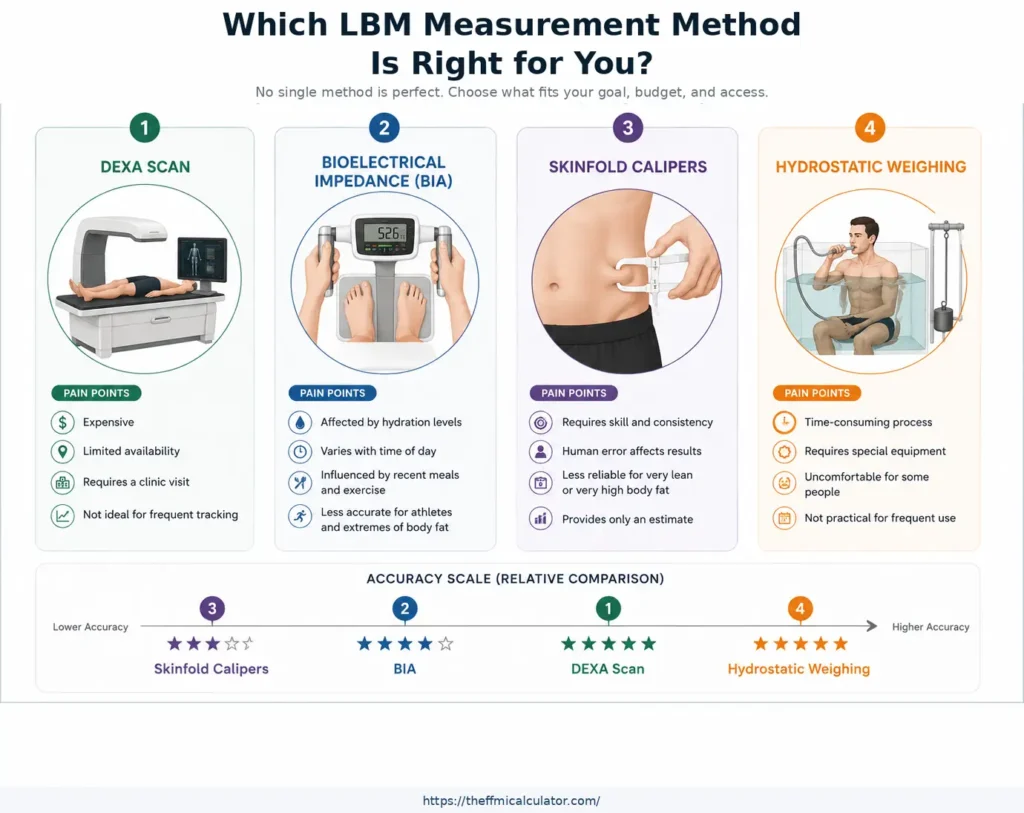
You have four real options, ranked from least to most accurate.
1. Formula calculators (Boer, James, Hume) Free, instant, and accurate within a few percent for most healthy adults. This is what the calculator on this page uses.
2. Bioelectrical Impedance Analysis (BIA) Sends a small electrical current through your body and measures resistance. Available in smart scales and handheld devices. Accuracy swings based on hydration, time of day, and even what you ate that morning.
3. Skinfold calipers A trained person pinches your skin at multiple sites and estimates body fat, then backs into LBM. Cheap, but highly dependent on the skill of the person doing it.
4. DEXA scan (Dual-Energy X-ray Absorptiometry) The clinical gold standard. A full-body scan separates your mass into fat, lean tissue, and bone mineral content with a precision within about 1%. Pricing varies widely, roughly $40 to $250 per scan in the US depending on the provider, and it is not usually covered by insurance for fitness purposes.
If you only need to track progress over months, a formula or BIA scale is fine, as long as you use the same method every time. Switching methods mid-tracking is the single biggest reason people think they “lost muscle” when they actually just switched measurement tools.
Lean Body Mass vs Muscle Mass
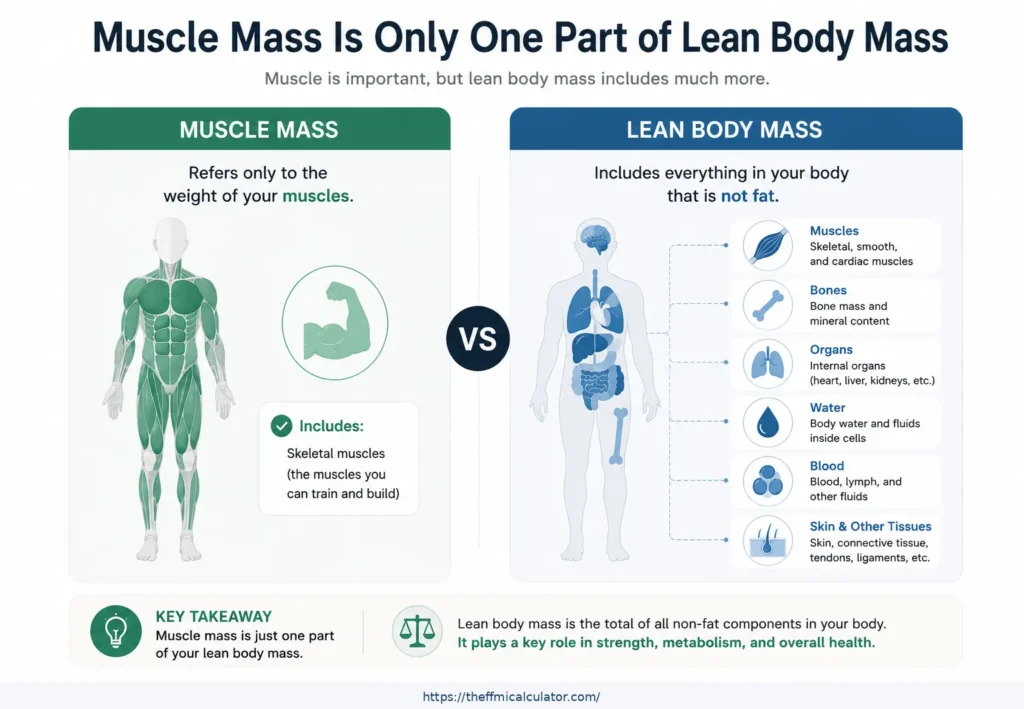
Lean body mass and muscle mass are not the same thing, even though people use the terms interchangeably. The lean body mass definition is broader than most people assume. It is not just “muscle.” Lean body mass includes:
- Skeletal muscle
- Organs (heart, liver, kidneys, brain)
- Bones
- Blood and body water
- Connective tissue and skin
Muscle mass is just one slice of that pie. Skeletal muscle typically makes up 30% to 40% of total body weight in adults, according to NHANES-based DXA research. The rest of your lean body mass is organs, bone, and water.
So when your LBM goes up, it does not automatically mean you built muscle. You could be carrying more water, or your organs adapted to a higher training load. This is why bodybuilders track skeletal muscle mass specifically when cutting weight, rather than relying on LBM alone.
Lean Body Mass vs Total Body Weight
Total body weight is LBM plus fat mass, nothing more. It is the only number a standard bathroom scale gives you, and on its own it tells you almost nothing about body composition.
Two examples make this clear. A bodybuilder and a sedentary person can weigh the same 200 lb and have LBM figures 40 or 50 lb apart. Total body weight also swings daily with water weight and food intake in ways LBM does not, which is exactly why relying on the scale alone is such an unreliable way to track fitness progress.
Lean Body Mass vs Skeletal Muscle Mass
This distinction trips up almost everyone who first encounters body composition data.
Skeletal muscle mass is the muscle tissue attached to your bones that you control voluntarily (your biceps, quads, abs, and so on). Lean body mass is the much larger category that includes skeletal muscle plus everything else that is not fat.
Think of it this way: skeletal muscle mass is a subset of lean body mass, never the other way around.
A high-end DEXA scan or InBody machine will give you both numbers separately. If you only have a basic formula like Boer or James, you are getting total LBM, not the muscle-specific breakdown. That is a real limitation, and any article that tells you otherwise is overselling a simple formula.
Lean Body Mass vs Fat-Free Mass
Lean body mass and fat-free mass (FFM) are almost the same thing, but not exactly.
The difference comes down to essential fat. Your body needs a small amount of fat to function, packed into cell membranes, bone marrow, and nerve tissue. That essential fat is counted inside lean body mass but excluded from fat-free mass.
The practical gap is small: about 2% to 3% in men and 5% to 12% in women, since women carry more essential fat for hormonal and reproductive function.
For almost every real world purpose, including fitness tracking and the calculator on this page, you can treat LBM and FFM as interchangeable. Researchers and clinicians make the distinction. Everyone else does not need to.
Lean Body Mass for Women
Women’s lean body mass calculations follow a separate equation in all three major formulas, and that is not an oversight. Women naturally carry 6% to 11% more essential body fat than men due to estrogen’s role in reproductive function, breast tissue, and hip and thigh fat storage.
This means a woman and a man at the same height and weight will produce different LBM results, even using the same formula. The female equations in Boer, James, and Hume all account for this by using different coefficients.
A healthy LBM for women generally sits above 68% of total body weight, according to genetic and body composition research compiled by Genomelink. Compare that to men, where the healthy threshold sits closer to 75%.
This is not a flaw in women’s bodies. It is biology working as designed, and any calculator or article that applies the same standard to both genders is giving you a less accurate number.
Healthy Lean Body Mass Percentage
There is no single magic percentage. But the published ranges are consistent across multiple sources.
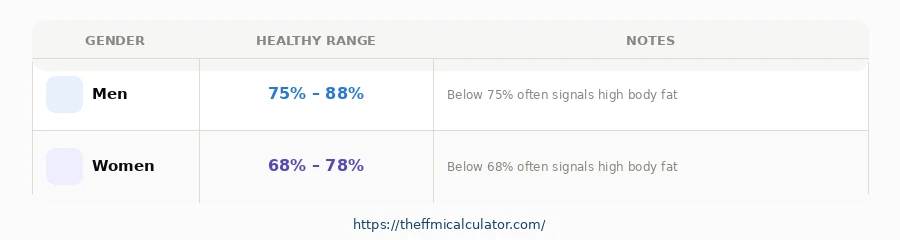
Sharecare’s clinical guidance puts it simply: men should aim for less than 25% fat mass, and women for less than 30%. Flip those numbers around and you get the lean mass percentage you are targeting.
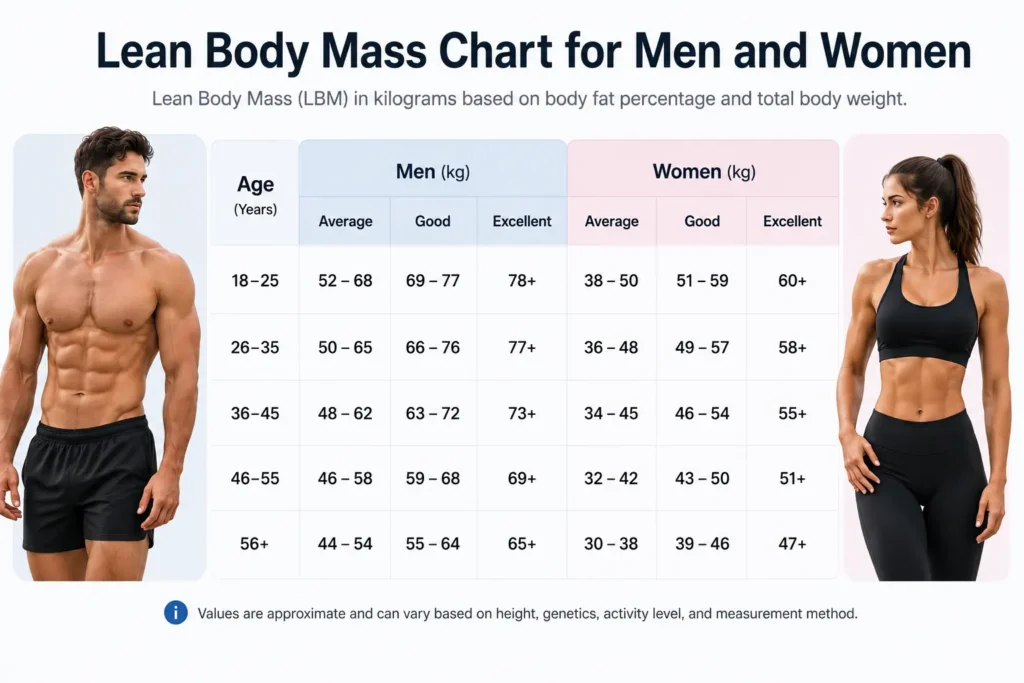
Athletes and bodybuilders often sit above these ranges during competition prep, since stage-lean conditions push body fat far below the healthy range temporarily. That is not “healthier,” just leaner for a specific, temporary goal. Going much below 5% body fat in men or 12% to 14% in women starts causing hormonal problems, not gains, according to clinical body composition guidance.
Lean Body Mass Average and Normal Range
Across the general adult population, lean body mass typically falls between 60% and 90% of total body weight, with men sitting toward the higher end and women toward the lower end of that range.
That is a wide range on purpose. Age, training history, genetics, and even ethnicity shift the number. A 2021 study in the Journal of Cachexia, Sarcopenia and Muscle (Kirk et al.), the Australian Body Composition Study, used DEXA scans on community-dwelling adults and found that lean mass percentiles stay fairly stable until around age 50, then start declining measurably.
Specifically, that study found median appendicular lean mass dropped by 3.7 kg in men and 1.8 kg in women between age 50 and age 70. That decline is not optional. It happens to almost everyone who does not actively train against it.
Lean Body Mass Chart
Here is a simplified reference chart based on the percentage ranges covered above. Multiply your body weight by the percentage to estimate where you fall.
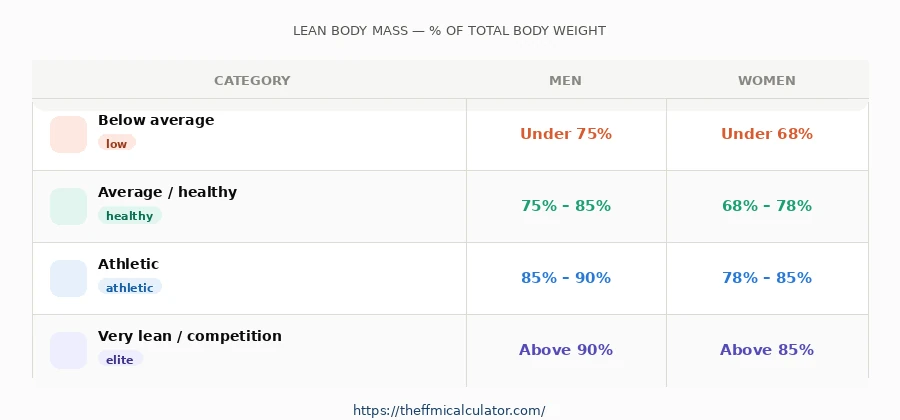
Example: a 180 lb man at the “athletic” range (85% to 90%) carries roughly 153 to 162 lbs of lean mass, leaving 18 to 27 lbs of fat. That matches almost exactly what our calculator returns for a 180 lb male user at 15% body fat, which is why these percentage ranges are useful as a sanity check against your formula based result.
Ideal Lean Body Mass
Here is where most articles oversell certainty: there is no single “ideal” lean body mass number, and any source that gives you one exact figure is guessing.
Ideal LBM depends entirely on your goal:
- General health: sit within the healthy percentage range for your gender (75%+ for men, 68%+ for women).
- Athletic performance: higher LBM with adequate strength-to-weight ratio matters more than the raw number.
- Bodybuilding competition: maximum LBM at minimum body fat, a temporary and often unsustainable state.
- Healthy aging: preserving existing LBM matters more than chasing a higher number, since the goal shifts from building to defending against sarcopenia.
A 25 year old male competitive lifter and a 60 year old male trying to stay independent both have a different “ideal” LBM, even at the identical height and weight. Chasing someone else’s number, especially one from a fitness influencer, is the wrong target.
Is there a maximum lean body mass?
Yes, and this is where a lot of natural lifters get misled. Researcher Casey Butt analyzed roughly 300 natural bodybuilding champions from 1947 to 2010 and built a formula that predicts maximum natural muscular potential from wrist and ankle circumference, since bone structure caps how much muscle you can carry.
His research, along with a separate 1995 study by Kouri et al. on pre-steroid and modern bodybuilders, points to a Fat-Free Mass Index (FFMI) ceiling of around 25 for men at single-digit body fat, natural genetic outliers aside. FFMI is simply lean body mass adjusted for height, so this caps how much LBM you can realistically build without enhancement, not just how lean you can get.
Most natural lifters reach 80% to 90% of that ceiling after four to eight years of consistent training, not months. If a “maximum LBM calculator” tells you that you can add 30 lbs of muscle in a year, that calculator is selling you a fantasy, not a realistic target. Use our FFMI calculator article to check where you stand against this ceiling.
How to Increase Lean Body Mass
Three things move this number. Nothing else matters nearly as much.
1. Progressive resistance training You need a training stimulus that forces your muscles to adapt. Two to four sessions a week of compound lifts (squats, deadlifts, presses, rows) outperforms any supplement on the market.
2. Sufficient protein intake The International Society of Sports Nutrition’s position stand recommends 1.4 to 2.0 grams of protein per kilogram of body weight per day for building and maintaining lean mass. A widely cited meta-analysis (Morton et al.) found the benefit of additional protein plateaus around 1.6 g/kg for most lifters, though some researchers place the upper useful limit closer to 2.2 to 2.35 g/kg.
3. A caloric surplus, or at least caloric balance You cannot build meaningful lean tissue in a steep calorie deficit. Mild surpluses of 200 to 300 calories above maintenance, paired with training, support lean mass gain without excessive fat gain.
Be realistic about the pace. Natural lean mass gains run slow. Most well-designed resistance training studies in healthy adults show gains in the range of a few hundred grams to low single-digit kilograms of lean mass over 8 to 12 weeks, not the dramatic transformations shown in before and after marketing photos. Anyone promising 10 kg of muscle in 12 weeks without other substances involved is not being honest with you.
Sleep and recovery matter too, though they get less attention than training and diet. Poor sleep raises cortisol and directly interferes with muscle protein synthesis, which blunts gains even when training and nutrition are dialed in.
FAQs
What is the lean body mass meaning?
Lean body mass (LBM) is the total weight of everything in your body except fat. It includes muscles, bones, organs, blood, skin, and body water. In simple terms, lean body mass equals your total body weight minus your body fat weight.
For example, if you weigh 70 kg and have 14 kg of body fat, your lean body mass is 56 kg. Doctors also use lean body mass to help estimate drug dosages because some medications are distributed differently in lean tissue than in fat tissue.
Does lean body mass include water?
Yes. Body water, which makes up roughly 50% to 65% of total body weight in adults, is counted as part of lean body mass. Only fat tissue is excluded.
Is lean body mass the same as muscle mass?
No. Lean body mass includes muscle plus organs, bones, and water. Skeletal muscle typically makes up only 30% to 40% of total body weight, even in lean adults.
How do I calculate my lean body mass?
Use a validated formula like Boer, James, or Hume, entering your weight, height, and gender. The calculator at the top of this page runs all three formulas automatically and converts units for you.
What is a healthy lean body mass percentage?
Generally 75% or higher for men and 68% or higher for women, based on body composition research from Genomelink and clinical guidance from Sharecare.
How accurate are lean body mass calculators?
Research published in PMC found that simple height, weight, and age-based formulas explain over 90% of the variation seen on DEXA scans, the clinical gold standard. They are accurate enough for tracking trends, though not a substitute for a clinical scan.
Can I lose lean body mass while dieting?
Yes, especially in a steep calorie deficit without resistance training or adequate protein. Studies show 1.2 to 1.6 g/kg of protein during weight loss helps preserve lean mass that would otherwise be lost alongside fat.
Why do men and women use different lean body mass formulas?
Women naturally carry 6% to 11% more essential body fat than men due to hormonal and reproductive needs. Every major LBM formula uses separate coefficients for men and women to account for this physiological difference.
Can you increase lean body mass while losing fat?
Yes, this is sometimes called body recomposition, and it is most achievable for beginners, people returning to training after time off, or anyone carrying a higher starting body fat percentage. It happens through a modest calorie deficit or maintenance intake combined with resistance training and high protein intake, though the rate of muscle gain slows considerably for advanced lifters already close to their genetic potential.
The Bottom Line
Three formulas. One calculator. Zero guesswork. That is what this page gives you. Boer, James, and Hume will each hand you a slightly different number, and now you know why, instead of panicking the next time two calculators disagree.
The percentage matters more than the raw kilograms. A 56 kg lean mass result means nothing on its own. It means something the moment you compare it against the 75% to 88% range for men or 68% to 78% range for women, and watch where it sits over the next six months. Run your numbers through the calculator above. Track the trend, not the single number. A number without context is just a number. Now you have the context.