

Maximum Natural FFMI Limit | Is FFMI 25 Natty or Juicy?
The fitness internet treats FFMI 25 like a brick wall. Cross it and you are automatically on steroids. Stay under it and you are clean. Simple, right?
Wrong. And the proof comes from the same 1995 study that created the “rule” in the first place.
Read our full muscle building timeline guide.
Key Takeaways
- The Kouri et al. 1995 study found no natural lifter in their sample exceeded FFMI 25 — but the researchers themselves called it a “preliminary” finding, not a biological absolute
- Pre-steroid era Mr. America winners from 1939 to 1959 averaged a normalized FFMI of 25.4 naturally
- FFMI 25 is a probability threshold, not a biological ceiling. Above 25, steroid use becomes likely. It does not become certain.
- Half of confirmed steroid users in the Kouri study scored below FFMI 25 — meaning a low FFMI does not prove someone is natural either
- The real red flag is not FFMI above 25 alone. It is FFMI above 25 combined with very low body fat, year-round conditioning, and rapid lean mass gains
Where Did the FFMI 25 Rule Come From?
The FFMI 25 threshold traces back to a single study. Kouri EM, Pope HG Jr, Katz DL, and Oliva P published their research in the Clinical Journal of Sport Medicine in 1995 under the title “Fat-free mass index in users and nonusers of anabolic-androgenic steroids.”
The study analyzed 157 male athletes 74 confirmed natural bodybuilders and 83 confirmed steroid users. The researchers calculated each athlete’s normalized Fat-Free Mass Index using height, weight, and body fat percentage. Their finding: none of the natural lifters in the sample exceeded a normalized FFMI of 25.
That single finding became the internet’s permanent shortcut. FFMI above 25 means steroids. FFMI below 25 means natural. End of discussion.
But here is the thing.
That is not what the researchers actually concluded. And the gap between what the study found and what the internet turned it into has misled lifters for 30 years.
What Did the Kouri Study Actually Say?
Read the original study carefully and you find something most fitness content never mentions.
The researchers described their findings as “preliminary.” They used the phrase “appears to be a reliable upper limit” not “is the biological ceiling” or “is impossible to exceed naturally.” The word “appears” and the qualifier “preliminary” were deliberate. The researchers understood they were working with a limited sample and a specific population at a specific time.
Here is what the data actually showed:
74 natural bodybuilders: normalized FFMI ranged from 16.6 to 25.0. Average was 21.8. 83 steroid users: many exceeded 25, some reaching 30 or higher. Average was 24.8.
Now here is the part that kills the simple narrative.
Almost half of the confirmed steroid users in the study scored below FFMI 25. That means having an FFMI under 25 does not prove someone is natural. And the researchers acknowledged this explicitly.
The study established statistical probability, not biological impossibility. FFMI above 25 makes steroid use more likely. It does not make it certain. These are fundamentally different claims, and the internet has been conflating them for three decades.
Can You Naturally Exceed FFMI 25?
The honest answer is yes and the evidence comes from history.
The Kouri study itself analyzed pre-steroid era Mr. America winners from 1939 to 1959. These men competed before anabolic-androgenic steroids were commercially available to athletes. They had no access to the performance-enhancing drugs that define modern bodybuilding. Their results:
Average normalized FFMI: 25.4
John Grimek, who won Mr. America in 1940 and 1941 and Mr. Universe in 1948, has an estimated normalized FFMI of approximately 24.0 in 1940 and 26.9 in 1941 based on Tom Venuto’s analysis of his documented competition stats. These numbers are based on visual body fat estimates, which carry uncertainty, but they confirm Grimek was operating near or above the 25 threshold naturally.
“The 25 limit is always normalized FFMI, not raw. Our FFMI vs Normalized FFMI guide explains exactly why this matters.”
Steve Reeves, the gold standard for pre drug natural physiques, hit approximately FFMI 23 at his 1947 Mr. America competition based on Tom Venuto’s verified data. Some later competition estimates push this to 25.6, depending on which stats and body fat estimates are used. The range reflects genuine uncertainty in historical body fat measurement.
Trexler et al. (2017) found that 62 of 235 collegiate football players had height-adjusted FFMI values above 25, with a 97.5th percentile of 28.1 kg/m² and a maximum observed value of 31.7 kg/m². The authors concluded that the previously proposed 25 kg/m² limit may underestimate the upper range in this specific athletic population.
Wait, it gets better.
Dr. Mike Israetel of RP Strength, who holds a PhD in Sport Physiology and has worked with elite natural athletes, made this point directly: natural muscle potential exists on a bell curve, and genetic outliers can and do naturally exceed FFMI 25. The issue is not whether it is possible. The issue is how rare it is.
His estimate: exceeding FFMI 25 naturally puts you in the top fraction of one percent of the human population for muscle-building genetics. Possible. Genuinely rare. Not impossible.
What Is the Real Natural FFMI Limit?
Here is where intellectual honesty matters more than a clean answer.
There is no single hard number. There is a range that reflects natural limits for most people, with genetic outliers extending slightly beyond it.
For men, the evidence supports this framework:
FFMI 22 to 23: achievable for dedicated natural lifters after 3 to 7 years of optimal training. This is where most serious natural athletes land.
FFMI 23 to 24: elite natural range. Requires exceptional genetics and 7 or more years of optimized training and nutrition. Modern drug-tested natural bodybuilding champions compete in this range.
FFMI 24 to 25: approaching the natural ceiling for almost everyone. Represents the top fraction of natural lifters.
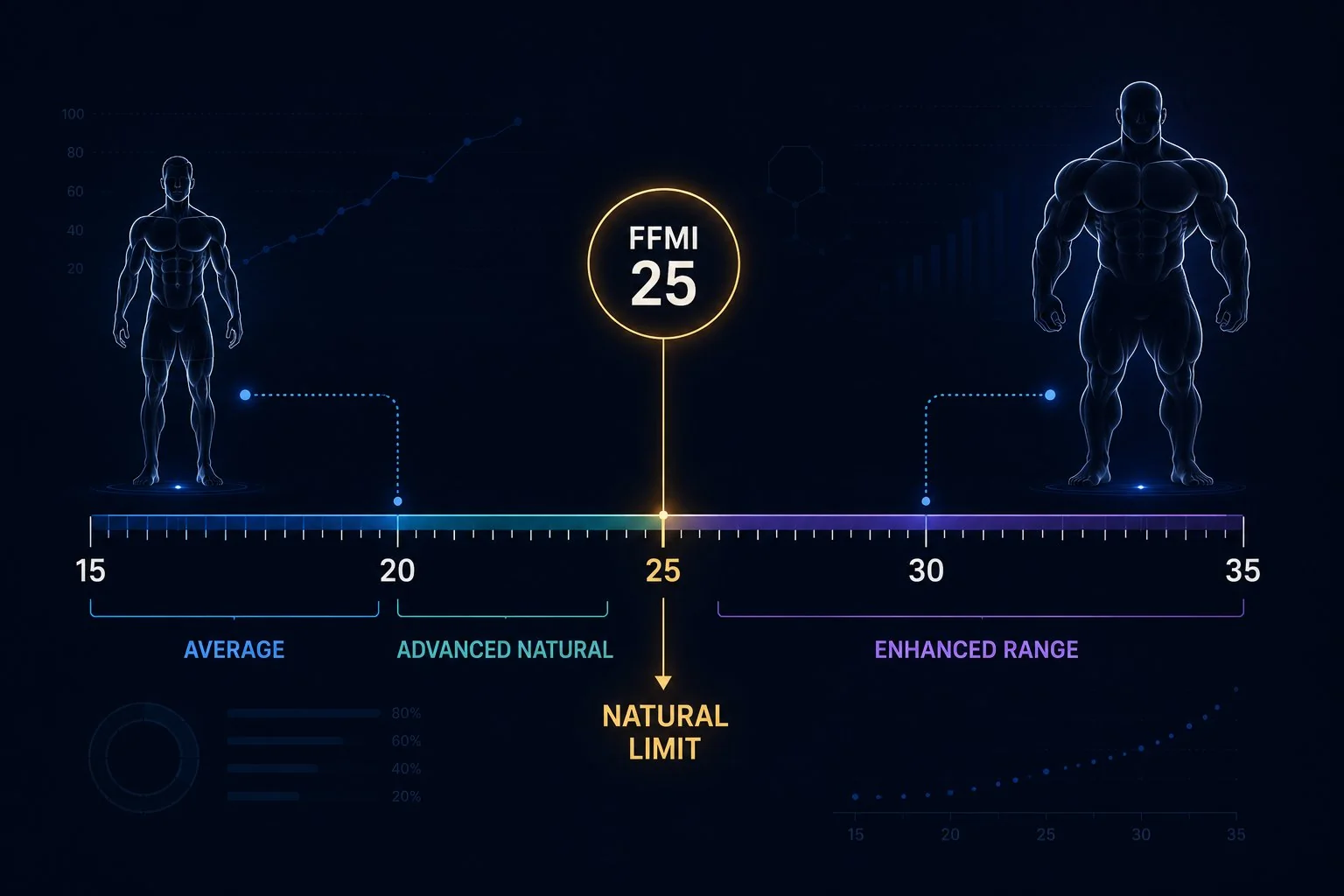
FFMI above 25: genuine genetic outliers can reach this naturally. It is rare enough that above 25 justifies serious scrutiny, but it does not justify a definitive accusation.
For women, the evidence is less clear. Chappell et al. (2018) reported a mean estimated FFMI of 18.1 ± 1.95 kg/m² among female competitors in their sample, but the study did not establish a female natural FFMI ceiling. The authors noted that no female upper threshold had been proposed and suggested 19-20 kg/m² as a reasonable objective starting point, based on available population estimates. These figures should be treated as reference points rather than a hard natural limit.
Why FFMI 25 Is a Red Flag, Not a Verdict
I have seen this debate play out on Reddit, YouTube comments, and fitness forums for years. And the same mistake repeats constantly.
People treat FFMI as a binary lie detector. Above 25 equals juiced. Below 25 equals natty. That framing ignores how statistics actually work.
FFMI is a probabilistic screening tool. When the Kouri study found no natural lifter above 25 in their sample of 74 people, that established a strong statistical signal. It did not establish a biological absolute. A sample of 74 people cannot define the upper limit of human natural potential.
Here is the correct way to think about it:
FFMI 22 to 24 at low body fat: consistent with elite natural development. Impressive but not suspicious.
FFMI above 25: statistically unusual for a natural lifter. Warrants scrutiny. Does not prove steroid use.
FFMI above 27 to 28: increasingly difficult to explain naturally even with exceptional genetics. Probability of PED use rises significantly.
FFMI above 30: virtually impossible naturally at any body fat level. This is where probability becomes near certainty.
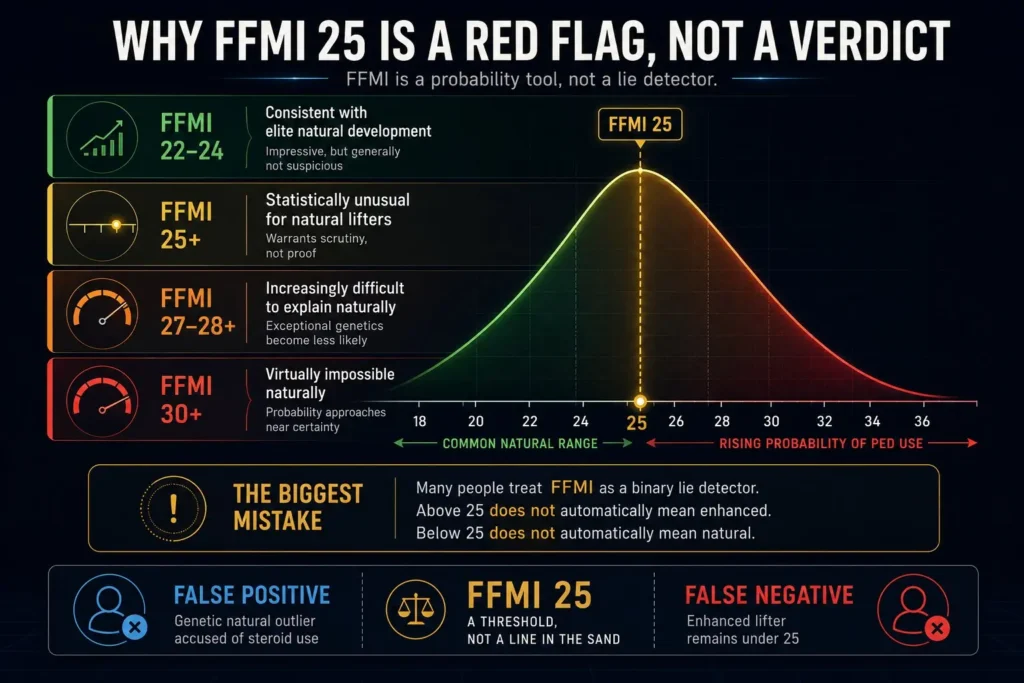
The problem with the flat “25 ceiling” is that it simultaneously over accuses genetic outliers who are legitimately natural and under-suspects enhanced lifters who stay just under 25 through careful drug cycling. Both errors happen constantly in online natty or not debates.
Why Genetics Change Everything
Genetics are the most ignored part of the FFMI conversation. People love pretending hard work beats everything. Hard work matters.
But genetics still set the ceiling.
Some people naturally have:
- broader clavicles
- better muscle insertions
- higher testosterone
- better insulin sensitivity
- faster recovery
- higher androgen receptor density
Those traits matter more than motivational quotes.
I trained with a guy years ago who barely tracked macros and still looked stage ready year round. Meanwhile another lifter trained harder, ate cleaner, and still struggled to stay lean.
That is reality.
Genetics do not decide whether you can improve. They decide how far your body can realistically go. That is why FFMI should be treated as a rough benchmark, not a universal law.
The Combination That Actually Exposes Steroid Use
FFMI alone is a weak diagnostic tool. The combination of factors tells a much more accurate story.
Here is what actually raises the probability of PED use to the point where reasonable people should take it seriously:
High FFMI combined with very low body fat. Maintaining FFMI 25 or above while staying below 8 to 10% body fat year-round is physiologically brutal for natural lifters. The hormonal cost of maintaining extreme leanness suppresses testosterone and growth hormone. Enhanced athletes can hold this combination because exogenous drugs replace what extreme leanness suppresses naturally.
Rate of lean mass gain. Natural lifters gaining 20 or more pounds of lean mass within a single off-season, especially after their first few years of training, cannot explain that gain through natural physiology. Advanced natural lifters gain 2 to 5 pounds of genuine muscle per year at best, based on Lyle McDonald’s model and Alan Aragon’s independently derived estimates.
Trap and shoulder disproportionality. The trapezius and deltoid muscles have the highest concentration of androgen receptors in the upper body. Steroid use produces disproportionate development in these areas. Someone with a normal-looking chest and arms but dramatically oversized traps and caps is showing one of the clearest visual indicators of androgen use.
Stage conditioning with excessive muscle mass. Coming in at FFMI 23 or 24 while maintaining 4 to 5% body fat for a competition requires hormonal support that most natural lifters simply cannot sustain without health consequences.
No single factor proves anything. The combination of several of these signals in one person is where the probability shifts substantially.
Famous Natural Athletes and Their FFMI Scores
These examples illustrate what verified natural development actually looks like at various levels.
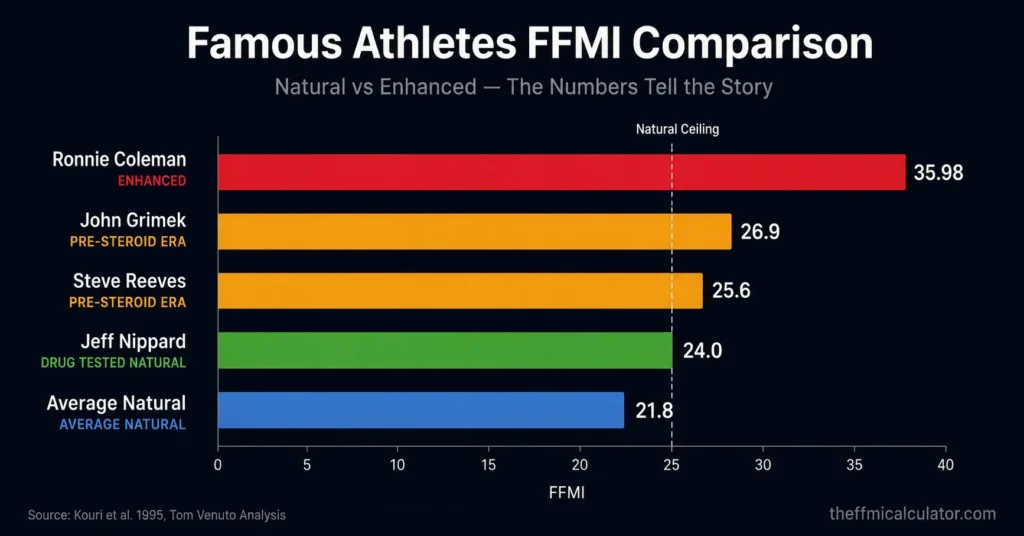
Jeff Nippard — FFMI approximately 24 Canadian natural bodybuilder, WNBF drug-tested competitor, and widely followed evidence-based fitness educator. Both his parents competed in bodybuilding, giving him genuinely elite genetics. Professionally measured body composition confirms his FFMI sits around 24. This is what the upper end of verified natural development looks like.
Steve Reeves — FFMI approximately 23 (1947) to 25.6 (later competitions) Competed from the mid-1940s through the 1950s before anabolic steroids were widely available to athletes. Tom Venuto’s analysis of his 1947 Mr. America stats places his FFMI at 23. Later competition estimates reach 25.6, cited by Kouri et al. in their original study. The variation reflects different competition weights and visual body fat estimates — not measurement precision. He remains the historical benchmark for pre-drug natural physiques.
John Grimek — FFMI 24.0 (1940) to 26.9 (1941) Won Mr. America 1940 and 1941 and Mr. Universe 1948. Competed entirely in the pre-steroid era. Tom Venuto’s analysis of his documented competition stats places his 1941 FFMI at 26.9 — above the Kouri threshold. These estimates carry uncertainty due to visual body fat assessment, but confirm Grimek operated near the natural ceiling with exceptional genetics. Some researchers estimate his FFMI even higher, though those numbers are disputed.
Ronnie Coleman — FFMI approximately 35.98 Eight time Mr. Olympia champion. His FFMI at competitive peak sits nearly 11 points above the natural ceiling. Coleman has discussed his preparation history publicly. His physique represents what is achievable with elite genetics combined with maximum pharmaceutical support.
The gap between Grimek at FFMI 26.9 and Coleman at FFMI 35.98 is not explained by better training or superior nutrition. It is explained by chemistry.
Want verified FFMI scores for more bodybuilders? Our complete Famous Bodybuilders FFMI Score list covers every major name with sources.
Is FFMI 26 Possible Naturally?
Possible? Yes, probable? No. A genuine FFMI 26 naturally at low body fat would likely require:
- elite genetics
- exceptional frame structure
- near perfect training consistency
- years of intelligent hypertrophy work
And even then, it would be extremely uncommon. Most “natural FFMI 26” claims online fall apart once:
- body fat gets measured correctly
- height gets verified
- drug testing enters the conversation
This is why many experienced coaches treat FFMI 25 as a practical ceiling rather than an absolute law. There will always be outliers. But outliers are not the standard.
Final Verdict: Is FFMI 25 Natty or Juicy?
FFMI 25 is not a magical steroid detector. It is a rough statistical benchmark. That is it. Most natural lifters will never reach a lean FFMI 25. Some genetically elite people absolutely can. But once physiques move far beyond that range, steroid probability rises dramatically.
And honestly?
That is probably the healthiest way to view FFMI. Use it as:
- a realistic muscle building benchmark
- a tool for setting expectations
- a way to understand natural muscle potential
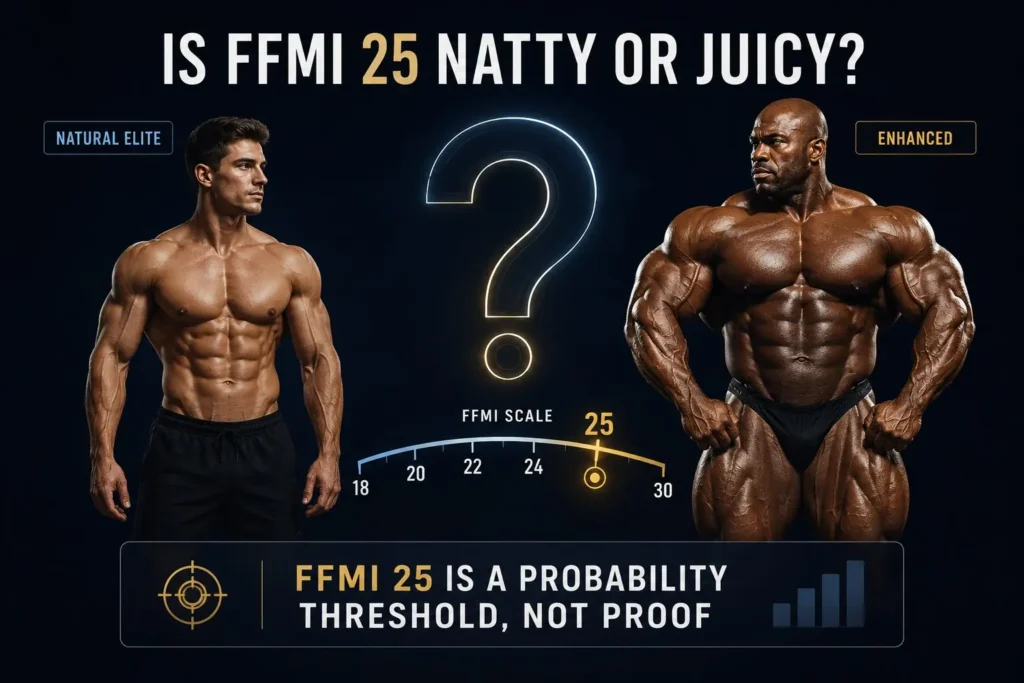
Do not use it as internet courtroom evidence. Because the moment people start treating one number like absolute truth, nuance disappears. And bodybuilding has enough fake certainty already.
FAQ
Is FFMI 25 the absolute natural limit?
No. The Kouri et al. 1995 study found no natural lifter in their sample exceeded 25, but the researchers called this finding “preliminary” and used the phrase “appears to be” rather than claiming biological impossibility. Pre-steroid era competitors like John Grimek and Steve Reeves likely exceeded 25 naturally. FFMI 25 is a strong probability threshold, not an absolute ceiling.
Can someone have an FFMI over 25 and still be natural?
Yes, but it is rare. Genetic outliers with exceptional muscle building capacity, high natural testosterone, and favorable androgen receptor density can reach FFMI 25 to 26 naturally. A 2017 study of NCAA collegiate athletes found drug-tested individuals exceeding 25 FFMI. The higher above 25 the score goes, the less likely a natural explanation becomes.
Does a low FFMI prove someone is natural?
No. The Kouri 1995 study found that approximately half of confirmed steroid users scored below FFMI 25. Enhanced athletes at the beginning of their PED use, on conservative protocols, or in off-season at higher body fat can easily maintain FFMI below 25. FFMI is a probability tool in both directions.
What FFMI is suspicious for steroid use?
Consistently maintaining FFMI above 25 at body fat below 10% for men, or above 22 at body fat below 16% for women, raises serious questions. Above FFMI 27 to 28, natural explanations become very difficult to defend. Above FFMI 30, natural status is essentially impossible based on all available physiological research.
What was the average FFMI of pre-steroid era bodybuilders?
The Kouri study analyzed Mr. America winners from 1939 to 1959 and found an average normalized FFMI of 25.4. This data point is often misused to argue that the natural ceiling must be above 25, but it represents elite genetic outliers who won national competitions, not the average natural lifter.
Is the FFMI 25 rule outdated?
Partially. The 1995 threshold remains a useful screening guideline, but more recent research on drug-tested collegiate athletes suggests the limit may be slightly conservative for some populations. The consensus among sports scientists is that FFMI 25 remains a reliable red flag, while acknowledging that rare genetic outliers can exceed it naturally.
How accurate is FFMI as a natty or not detector?
Moderately accurate as a screening tool, not reliable as a definitive verdict. The original study showed that FFMI above 25 was associated with steroid use in their sample, but half of steroid users were below 25. Combining FFMI with rate of muscle gain, body fat percentage, physical indicators like trap development, and drug test history produces a much more accurate assessment than FFMI alone.
Is FFMI 26 naturally possible?
Technically yes, but extremely uncommon. Most natural FFMI 26 claims online involve inaccurate body fat estimates or questionable natty status.
Does lowering body fat increase FFMI?
Not directly. Lowering body fat can improve muscle definition, but FFMI depends mainly on lean body mass relative to height.
FFMI 25 is one of the most useful and most misused numbers in fitness. It is a signal, not a sentence. Use it as one piece of evidence, not a verdict.
The only thing worse than ignoring FFMI entirely is treating it as the final word.
References
- Kouri EM, Pope HG Jr, Katz DL, Oliva P. Fat-free mass index in users and nonusers of anabolic-androgenic steroids. Clinical Journal of Sport Medicine. 1995;5(4):223-228.
- Trexler ET, Smith-Ryan AE, Mann JB, et al. Fat-free mass index in NCAA Division I and II collegiate American football players. Journal of Strength and Conditioning Research. 2017;31(10):2719-2727.
- Chappell AJ, Simper T, Barker ME. Nutritional strategies of high level natural bodybuilders during competition preparation. Journal of the International Society of Sports Nutrition. 2018;15:4.
- Jagim AR, Harty PS, Jones MT, et al. Fat-free mass index in sport: normative profiles and applications for collegiate athletes. Journal of Strength and Conditioning Research. 2024.
- Schutz Y, Kyle UG, Pichard C. Fat-free mass index and fat mass index percentiles in Caucasians aged 18 to 98 years. International Journal of Obesity. 2002;26:953-960.
- Bhasin S, Storer TW, Berman N, et al. The effects of supraphysiologic doses of testosterone on muscle size and strength in normal men. New England Journal of Medicine. 1996;335(1):1-7.
- Venuto T. What Is Your Maximum Muscle Building Potential? Fat-Free Mass Index Analysis of Pre-Steroid Era Mr. America Winners. Burn the Fat Inner Circle. Updated 2018. Available at: https://www.burnthefatinnercircle.com/public/Your-Maximum-Muscle-Building-Potential-2.cfm
- Helms ER, Aragon AA, Fitschen PJ. Evidence-based recommendations for natural bodybuilding contest preparation. Journal of the International Society of Sports Nutrition. 2014;11:20.
- Currier BS, Harty PS, Moon JM, et al. Fat-free mass index in a diverse sample of male collegiate athletes. International Journal of Exercise Science and Applied Research. 2019;11(6).


