FFMI vs Lean Body Mass | What Is the Difference?
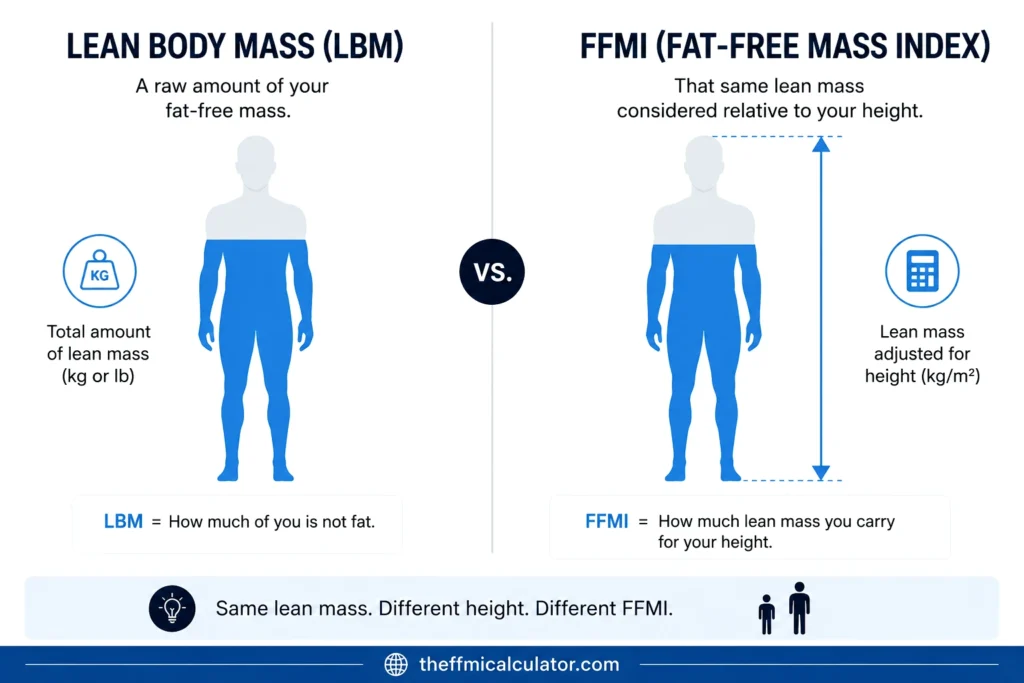
Lean body mass (LBM) is a raw number: how many kilograms or pounds of you are not fat. FFMI takes that same number and divides it by your height squared, turning it into a score you can compare against other people regardless of how tall they are. That is the basic difference in one sentence. Everything else in this guide is about why that difference actually matters, and where most people get the math wrong.
Key Takeaways
- LBM is a weight measurement, FFMI is a height-adjusted score built from that weight
- FFMI = LBM in kg divided by height in meters squared
- A 2024 review in Advances in Nutrition concluded LBM and fat-free mass (FFM) are chemically the same component, despite decades of separate use
- The famous “natural FFMI limit of 25” comes from a 1995 study of 157 athletes, not a universal law
- Comparing a raw LBM number to a normalized FFMI score, without adjusting for height, is the most common mistake people make
What Is Lean Body Mass?
Lean body mass is your total body weight minus your fat mass. Muscle, bone, organs, blood, and water all count. Fat does not. Body composition science calls this the two-component model, and it is the simplest possible way to break down a body:
Body weight = Fat mass + Fat-free mass
If you weigh 180 lb at 20 percent body fat, your fat mass is 36 lb, which leaves an LBM of 144 lb. That number on its own tells you how much of you is not fat, but it says nothing about whether that is a lot or a little for someone your height. From here, the same LBM number feeds directly into FFMI once height enters the picture, which is the whole subject of this guide. For the full breakdown of how LBM is calculated and measured, see our complete Lean Body Mass guide.
What Is FFMI?
FFMI, fat-free mass index, takes your lean body mass and divides it by your height in meters squared. It works the same basic way BMI works for total body weight, except FFMI only looks at the fat-free part of you. BMI itself dates back to the 1830s, when Belgian mathematician Adolphe Quetelet built the original formula, weight divided by height squared, decades before anyone thought to apply that same height-adjustment logic specifically to fat-free mass.
Where LBM answers “how much of you is not fat,” FFMI answers “how muscular are you for your height.” A 5-foot-4 lifter and a 6-foot-4 lifter can carry the same LBM in pounds and still have very different FFMI scores, because the taller person is spreading that mass over a much bigger frame.
FFMI vs Lean Body Mass: The Core Difference
| Lean Body Mass | FFMI | |
|---|---|---|
| What it measures | Total fat-free weight | Fat-free weight relative to height |
| Unit | Kilograms or pounds | A single index number |
| Height factored in? | No | Yes |
| Best for | Tracking your own progress over time | Comparing muscularity across different people |
LBM is the raw material. FFMI is what you get when you standardize that raw material for height, the same way a company reports revenue per employee instead of just total revenue.
How FFMI Is Calculated
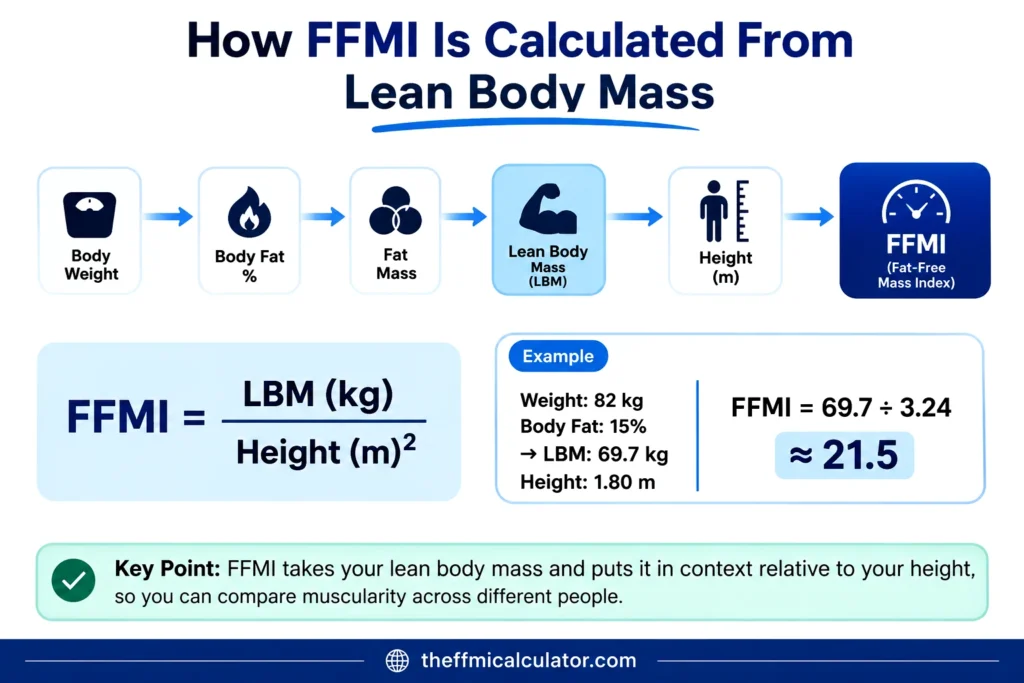
The base formula is simple: FFMI equals your lean body mass in kilograms, divided by your height in meters, squared.
FFMI = LBM (kg) / height (m)²
A person weighing 82 kg at 15 percent body fat has an LBM of 69.7 kg. At 1.80 m tall, that gives an FFMI of 69.7 divided by 3.24, or about 21.5.
Want to see your own numbers? Use our Fat Free Mass Index Calculator to calculate your FFMI, fat-free mass, and body fat mass.
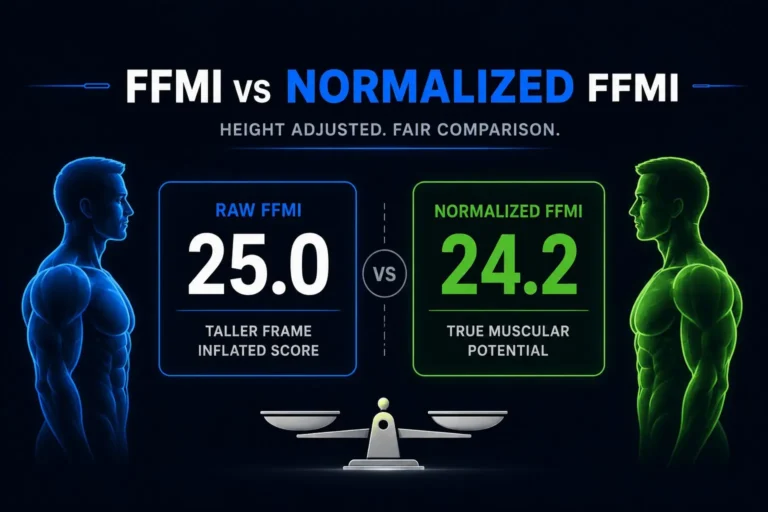
Height creates a real bias in this formula, though. Human bodies scale in three dimensions, but FFMI only divides by height squared, two dimensions. That systematically makes tall people look less muscular than they actually are, and short people look more muscular than they actually are. Researchers Kouri and colleagues corrected for this in a 1995 study by adding a height adjustment, creating what is now called normalized FFMI.
If you want to understand why height-adjusted FFMI can give a different result from raw FFMI, see our guide to FFMI vs Normalized FFMI.
Kouri’s original 1995 paper used a correction factor of 6.3. Most modern FFMI calculators, including the one this guide points to, use a slightly revised factor of 6.1, though the difference between the two is small enough to rarely matter in practice.
Normalized FFMI = FFMI + 6.1 × (1.8 − height in meters)
This adjusts everyone’s score to what it would theoretically be at exactly 1.8 meters, about 5 foot 11. Someone shorter than that gets a small boost. Someone taller gets a small reduction. At exactly 1.8 m, normalized FFMI and raw FFMI are identical.
One honest caveat worth knowing: this correction factor was calculated from a regression line built using non-steroid users with an FFMI of 22 or higher in Kouri’s original sample. It works well in that range. Applying it without question to every possible height and FFMI combination, including people far below that threshold, stretches the formula beyond what it was actually built to do.
Are LBM and FFM Actually the Same Thing?
For decades, textbooks treated lean body mass (LBM) and fat-free mass (FFM) as subtly different things. A 2024 review published in Advances in Nutrition, led by body composition researcher Steven Heymsfield, revisited this terminology and concluded that LBM and FFM are chemically equivalent.
The term LBM dates back to 1942, when US Navy physician Captain Albert Behnke used it to describe the body minus fat, while including a small amount of what he called essential fat, roughly 2 to 5 percent of LBM itself, tied up in bone marrow, nerve tissue, and cell membranes. FFM, by contrast, was defined as completely fat-free, based on how tissue was chemically extracted in lab studies.
Heymsfield’s team traced the actual lab methods used in the classic body composition studies from the 1940s and 1950s and found something that had gone unnoticed for 80 years. The solvents used to extract “fat” in those studies removed the same essential lipids Behnke described as part of LBM. In other words, the fat-free mass measured in those foundational studies already included Behnke’s essential fat. LBM and FFM had been chemically identical the entire time, just described with two different names.
The paper’s own conclusion is direct: FFM is now the chemically correct term, and LBM should be treated as a historical label rather than a distinct measurement. In practice, most calculators, including FFMI calculators, still use LBM and FFM interchangeably, and this guide does the same, since the underlying number is the same either way. One related term worth avoiding altogether is lean mass, since it gets used loosely to mean LBM, FFM, or muscle mass depending on who is writing, and that looseness is exactly what causes confusion between fat-free mass and muscle mass in the first place.
What Counts as Fat Free Mass?
Skeletal muscle usually makes up the largest share of fat-free mass in a healthy adult, but it is far from the only component, and treating the two as interchangeable is one of the most common mistakes on this whole topic.
Take someone weighing 80 kg at 15 percent body fat. That is 12 kg of fat mass and 68 kg of fat-free mass. But 68 kg of FFM does not mean 68 kg of muscle. That number still includes bone, organs, water, protein, blood, and connective tissue, muscle is only the largest slice of it, not the whole thing.
Bone mineral contributes a smaller but stable share, one that barely shifts unless someone experiences significant bone loss. Organs, including the heart, liver, and kidneys, sit near the top of the list per unit of weight, since they are dense and metabolically active. Total body water makes up the largest single share, close to 73 percent of fat-free mass based on the classic reference ratio used in body composition science, and it is also the component that swings the most day to day. Protein forms the structural backbone of muscle tissue and organs alike, and it is the raw material your body needs to repair and build any of the above. Blood and connective tissue round out the list, smaller contributors individually but still part of the total.
None of these components move independently. Lose water through dehydration and your fat-free mass drops overnight, even though you have not lost a gram of muscle. That single fact explains more FFMI confusion than almost anything else on this list.
How to Measure LBM and FFMI
Both numbers start from the same starting point: an accurate measurement of body fat percentage. From there, calculating LBM and FFMI is simple arithmetic, but getting a trustworthy body fat percentage in the first place is where methods diverge.
DXA scans, sometimes written DEXA, use low-dose X-rays to separate fat, bone, and lean tissue directly, with an error margin of roughly 0.5 to 2 percent. Hospitals and sports science labs treat it as the closest thing to a gold standard outside a full cadaver study. Bioelectrical impedance analysis, the kind built into home scales, sends a small current through the body and estimates composition from resistance, with a wider error margin, typically 4 to 10 percent, that shifts with hydration and recent meals. Body density methods, the underwater weighing approach that traces back to Behnke’s original 1942 work, calculate fat percentage from how much a person weighs on land versus submerged in water, using the fact that fat is less dense than lean tissue.
Whichever method you use to get body fat percentage, the LBM and FFMI math afterward does not change. A more accurate body fat number simply means a more accurate LBM and FFMI at the end.
The FFMI Natural Limit: What the Research Shows
The “FFMI 25” figure that gets repeated across fitness forums traces back to a specific 1995 study by Kouri, Pope, Katz, and Oliva, published in the Clinical Journal of Sport Medicine. The researchers measured 157 male athletes, 74 of them non-users of anabolic steroids and 83 confirmed users. Almost none of the natural athletes crossed a normalized FFMI of 25. Many of the steroid users, by comparison, easily exceeded that mark, with some surpassing 30.
For extra context, the same researchers estimated the FFMI of 20 Mr. America winners from the pre-steroid era, 1939 to 1959, and found a mean of 25.4, close to the modern natural sample’s ceiling.
That number deserves a dose of skepticism, though, and not because it is wrong. The 157 athletes in the study were self-selected competitive bodybuilders training seriously enough to compete, not a random sample of the general male population. A dedicated, genetically favored, drug-free lifter can and occasionally does land above 25, and researchers have documented cases since. Treat FFMI 25 as a strong reference point for what serious natural training can produce, not a hard biological ceiling stamped on every individual. Genetic potential varies enough between people that no single number, including this one, predicts what any specific lifter can achieve. Women, who carry roughly 10 to 20 times less natural testosterone, show a correspondingly lower natural ceiling, typically cited around 21 to 22.
A Real Example of Where the Confusion Comes From
A lifter on a training forum once laid out a scenario that captures this whole topic in one confused post, while chasing what he called his maximum drug-free muscular genetic potential. At 5 foot 8 (173 cm), he had read that his maximum natural LBM was 155 lb and his maximum natural FFMI was 25. Trying to hit both numbers at 9 percent body fat, he ran the math two different ways and got two different answers: one path capped him at 170 lb total bodyweight, the other at 180 lb.
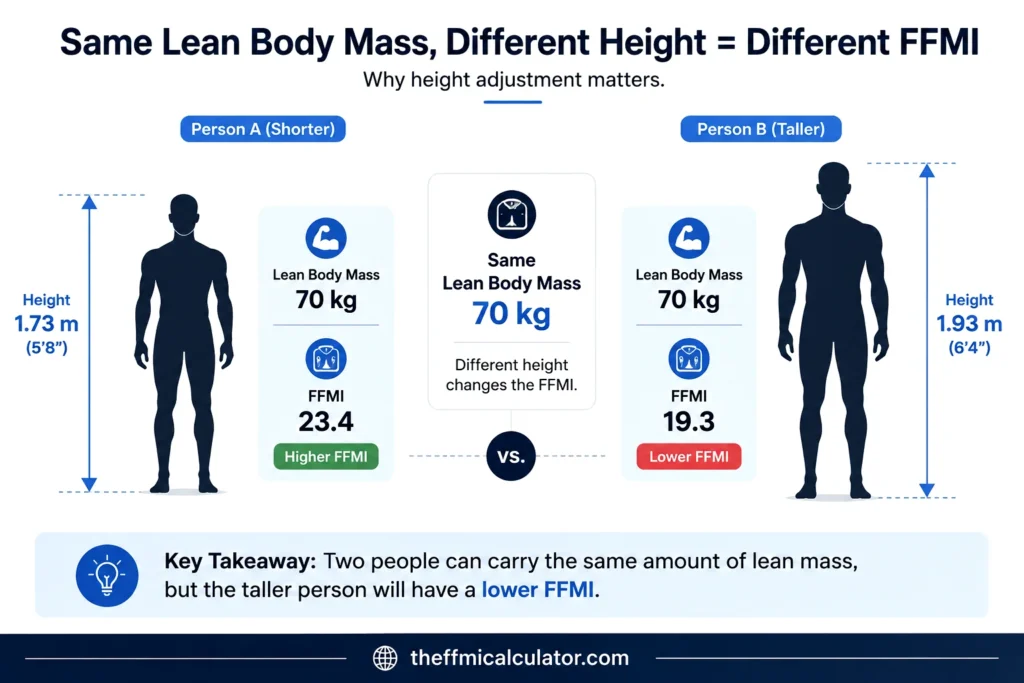
Running his numbers again here confirms exactly what went wrong. At 173 cm, an LBM of 155 lb, 70.3 kg, produces an FFMI of 70.3 divided by 1.73 squared, which comes out to roughly 23.5, not 25. To actually reach FFMI 25 at that same height, LBM would need to be closer to 165 lb, about 74.8 kg, not 155 lb. The two figures he had read, a 155 lb LBM cap and an FFMI cap of 25, were never mathematically compatible at his height in the first place. They came from two different sources using two different formulas, and nobody had cross-checked them against each other before repeating them online.
The lesson generalizes well beyond one forum post. Any time an LBM number and an FFMI number for the same height do not agree, run the FFMI formula yourself before assuming your math is the problem.
Common Mistakes When Comparing FFMI and LBM
Comparing your raw FFMI to someone else’s normalized FFMI is the single most common error, and it is an easy one to make since most calculators just show one number without labeling which type it is. A 6 foot 4 lifter’s raw FFMI will always undersell them compared to their normalized score.
Treating a single BIA reading as gospel causes a similar problem one level earlier. BIA scales carry a real error margin, roughly 4 to 10 percent, and a bad body fat percentage estimate throws off both LBM and FFMI by that same margin. Chasing FFMI 25 as a personal requirement, rather than a population reference point drawn from competitive athletes, sets an unnecessarily narrow and sometimes discouraging target for lifters who are training for health or general strength rather than competing.
Confusing FFMI with body fat percentage trips up plenty of beginners too. A low body fat percentage does not guarantee a high FFMI, and a high FFMI does not require an especially low body fat percentage. They measure different things and can move independently of each other.
FAQs
Is FFMI more useful than LBM?
For comparing muscularity between people of different heights, yes. For tracking your own progress over time at a fixed height, LBM works just as well and is simpler to calculate.
What is a good FFMI for a natural lifter?
Roughly 20 to 22 is above average for a trained man, 22 to 25 reflects years of serious training, and normalized scores above 25 are uncommon without performance-enhancing drugs, based on the original Kouri et al. research sample.
Can FFMI be wrong or misleading?
Yes, mainly through inaccurate body fat percentage inputs. Since FFMI is built directly from your body fat estimate, an error there carries straight through to your FFMI score.
Does FFMI account for bone density or body frame size?
Not directly. FFMI uses total fat-free mass, which includes bone mineral as one component among several, but it does not isolate or separately score frame size or bone density on its own.
Why do LBM and FFMI numbers sometimes not match up?
Usually because they were calculated with different underlying assumptions, different body fat percentage estimates, or because someone compared a raw FFMI to a normalized one without realizing the difference, exactly the mix-up covered earlier in this guide.
Conclusion
LBM tells you how much of you is not fat. FFMI tells you how that number stacks up once your height is factored in. Neither one replaces the other, and the moment you start comparing your FFMI to someone of a different height, or repeating a “natural limit” number without checking where it came from, is the moment the confusion starts. Run the math yourself, know which version of FFMI you are looking at, and treat population averages as reference points rather than personal ceilings.