

High Weight Low Rep vs Low Weight High Rep: What the 2026 Research Says
In 2026, the American College of Sports Medicine (ACSM) published a position stand synthesizing 137 systematic reviews covering more than 30,000 participants. The evidence search ran through October 2024, so this is a major 2026 evidence synthesis not a review of every study published during 2026. Its findings indicate that muscle growth can occur across a broad range of loads, roughly 30% to 100% of your one-rep max (1RM), when training is sufficiently challenging (Currier et al., 2026).
The main distinction is the goal: both approaches can build muscle, heavier loads generally suit maximal strength training, and lighter loads with more repetitions can help develop muscular endurance.
This guide compares the research, explains its limitations, and offers practical ways to choose a rep range. I also share my experience with heavier and lighter sets, clearly separated from the research.
What You Will Learn
- Which rep range best fits your goal
- What counts as high, moderate and low reps
- What research says about muscle growth, strength and endurance
- How close to failure to train
- How to progress, combine rep ranges and adapt training to your needs
- Common myths and useful ways to track progress
Key Takeaways
Muscle size: similar across a wide range of loads when your sets end close to failure
Strength: heavier loads, about 80% of your one rep max or more, give better results
Toned: comes from muscle size and body fat, not from your rep range
Progress: on lighter weights add reps first, on heavier weights add small amounts of weight
Effort: you do not need to take every set to failure; finishing before form breaks down is a practical approach, although the ideal distance from failure varies
High Reps Low Weight vs Low Reps High Weight
The best choice depends on your goal. Use the table for a quick comparison; the sections below explain the evidence and practical trade offs.
| Your goal | Better choice | Why |
|---|---|---|
| Muscle size | A broad range of loads can work | ACSM 2026 found that hypertrophy can occur across roughly 30% to 100% of 1RM; results depend on the overall program and effort |
| Maximum strength | Heavier loads, about 80% of 1RM or more | ACSM 2026, 2017 meta-analysis |
| Muscular endurance | Lighter loads and higher reps are useful | A 2015 trial found improvement on the upper-body endurance test in the light-load group; this does not establish superiority for every endurance task |
| Limited equipment or home training | Use available loads, bands or bodyweight | ACSM 2026 found multiple equipment and home-based approaches can be effective; lighter loads are not automatically safer for painful joints |
Before using these labels, remember that “high” and “low” reps are practical categories, not universal scientific cutoffs. The ranges below are common gym shorthand; research often compares specific loads or percentages of one-rep max (1RM) instead.
High vs Low Reps: What Counts as Each?
There is no single definition. Guides and studies use different cutoffs, so treat these labels as convenient shorthand.
In everyday gym language, “low reps” usually means about 1 to 6 reps, “moderate” means about 6 to 12, and “high reps” means about 12 to 20 or more. These are common habits, not scientific rules.
Here is how the numbers change depending on where you look:
| Source | How it defines the ranges |
|---|---|
| The old rep continuum | 1 to 6 for strength, 7 to 12 for size, 12 or more for endurance |
| A 2015 trial | 8 to 12 reps vs 25 to 35 reps |
| ACSM 2026 | Heavier loads (about 80% 1RM or more) favor maximal strength; hypertrophy can occur across a broad load range; moderate loads (about 30%–70% 1RM) are useful for power when moved fast |
The traditional repetition continuum is the one many lifters learned: low reps for strength, moderate reps for size, and high reps for endurance. A 2021 review by Schoenfeld and colleagues re-examined those assumptions. Muscle can grow across a wide range of loads, while heavier loads remain the more reliable choice when the goal is maximal strength (Schoenfeld et al., 2021). This does not mean every rep range is equally comfortable, time efficient, or suitable for every exercise.
There is one more problem. The same percentage of your 1RM gives different rep counts on different exercises. A review of 952 tests, 7,289 people and 269 studies found that you can do more reps at the same percentage on a leg press than on a bench press (Nuzzo et al., 2024). So “10 reps” does not always mean the same intensity.
For practical use, think of 1-5 reps as low, 6-12 as moderate, and 13 or more as high. These are labels not physiological boundaries the same rep count can feel different across exercises and loads.
High Weight Low Rep vs Low Weight High Rep for Muscle Growth
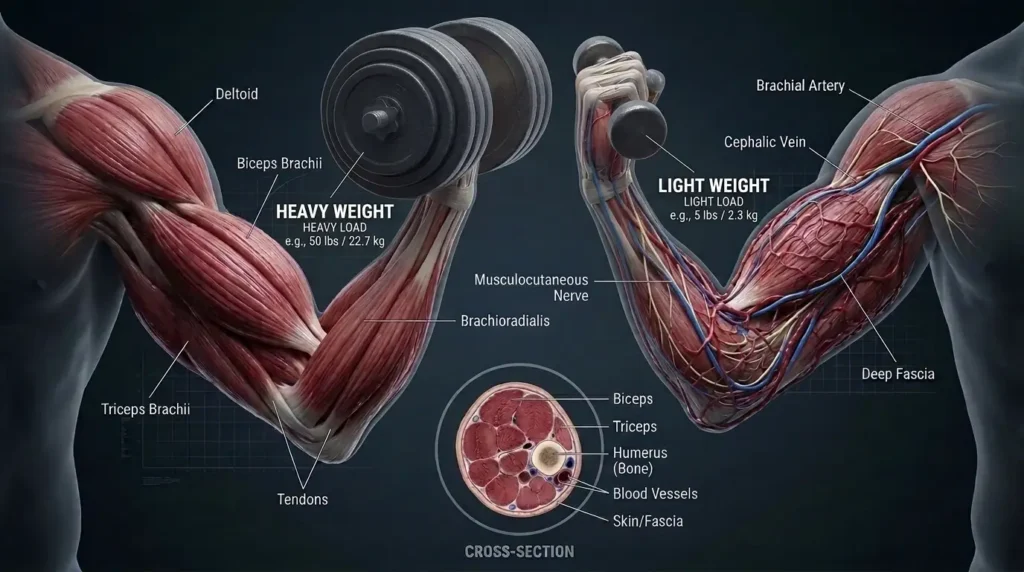
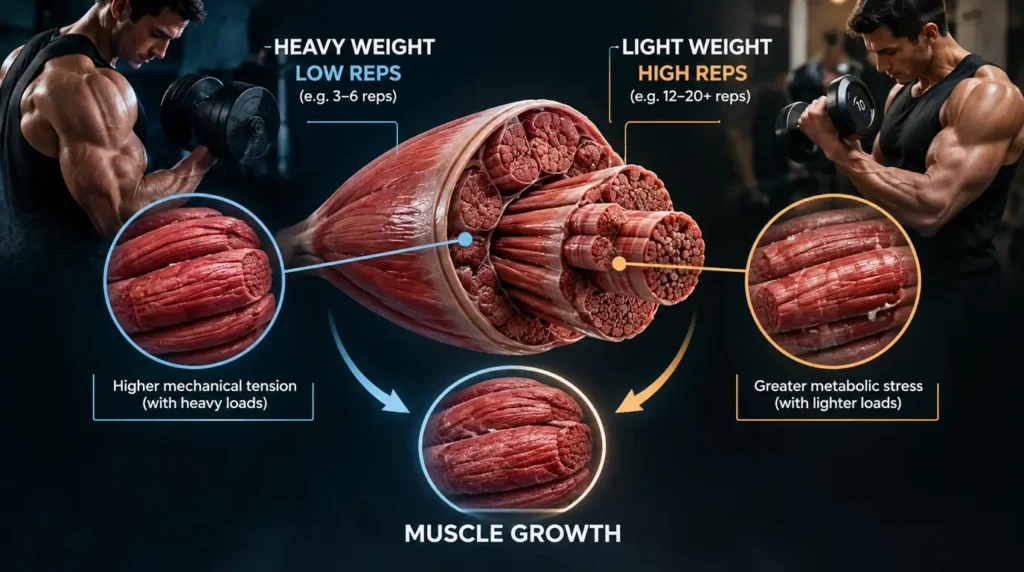
Both approaches can build muscle. When sets are sufficiently challenging, research generally finds similar hypertrophy across a broad range of loads. The most practical range still depends on the exercise, the lifter and the goal.
What the 2015 trial found
Researchers trained 18 well trained men for 8 weeks, three days a week. One group used heavier weights for 8 to 12 reps. The other used lighter weights for 25 to 35 reps. Every set went to failure.
Muscle growth was similar. Thigh muscle grew about 9.3% in the heavy group and 9.5% in the light group. Growth in the arm muscles also did not differ significantly between the groups (Schoenfeld et al., 2015).
These findings do not mean every load is equally convenient. Very light loads usually require more repetitions, and the set may become uncomfortable before the target muscle is close to its limit. Heavier loads can be more time efficient for strength practice, while moderate loads may be a practical compromise for many lifters. The study was small 18 trained men, split into groups of nine, so treat it as one useful piece of evidence, not proof on its own.
Two other trials add useful context
In a 2012 study, 18 men with no lifting experience trained their legs for 10 weeks. Researchers compared three sets at 30% of one-rep max with one or three sets at 80%. MRI-measured quadriceps volume increased by 6.8% with the lighter three set protocol and 7.2% with the heavier three set protocol. The heavier one set condition increased volume by 3.2%. The differences between groups were not statistically significant, so the results do not prove that the protocols were identical but they show why load alone is a poor predictor of muscle growth when the amount of work differs (Mitchell et al., 2012).
A 2016 trial in 49 resistance trained men compared 20-25 reps at roughly 30-50% of 1RM with 8-12 reps at roughly 75-90% for 12 weeks. Both groups increased lean mass and muscle fiber size without a significant between-group difference. The heavier group did, however, improve bench press 1RM more (about 14 kg versus 9 kg), illustrating the distinction between gaining muscle and practising maximal strength (Morton et al., 2016).
What the bigger reviews found
A 2017 meta analysis compared loads of 60% of 1RM or less with loads above 60%, all taken to failure. Muscle growth was similar (Schoenfeld et al., 2017).
A 2021 network meta analysis found that muscle growth did not depend on load (Lopez et al., 2021).
A 2023 review of 119 studies and 3,364 people, 47% of them women, found that all training prescriptions promoted muscle growth to a similar degree (Currier et al., 2023).
The 2026 ACSM position stand also concluded that muscle hypertrophy can be achieved with a broad range of resistance training prescriptions. Interpret this as flexibility in programming not proof that every load produces identical results for every person (Currier et al., 2026).
The catch
Three important qualifications help put these findings in context.
First, effort matters. These studies mostly used sets taken to failure or close to it. A light set that stops early because it feels boring does not count the same way.
Second, weekly training volume matters too. The ACSM review found that higher weekly training volumes can support greater muscle growth, with 10 or more sets per muscle group per week being a useful evidence based target. However, this is not a universal minimum or a guarantee of better results for every lifter (Currier et al., 2026).
Third, most of the evidence comes from beginners and young adults. The averages may not match every person, and ACSM says so.
High Rep vs Low Rep Training for Strength and Endurance
For maximal strength, heavier loads are generally the better choice. Higher repetition training can improve performance on higher repetition tasks, but the endurance result depends on the task and should not be generalized to every sport or activity.
ACSM found that strength improved most with loads of about 80% of 1RM or more, 2 to 3 sets per exercise, and at least two sessions a week (Currier et al., 2026).
The 2015 trial shows the difference clearly:
Squat strength: up about 19.6% in the heavy group vs 8.8% in the light group
Bench press strength: up about 6.5% vs 2.0%, a trend and not a clear difference
Upper body muscular endurance: up about 16.6% in the light group, while the heavy group did not improve
A 2017 meta analysis agrees. One rep max strength was greater with heavy loads, while isometric strength showed no clear difference (Schoenfeld et al., 2017).
Why does this happen? Part of strength is skill. When you practice heavy lifts, your body gets better at producing force with heavy loads. When you only train light, a heavy single can feel strange. You get better at what you practice.
That does not mean light training is useless. It means the result depends on your goal.
Do You Need to Train to Failure?
No. You do not need to take every set to momentary muscular failure. ACSM found that training to momentary fatigue did not consistently improve outcomes, but this does not establish one exact number of reps to leave in reserve for every lifter or exercise (Currier et al., 2026).
Here is what the research shows:
A 2023 meta analysis of 15 studies found a trivial advantage for sets classified as reaching failure over non failure training when different definitions of failure were grouped together. However, when researchers specifically compared momentary muscular failure with non-failure training, they found no clear advantage for muscle growth (Refalo et al., 2023).
A 2024 series of exploratory meta-regressions found that muscle growth tended to increase when sets ended closer to failure, while estimated reps in reserve had a negligible relationship with strength gains. The analysis was exploratory, and reps in reserve were estimated from descriptions of the training protocols rather than measured directly, so the exact relationship remains uncertain (Robinson et al., 2024).
The exact best distance from failure remains uncertain; current evidence does not establish one target for everyone.
Why does this matter for light weights? Many lifters say that on very high rep sets they stop because of the burn, not because the muscle cannot do more. Light sets only work when you push close to your limit. Some people argue that only the last few hard reps of a set count. That is a theory, not a proven finding.
A practical starting point: finish most sets with a small number of clean repetitions still possible, then adjust based on the exercise, load, experience, and recovery. This is a coaching guideline, not a proven universal optimum. If you train to failure, use it only where a missed repetition can be managed safely. Older adults and people with relevant health concerns should adapt training to their abilities and seek professional guidance when needed.
Do Light Weights Build Lean Muscle While Heavy Weights Build Bulk?
No. Light weights do not build a special type of lean muscle, and heavy weights do not automatically make you bulky. Both light and heavy loads can build muscle when your sets provide enough stimulus.
Two things drive how defined you look: how much muscle you have and how much fat covers it. ACSM found that muscle growth does not depend on load, so light weights do not give you a different kind of muscle (Currier et al., 2026).
What about burning fat from the muscle you train? Training a particular muscle does not reliably make the body preferentially lose fat from that exact area. Exercises can strengthen the target muscle, but changes in body fat depend on overall energy balance and individual fat-loss patterns.
The burn and pump are short-term effects of blood flow and effort, not evidence of fat loss from that area.
Women and the “bulky” worry
A 2020 meta analysis found no significant difference between men and women in muscle growth (Roberts et al., 2020). Another 2020 meta analysis found that women gained a medium amount of muscle and large amounts of strength from resistance training (Hagstrom et al., 2020). In these studies, women gained muscle at a rate similar to men.
High Rep vs High Weight for Fat Loss and Definition
Current evidence does not establish that choosing a particular rep range, by itself, produces greater fat loss. Body fat change is influenced by sustained energy balance, diet, activity, and individual factors. The evidence cited here also does not establish that doing 3 sets of 5 instead of 3 sets of 10 changes fat gain during a calorie surplus, independent of the wider training and nutrition program.
For a more defined look, build or retain muscle with progressive training and manage body fat through your overall diet and activity. Choose a rep range you can train hard with.
More Weight vs More Reps: What Should You Add Next Session?
Adding reps and adding weight are both valid ways to progress. Add reps first when the smallest available load increase would be too large; use small weight increases when they fit the exercise and goal.
A 2022 trial followed 43 resistance trained participants for eight weeks of lower body training. One group progressed by adding load while keeping repetitions relatively constant; the other increased repetitions while keeping load constant. Both approaches produced similar changes in most muscle size measures. Strength gains slightly favored load progression, but the between-group difference was small and of uncertain practical importance (Plotkin et al., 2022).
Why light weights favor adding reps
Here is a simple piece of math. A 5 pound jump on a 100 pound lift is a 5% increase. The same 5 pound jump on a 50 pound lift is a 10% increase.
On lighter weights, the smallest weight jump is a bigger step. That is why adding a rep or two first often feels smoother.
ACSM says overload is likely needed for long term progress. You can create it through load, volume, frequency, exercise choice or duration (Currier et al., 2026).
Reps or Weight? A Simple Rule
This is a common, practical method not a protocol proven to be best for everyone.
Pick a rep range for an exercise, for example 8 to 12. Start with a weight where you reach 8 reps with 1 to 3 reps left. Each session, try to add one rep to your sets. When you reach 12 reps on every set with good form, add a small amount of weight. Drop back to about 8 reps and repeat.
| Session | Weight | Reps per set |
|---|---|---|
| 1 | 40 kg | 8, 8, 8 |
| 2 | 40 kg | 9, 8, 8 |
| 3 | 40 kg | 9, 9, 8 |
| Later | 40 kg | 12, 12, 12 |
| Next | 42.5 kg | 8, 8, 8 |
Only add weight when your form stays clean. A heavier weight with sloppy form does not make the exercise harder for the muscle you want to train. It just changes how you lift it.
Should You Combine Heavy and Light Training?
You can combine heavy and light training, but you do not need both to build muscle. Combining ranges is one way to practise heavier lifts and add higher-repetition accessory work. Current evidence does not show that this approach is inherently better for everyone. ACSM found no consistent effect of periodization on outcomes, while exercise order and repetition speed did not consistently change muscle growth (Currier et al., 2026).
A 2023 review found broadly comparable results across many training prescriptions, while an umbrella review noted limited evidence for several variables, including exercise order, tempo and periodization (Currier et al., 2023; McLeod et al., 2024).
Common ways lifters combine both include:
Heavy first, light after: a heavy compound lift first, then lighter accessory work
Heavy day and light day: one session with heavier loads, another with lighter loads for the same muscle
Blocks: a few weeks heavier, then a few weeks lighter
A heavier final set: two sets at your normal weight, then a heavier set to failure
How long should you rest?
A 2024 Bayesian meta analysis of nine studies found substantial uncertainty and overlap across rest interval comparisons; its results do not support a strict 90 second maximum or a universal rule that very short rests necessarily reduce growth (Singer et al., 2024). In practice, rest long enough to maintain good technique and performance. Strength focused sets often require longer recovery than short rest circuits.
Joints, Tendons and Injury Risk: Heavy vs Light
Neither “heavy” nor “light” can be declared universally safer from the evidence cited here. The article’s cited research does not directly establish which approach has lower injury rates. ACSM’s review supports resistance training for healthy adults, but it did not establish that all training approaches are suitable for every person or compare injury rates between loads (Currier et al., 2026).
What about tendons? A 2022 systematic review and meta-analysis of healthy lower-limb tendons found that mechanical loading can improve tendon properties, including stiffness, but the optimal loading prescription remains uncertain. These findings do not show that heavy training prevents injuries or that a particular rep range is safest (Lazarczuk et al., 2022).
What this means in practice:
Sharp pain is different from normal training discomfort. Stop and get it checked.
If a joint is uncomfortable with a particular load, a lighter variation may be worth trying if it is comfortable and can be performed with good technique. Lighter loads are not automatically safer, and persistent or sharp pain warrants assessment.
Raise weights gradually. Do not chase numbers with sloppy form.
Beginners, Women, Older Lifters and Home Training: Does the Answer Change?
Beginners
A 2016 meta analysis found that low loads (50% of 1RM or less) can still produce substantial gains in untrained people (Schoenfeld et al., 2016). Beginners should start with manageable loads, learn the movements, and add reps or weight gradually; there is no need to begin with maximal or near-maximal weights.
Women
The research above applies to women. Muscle growth in women was comparable to men (Roberts et al., 2020), and training led to medium muscle gains and large strength gains (Hagstrom et al., 2020).
Older lifters
A 2016 meta analysis of 15 studies involving 448 older adults (mean age 67.8) compared heavier loads of about 80% of 1RM with light to moderate loads of about 45%. Strength gains tended to favor heavier loads, while muscle size differences were smaller. Lower loads can still be useful when enough challenging repetitions are performed (Csapo and Alegre, 2016). Older lifters should adapt training to their health, experience and ability to maintain technique; failure is not a requirement.
Light weights, home and travel
ACSM found that bands, bodyweight and home based training are effective (Currier et al., 2026). If you only have light weights, take sets close to your limit and add reps over time.
Rep Range Myths: What the Evidence Says
| Myth | Verdict | What the research shows |
|---|---|---|
| Light reps tone you | No | Fat does not burn from the muscle you train, and growth does not depend on load |
| Heavy lifting only builds strength | No | Heavy and light loads gave similar muscle growth in several reviews |
| Women should lift light | No | Women gain muscle at a similar rate to men |
| 8 to 12 reps is the only growth zone | No | ACSM and the 2021 review found a wide range works |
| You must train to failure | Not required | ACSM says failure is not necessary |
| High volume raises hormones, and that grows muscle | Not supported | In 49 trained men over 12 weeks, post workout hormone rises were not linked to muscle growth (Morton et al., 2016) |
| Heavy builds fast twitch fibers, light builds slow twitch | Not shown | A meta-analysis of 10 study groups found no significant difference between low and high load training taken to failure (Grgic, 2020) |
| The pump or the burn means growth | Unclear | Evidence is mixed, and ACSM found no consistent effect from rep speed |
| Light weights cannot build strength | Partly | They build some, but less strength at heavy loads |
| Mind muscle connection is essential | Mixed | A meta-analysis found external focus helped short term strength, with no clear long term difference (Grgic et al., 2021) |
How to Choose Your Rep Range
Match the rep range to your goal, technique and recovery. Include heavier sets for maximal strength, use a challenging and manageable range for muscle growth, and practise higher repetitions for endurance tasks. A simple plan you can repeat and progress is a reasonable starting point.
| If your priority is… | Practical approach |
|---|---|
| Maximum strength | Include heavier sets and practice the lifts you want to improve |
| Muscle growth | Choose a manageable load that lets you train hard and progress consistently |
| Muscular endurance | Use higher-repetition work relevant to the task you want to improve |
| Limited equipment at home | Use available weights, bands or bodyweight variations that provide sufficient challenge |
| Sustainable training | Choose a rep range you can perform with good technique and recover from |
Use these practical checks when building your plan:
- Set a realistic starting volume. Higher weekly volumes, particularly 10 or more sets per muscle group, can support hypertrophy, but your starting point should reflect experience and recovery.
- Train consistently. ACSM recommends high-effort resistance training at least twice a week for all major muscle groups.
- Keep failure optional. Leave some repetitions in reserve on many sets, adjusting to the exercise and how well you can judge effort.
- Track and progress. Add reps or load over time, and choose a plan you can sustain.
My own experience
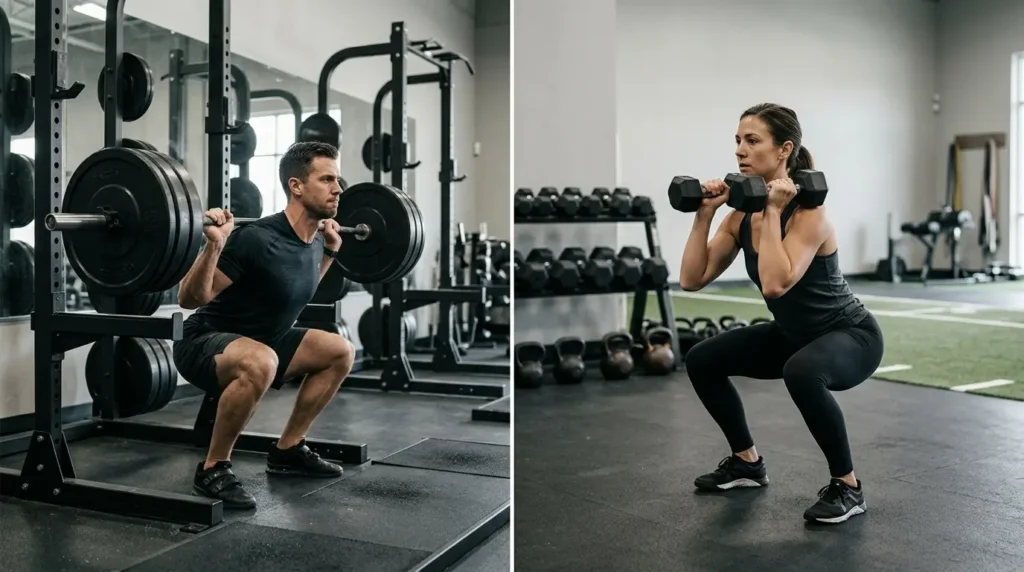
In my own training, I mostly use 8-10 reps with a challenging load. I usually do two sets at my normal weight, then increase the load for a third set of 6-8 reps, sometimes taking it to failure. When I tried 18-20 reps with lighter weights, I felt I adapted to the effort and did not notice much growth.
That is an observation, not a controlled comparison. I did not isolate load, effort, progression or other training variables, so it cannot show that heavier weights are inherently better for muscle growth. Research generally finds similar hypertrophy across a broad range of loads when training is sufficiently challenging.
How to Tell Whether Your Training Is Working
Your rep range is a programming tool, not a score of progress by itself. Track these measures over time:
- The load and reps you complete
- Weekly hard sets per muscle group
- Body measurements over several weeks
- Body composition over several months
FFMI, or fat-free mass index, relates fat-free mass to height. It can provide one longer-term indicator of changes in fat-free mass, but it is not a direct measurement of skeletal muscle. Hydration, the method used to estimate body fat, and measurement error can affect the result. Use FFMI alongside strength records, body measurements and consistent body composition estimates not as a replacement for them.
Related guides: FFMI calculator, FFMI vs. normalized FFMI, and body fat calculator.
FAQ
High reps or high weight: which is better?
It depends on your goal. A broad range of loads can build muscle when the sets are sufficiently challenging. Heavier loads generally suit maximal strength goals, while lighter loads and higher reps are useful for higher repetition endurance tasks.
Do light weights build muscle?
Yes. Research shows that lighter loads can build muscle comparably to heavier loads when the training is sufficiently challenging. Very light loads usually require more repetitions, and you need a plan that allows you to progress.
Does lifting heavy with low reps build muscle?
Yes. Heavy loads can build muscle and are generally better for maximal strength gains. Research has found broadly similar muscle growth with heavy and light training when effort is sufficient.
How many reps for muscle growth?
There is no single number. A wide range works, from low reps with heavy weights to high reps with light weights, as long as your sets end close to failure. Many lifters find moderate ranges, around 6 to 15 reps, the easiest to train hard with.
Should I add weight or reps?
Add reps first when a weight increase would be too large; otherwise, increase the load in small steps while maintaining good form.
Can I combine heavy and light training?
Yes. Combining heavy and light training can help you work toward different goals, but current evidence does not show that everyone needs to combine them to build muscle. Choose a plan you can perform consistently and progress.
Do high reps help fat loss or toning?
Evidence does not establish that one rep range produces more body-fat loss than another. A more defined look generally depends on building or retaining muscle and managing body fat.
Is lifting heavy safe?
Resistance training can be appropriate across age groups, but exercise selection and loading should match individual ability and health. The evidence cited here does not establish that heavy or light loads have lower injury rates. Progress gradually and use controlled technique.
How many sets per week do I need?
ACSM found that higher weekly volumes particularly 10 or more sets per muscle group can improve hypertrophy. Its strength findings also support 2-3 sets per exercise in relevant programming contexts; neither figure is a universal prescription for every trainee.
The Bottom Line
Both approaches can build muscle; heavier loads are generally better for maximal strength, while higher repetition work can improve muscular endurance. Choose a controllable load that lets you train hard, recover and progress. Judge progress by performance over time, not by the pump or burn alone.
How This Article Uses the Evidence
The main conclusions are anchored to systematic reviews, meta analyses, and the 2026 ACSM position stand, which synthesized 137 systematic reviews and more than 30,000 participants. Individual trials are included to illustrate how different protocols performed, not to imply that one small study settles the question. Study findings apply to the populations and training programs actually examined; they should not be treated as guarantees for every lifter. The evidence search for the ACSM overview ran through October 2024, even though the position stand was published in 2026.
References
Currier BS, D’Souza AC, Fiatarone Singh MA, Lowisz CV, Rawson ES, Schoenfeld BJ, Smith-Ryan AE, Steen JP, Thomas GA, Triplett NT, Washington TA, Werner TJ, Phillips SM. American College of Sports Medicine Position Stand. Resistance Training Prescription for Muscle Function, Hypertrophy, and Physical Performance in Healthy Adults: An Overview of Reviews. Medicine & Science in Sports & Exercise. 2026;58(4):851–872. https://doi.org/10.1249/MSS.0000000000003897
Currier BS, McLeod JC, Banfield L, et al. Resistance training prescription for muscle strength and hypertrophy in healthy adults: a systematic review and Bayesian network meta-analysis. British Journal of Sports Medicine. 2023;57(18):1211–1220. https://doi.org/10.1136/bjsports-2023-106807
Csapo R, Alegre LM. Effects of resistance training with moderate vs heavy loads on muscle mass and strength in the elderly: a meta-analysis. Scandinavian Journal of Medicine & Science in Sports. 2016;26(9):995–1006. https://doi.org/10.1111/sms.12508
Grgic J. The effects of low-load vs. high-load resistance training on muscle fiber hypertrophy: a meta-analysis. Journal of Human Kinetics. 2020;74:51–58. https://doi.org/10.2478/hukin-2020-0013
Grgic J, Mikulic I, Mikulic P. Acute and long-term effects of attentional focus strategies on muscular strength: a meta-analysis. Sports. 2021;9(11):153. https://doi.org/10.3390/sports9110153
Hagstrom AD, Marshall PW, Halaki M, Hackett DA. The effect of resistance training in women on dynamic strength and muscular hypertrophy: a systematic review with meta-analysis. Sports Medicine. 2020. https://doi.org/10.1007/s40279-019-01247-x
Lazarczuk SL, Maniar N, Opar DA, Duhig SJ, Shield A, Barrett RS, Bourne MN. Mechanical, material and morphological adaptations of healthy lower limb tendons to mechanical loading: a systematic review and meta-analysis. Sports Medicine. 2022;52(10):2405–2429. https://doi.org/10.1007/s40279-022-01695-y
Lopez P, Radaelli R, Taaffe DR, et al. Resistance training load effects on muscle hypertrophy and strength gain: systematic review and network meta-analysis. Medicine & Science in Sports & Exercise. 2021;53(6):1206–1216. https://doi.org/10.1249/MSS.0000000000002585
McLeod JC, Currier BS, Lowisz CV, Phillips SM. The influence of resistance exercise training prescription variables on skeletal muscle mass, strength, and physical function in healthy adults: an umbrella review. Journal of Sport and Health Science. 2024;13(1):47–60. https://doi.org/10.1016/j.jshs.2023.06.005
Mitchell CJ, Churchward-Venne TA, West DWD, et al. Resistance exercise load does not determine training-mediated hypertrophic gains in young men. Journal of Applied Physiology. 2012;113(1):71–77. https://doi.org/10.1152/japplphysiol.00307.2012
Morton RW, Oikawa SY, Wavell CG, et al. Neither load nor systemic hormones determine resistance training-mediated hypertrophy or strength gains in resistance-trained young men. Journal of Applied Physiology. 2016;121(1):129–138. https://doi.org/10.1152/japplphysiol.00154.2016
Nuzzo JL, Pinto MD, Nosaka K, Steele J. Maximal number of repetitions at percentages of the one repetition maximum: a meta-regression and moderator analysis of sex, age, training status, and exercise. Sports Medicine. 2024;54:303–321. https://doi.org/10.1007/s40279-023-01937-7
Plotkin D, Coleman M, Van Every D, Maldonado J, Oberlin D, Israetel M, Feather J, Alto A, Vigotsky AD, Schoenfeld BJ. Progressive overload without progressing load? The effects of load or repetition progression on muscular adaptations. PeerJ. 2022;10:e14142. https://doi.org/10.7717/peerj.14142
Refalo MC, Helms ER, Trexler ET, Hamilton DL, Fyfe JJ. Influence of resistance training proximity-to-failure on skeletal muscle hypertrophy: a systematic review with meta-analysis. Sports Medicine. 2023;53(3):649–665. https://doi.org/10.1007/s40279-022-01784-y
Roberts BM, Nuckols G, Krieger JW. Sex differences in resistance training: a systematic review and meta-analysis. Journal of Strength and Conditioning Research. 2020;34(5):1448–1460. https://doi.org/10.1519/JSC.0000000000003521
Robinson ZP, Pelland JC, Remmert JF, Refalo MC, Jukic I, Steele J, Zourdos MC. Exploring the dose-response relationship between estimated resistance training proximity-to-failure, strength gain, and muscle hypertrophy: a series of meta-regressions. Sports Medicine. 2024;54(9):2209–2231. https://doi.org/10.1007/s40279-024-02069-2
Schoenfeld BJ, Wilson JM, Lowery RP, Krieger JW. Muscular adaptations in low- versus high-load resistance training: a meta-analysis. European Journal of Sport Science. 2016;16(1):1–10. https://doi.org/10.1080/17461391.2014.989922
Schoenfeld BJ, Grgic J, Ogborn D, Krieger JW. Strength and hypertrophy adaptations between low- vs high-load resistance training: a systematic review and meta-analysis. Journal of Strength and Conditioning Research. 2017;31(12):3508–3523. https://doi.org/10.1519/JSC.0000000000002200
Schoenfeld BJ, Grgic J, Van Every DW, Plotkin DL. Loading recommendations for muscle strength, hypertrophy, and local endurance: a re-examination of the repetition continuum. Sports. 2021;9(2):32. https://doi.org/10.3390/sports9020032
Schoenfeld BJ, Peterson MD, Ogborn D, Contreras B, Sonmez GT. Effects of low- vs high-load resistance training on muscle strength and hypertrophy in well-trained men. Journal of Strength and Conditioning Research. 2015;29(10):2954–2963. https://doi.org/10.1519/JSC.0000000000000958
Singer A, Wolf M, Generoso L, et al. Give it a rest: a systematic review with Bayesian meta-analysis on the effect of inter-set rest interval duration on muscle hypertrophy. Frontiers in Sports and Active Living. 2024;6:1429789. https://doi.org/10.3389/fspor.2024.1429789


