
Body Recomposition Calculator | Find Your Calories, Macros & Body Composition Targets
Every result below is a research informed estimate, not a guarantee, since actual body composition change depends on training consistency, sleep, genetics, and how accurately you know your starting body fat percentage.
Your Results
Estimates, not guaranteesFill in your details and hit calculate to see your estimated targets.
Current vs target
Calories
Macros (daily)
Estimated target assuming lean body mass remains approximately constant.
These results are estimates, not guarantees. Actual body-composition changes depend on calorie intake, training, protein intake, sleep, activity, genetics and individual response. Body-fat percentage estimates can also affect the accuracy of the calculation.
Last updated: August 19, 2026
Scale barely moving despite weeks of consistent training? That is usually body recomposition at work, not a stall, the process of losing fat while building or maintaining lean mass at the same time, often with little change in the number on the scale.
This free body recomposition calculator estimates your calorie target, protein needs, and macro split for exactly that process. What makes this body recomposition calculator useful for most people is that every formula behind it, from the calorie math to the protein targets, is explained in plain language below rather than hidden behind a black box.
Enter your sex, age, height, weight, current body fat percentage, activity level, training experience, and recomposition goal below to get your personalized numbers.
Key Takeaways
- Body recomposition means losing fat while building or maintaining lean mass, often with little change in scale weight
- The calculator uses the Mifflin-St Jeor formula for BMR, then multiplies by your activity level alone to estimate TDEE, with no separate calorie bonus for training days
- Balanced Recomp applies a 7 percent deficit, Lose More Fat applies a 20 percent deficit, and Build More Muscle applies an 8 percent surplus; these are conservative settings chosen for this calculator rather than universal prescriptions for everyone
- Protein is calculated from lean body mass and adjusted by your goal and training experience, research points to diminishing returns above roughly 1.6 g/kg body weight for general training gains
- Every result is a research informed estimate, not a guarantee, since BMR, TDEE, and your entered body fat percentage are all estimates themselves
What Is Body Recomposition?
Body recomposition, often shortened to “recomp,” means reducing body fat while gaining or maintaining lean mass. It often happens without a large change in scale weight because fat mass can decrease while lean mass stays the same or increases. As a result, your weight may remain nearly flat even as your body composition improves.
Can You Gain Muscle While Losing Fat?
Yes, and a 2020 review in the Strength and Conditioning Journal by Christopher Barakat and colleagues at the University of Tampa confirmed it happens in resistance-trained individuals, not just beginners. The review identified progressive resistance training combined with evidence-based nutrition as the two key drivers.
It is not equally easy for everyone. Beginners, people returning after a training break, and those carrying more body fat generally have the most room to build muscle and lose fat simultaneously. Experienced, already-lean lifters can still recomp, but progress tends to be slower and the margin for error shrinks.
Why the Scale May Not Change Much
Losing 2 kg of fat while gaining 1 kg of lean mass shows up as only a 1 kg drop on the scale, even though your body composition improved by 3 kg worth of change. Day to day water retention, glycogen storage, and digestion can also mask real progress for days at a time, which is exactly why tracking scale weight alone is one of the most common recomposition mistakes.
How Our Body Recomposition Calculator Works
The calculator runs your inputs through seven steps to reach your final numbers.
Fat Mass
Fat mass equals your body weight multiplied by your current body fat percentage. A 180 lb person at 18 percent body fat carries about 32.4 lb of fat mass.
Lean Body Mass
Lean body mass equals body weight minus fat mass, so the same 180 lb person at 18 percent body fat has roughly 147.6 lb of lean mass. Lean body mass is not identical to skeletal muscle. It also includes bone, organs, water, and connective tissue; muscle is simply the largest single piece of it.
BMR
The calculator estimates basal metabolic rate using the Mifflin-St Jeor equation, which factors in weight, height, age, and sex. The male and female equations use different sex coefficients, so the two formulas differ by 166 kcal at the equation level.
TDEE
Total daily energy expenditure is estimated by multiplying your BMR by an activity multiplier. The activity level reflects your overall daily activity and exercise level, so the calculator does not add a separate calorie bonus for individual training sessions. This avoids counting exercise twice when estimating your total daily energy expenditure.
What Does Each Activity Level Mean?
Your activity selection is important because it directly affects the TDEE estimate. Choose the category that best matches your typical overall activity rather than selecting a higher level simply because you exercise.
| Activity level | What it generally means |
|---|---|
| Sedentary | Mostly sitting or desk based activity with little intentional exercise |
| Light | Light daily movement and/or light exercise around 1-3 days per week |
| Moderate | Regular exercise or training several days per week combined with a moderately active lifestyle |
| Very Active | Hard or frequent training combined with high daily physical activity |
| Extremely Active | Very high training volume and/or a highly physically demanding daily workload |
These descriptions are intended to help you choose the appropriate category; the exact multiplier used for each level is determined by the calculator’s underlying methodology. Because TDEE is an estimate, choosing an activity category that is too high or too low can meaningfully affect your calorie target.
Calorie Target
Your TDEE is then adjusted by your selected goal. Lose More Fat applies a 20 percent deficit, Balanced Recomp applies a 7 percent deficit, and Build More Muscle applies an 8 percent surplus. These are intentionally conservative settings chosen for this calculator rather than universal prescriptions, since the appropriate calorie adjustment varies between individuals and goals.
Macros
Protein, dietary fat, and carbohydrates are the three macronutrients the calculator balances once your calorie target is set. Protein is calculated from lean body mass, adjusted by both your goal and your training experience, since more experienced lifters may benefit from a tighter protein target to keep progressing. Fat is set at whichever is higher: a minimum based on body weight, or 20 percent of total calories, to provide a practical minimum for dietary fat. Carbohydrates fill whatever calories remain after protein and fat are accounted for.
Target Body Composition
The calculator also estimates a target weight, assuming your lean mass stays roughly constant while your body fat percentage moves toward your goal. This is a mathematical projection based on maintaining your current lean body mass while reaching the selected body-fat percentage, not a fixed outcome.
Which Formula Does the Calculator Use?
The calculator uses the Mifflin-St Jeor equation for every user, regardless of whether a body fat percentage is entered.
Mifflin-St Jeor
This formula estimates BMR from weight, height, age, and sex alone, without requiring a body fat percentage. It is widely used because it performs reasonably well across a broad range of people without needing an extra input that many cannot measure accurately.
Katch-McArdle
This alternative formula estimates BMR directly from lean body mass rather than total weight, which can be useful when lean body mass is measured accurately. Because body fat percentage entered into a calculator is frequently just an estimate itself, feeding an imprecise number into a lean-mass-based formula does not necessarily improve accuracy over Mifflin-St Jeor, which is why this calculator standardizes on Mifflin-St Jeor for consistency across all users.
Understanding Your Body Recomposition Calculator Results
Current Body Composition
This card shows your current body fat percentage, fat mass, lean mass, and estimated FFMI, all calculated directly from the weight and body fat percentage you entered.
FFMI is an estimate of fat-free mass relative to height and can be useful for comparing muscularity between people of different heights, but it is not a direct measurement of muscle mass.
Target Body Composition
This card shows your target body fat percentage, estimated target weight, and the fat mass you would need to lose to get there, assuming lean mass stays constant along the way.
Maintenance Calories
This is your estimated TDEE, the calorie level at which your weight would theoretically hold steady given your current body weight and activity level.
Recomposition Calories
This is your maintenance calories adjusted by your selected goal, the actual daily target the rest of your plan is built around.
Daily Macros
Acting as a body recomposition diet calculator, this card shows protein, carbohydrate, and fat targets in grams, built from your recomposition calorie target as described in the methodology section above.
Training Day vs Rest Day Calories
If your plan includes calorie cycling, remember that shifting calories between training and rest days changes when you eat, not necessarily the underlying energy balance across the week. Accumulated energy balance over time still drives changes in body weight and composition regardless of how calories are distributed between days.
How Many Calories Should You Eat for Body Recomposition?
Should You Eat in a Calorie Deficit?
A modest deficit is a practical way to target a negative energy balance when fat loss is your priority and you have more body fat to lose, while resistance training and adequate protein work to preserve lean mass.
Can You Recomp at Maintenance Calories?
Yes, potentially. Eating at maintenance removes the pressure of a deficit entirely and can work well for people whose main goal is building muscle while simply not gaining fat, particularly earlier in a training career when muscle-building potential is highest.
What About a Small Calorie Surplus?
A small surplus, often around 10 percent above maintenance or a modest calorie increase such as 200 to 300 kcal per day depending on the person’s maintenance needs, is one reasonable approach some coaches use, including nutrition writer Alan Aragon in discussions of lean recomposition. It is one scenario among several, not a universal prescription that fits every situation.
Why You Should Avoid an Aggressive Deficit
A large deficit undermines training performance, slows recovery between sessions, and makes it harder to hold onto lean mass, working directly against the muscle side of the recomposition goal even as it accelerates fat loss.
Does Weekly Energy Balance Matter More Than One Day?
Yes. What determines changes in body mass over time is accumulated energy balance, so looking at your intake and expenditure across several days or weeks is more useful than judging a single high or low day. This is why calorie cycling between training and rest days does not change the underlying energy balance simply because calories are distributed differently between days.
Protein for Body Recomposition
Why Protein Matters
Protein directly supports muscle protein synthesis, helps retain lean mass during a deficit, supports training adaptation, and improves satiety, making a calorie deficit easier to sustain without constant hunger.
How Much Protein Do You Need?
A 2018 meta-analysis in the British Journal of Sports Medicine, led by Robert Morton at McMaster University with senior author Stuart Phillips, pooled 49 studies and 1,863 participants and found that protein supplementation reliably improved resistance-training gains in fat-free mass and strength, with the dose-response curve in the analysis plateauing around 1.62 g/kg of body weight per day. That number describes where additional benefit stopped showing up in this specific pooled dataset; it is not a hard ceiling that applies identically to every individual or every goal.
Protein During a Calorie Deficit
Leaner individuals and people dieting harder generally benefit from pushing protein higher than typical maintenance recommendations. A 2014 review by Eric Helms, Alan Aragon, and Peter Fitschen, published in the Journal of the International Society of Sports Nutrition, focused specifically on contest-preparation athletes and suggested a range of 2.3 to 3.1 g/kg of lean body mass per day for lean, resistance-trained individuals cutting for competition. That range describes advanced, very lean athletes in a specific context, not a target every casual gym-goer needs to hit.
Does Protein Timing Matter?
Total daily protein intake matters far more than the exact timing of each meal. Spreading protein across several meals a day is a practical way to hit your total without needing a rigid, minute-by-minute schedule.
What Does the Research Say About Protein Overfeeding?
Antonio et al. 2014
Jose Antonio and colleagues at Nova Southeastern University had 30 resistance-trained men and women consume roughly 4.4 g/kg of protein per day for 8 weeks without changing their training. The high-protein group ended up eating significantly more total calories than the control group, yet the study found no significant between-group differences in body weight, fat mass, fat-free mass, or body fat percentage.
This does not mean unlimited protein calories can never cause weight or fat gain. It means that in this specific 8-week, free-living, resistance-trained sample, extra protein calories behaved differently than extra calories from other sources typically do.
Bray et al. 2012
George Bray and colleagues at Pennington Biomedical Research Center placed 25 healthy adults in an inpatient metabolic ward and overfed them roughly 40 percent above maintenance, about 954 kcal per day, for 8 weeks, on diets containing 5, 15, or 25 percent of calories from protein. Higher protein intake was associated with significantly greater lean-mass gain and higher energy expenditure, while fat mass increased across all three groups regardless of protein level.
Why These Two Studies Seem Different
Antonio’s study followed free-living, already resistance-trained people who kept their normal training constant while adding protein calories. Bray’s study was a tightly controlled inpatient overfeeding experiment specifically designed to force weight gain through a large forced calorie surplus. Different designs, different questions, and genuinely different answers, both are valid; they simply are not measuring the same scenario.
Bray et al. 2015
A metabolic-chamber follow-up by the same Bray-led research group found that excess energy coming specifically from protein was associated with a measurable increase in 24-hour and sleeping energy expenditure compared with excess energy from a low-protein diet.
High protein can influence body composition and energy expenditure in measurable ways, but it does not make total calories irrelevant. Both things are true at once, and that balance is the real takeaway from this research.
Can You Build Muscle While in a Calorie Deficit?
Yes, under the right conditions. It happens most readily in beginners, people returning to training after time off, and individuals carrying more body fat, echoing the same populations identified in Barakat’s 2020 review. Resistance training provides the stimulus, adequate protein supplies the raw material, and the size of the deficit matters, since a smaller deficit leaves more room for muscle to be built than an aggressive one. Advanced, already-lean lifters have the least margin for this to happen at a meaningful rate.
How to Train for Body Recomposition
Resistance Training Is the Foundation
Without a resistance-training stimulus, extra protein and a favorable calorie target have nothing to signal muscle growth. Training is what makes the rest of the plan matter.
Train Close Enough to Failure
Sets taken reasonably close to muscular failure, rather than stopped several reps early out of habit, provide a strong growth stimulus without requiring every set to reach momentary muscular failure.
How Much Training Volume?
A practical, commonly cited framework is roughly 10 to 20 sets per major muscle group per week, with training frequency used to distribute that volume in a way you can recover from. Training a muscle around twice weekly can be a practical way to distribute weekly volume, but it is not a mandatory frequency for everyone. Treat the 10 to 20 set range as a reasonable starting point to adjust from, not the single correct number for every individual.
Progressive Overload
Gradually increasing reps, load, or execution quality over time is what drives muscle hypertrophy and keeps a muscle group adapting instead of plateauing at the same stimulus week after week.
How Often Should You Lift?
There is no mandatory number of weekly sessions. Three, four, and five days can all work well depending on how the volume is distributed and how well you recover between sessions.
What About Cardio?
Cardio supports fitness, general health, and additional calorie expenditure, but resistance training remains the primary signal your body uses to build or retain muscle during recomposition.
Who Is Most Likely to Recomp Successfully?
Beginners
New lifters have the most muscle-building headroom and often see fat loss and muscle gain happen simultaneously in their first several months of consistent training.
People Returning After a Training Break
Returning lifters tend to regain lost muscle faster than true beginners build it for the first time, a pattern often described as muscle memory, which creates favorable conditions for recomposition.
People With More Body Fat
Higher starting body fat provides more stored energy the body can draw on to help fuel muscle-building processes during a modest deficit.
Intermediate Lifters
Progress slows compared to beginners but recomposition remains realistic with consistent training and adequate protein.
Advanced or Very Lean Lifters
The opportunity generally shrinks as someone gets leaner and closer to their individual muscular potential, since there is simply less room left for simultaneous gains to occur at a meaningful pace.
Body Recomposition at Different Body Fat Levels
Can You Recomp at 25% Body Fat?
Yes, it can be possible, and higher starting body fat is generally favorable for recomposition rather than a barrier to it. There is no universal body fat cutoff above or below which recomposition suddenly becomes possible or impossible. Sex, training history, current muscle mass, and individual response all shape the outcome.
Why Getting Leaner Can Make Recomp Harder
As body fat drops, available energy reserves shrink and the margin for simultaneously building muscle narrows, which is part of why advanced, lean lifters tend to see slower recomposition progress than beginners with more body fat to draw on.
Why Body-Fat Percentage Isn’t a Perfect Predictor
Every body fat measurement method carries its own margin of error, so a body fat percentage entered into any calculator is an estimate feeding into other estimates, not a precise, fixed input.
Body Recomposition for Women
Using a body recomposition calculator, female inputs work the same way as male inputs: the same core principles apply, a modest calorie target based on your goal, adequate protein relative to lean mass, and consistent resistance training. Body composition, calorie needs, and protein targets are calculated using the same core methodology for the calculator’s female inputs as for male inputs, without a separate scoring system. One practical note specific to tracking progress: normal hormonal fluctuations across the menstrual cycle can cause temporary water retention and noticeable changes in scale weight, independent of any real change in fat or lean mass, which is one more reason to track trends over weeks rather than single readings.
Body Recomposition for Men
A body recomposition calculator male setup uses the same calorie, protein, and training principles covered above. Men typically have higher average lean mass and androgen levels than women, which can contribute to differences in muscle-building potential and body-composition patterns, although individual responses vary widely. The underlying recomposition process, resistance training plus adequate protein plus a sensible calorie target, works the same way regardless of sex.
How Long Does Body Recomposition Take?
Recomposition is gradual by nature. No fixed number of weeks guarantees a specific transformation, since the actual rate depends heavily on your starting point. Beginners may see noticeable changes within a few months, while advanced lifters typically progress much more slowly.
Why Our Timeline Is an Estimate
The timeframe shown factors in your training experience and weekly training days, but it still rests on several estimated inputs: your TDEE estimate, your body fat percentage estimate, and assumptions about consistent adherence, training, sleep, and genetics. Day-to-day water and glycogen shifts add further noise on top of all of that.
When Should You Recalculate?
A practical reassessment window is roughly every 4 to 6 weeks. Recalculating every few days just adds noise from normal weight fluctuation without giving your body enough time to show a real trend.
How to Track Body Recomposition Progress
Weekly Average Body Weight
A 7 day rolling average smooths out daily water and food-weight swings far better than any single morning reading.
Waist Measurement
A simple tape measurement around the waist tracks fat-loss trends well and does not require any equipment beyond a tape measure.
Body Fat Estimate
Whichever method you use, consistency in when and how you measure matters more than chasing a single perfectly precise number.
Progress Photos
Photos taken in the same lighting, pose, and time of day often reveal composition changes that scale weight alone completely misses.
Gym Performance
Steady or improving strength on your main lifts is one of the more reliable practical signs that lean mass is being maintained or built, even when the scale barely moves.
Lean Body Mass
If you have access to repeat body-fat testing, tracking estimated lean mass over time gives a more direct read on whether muscle is actually being retained or gained through the process.
Why Scale Weight Alone Is Not Enough
Scale weight cannot distinguish between fat, muscle, water, and glycogen. Two people can lose the same 5 lb on the scale and have completely different, even opposite, changes in actual body composition underneath that number.
How Accurate Is a Body Recomposition Calculator?
Why Calculator Results Are Estimates
BMR is an estimate. TDEE is an estimate built on top of that estimate. Real-world activity is genuinely difficult to quantify from a single dropdown selection. Your entered body fat percentage may itself be inaccurate. And no calculator can predict your exact future rate of muscle gain, since that depends on individual biology as much as inputs.
Why Your Body Fat Percentage Matters
Because fat mass, lean mass, protein targets, and FFMI are all calculated directly from the body fat percentage you enter, an inaccurate starting number throws off every downstream result by a similar margin.
DEXA, BIA and Other Measurement Methods
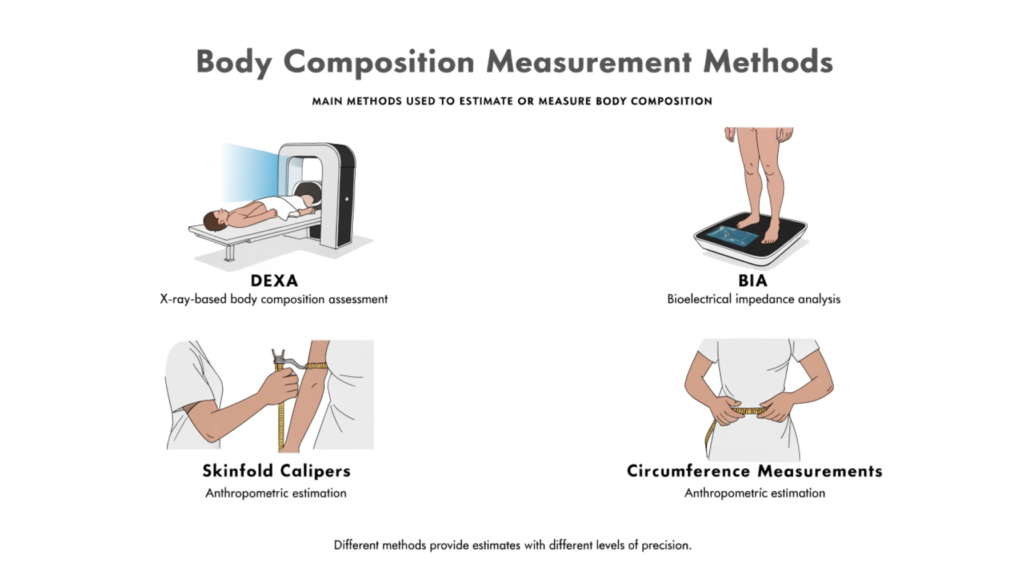
DEXA scans, also written DXA, are widely used as a reference method for assessing body composition, but they are not perfectly error-free. Results can vary with the scanner, software, protocol, and other measurement conditions. Bioelectrical impedance analysis, or BIA, is convenient and can be useful for tracking trends over time, but estimates can vary substantially with hydration, device type, measurement conditions, and the prediction equation used. Skinfold calipers, sometimes just called skinfolds, and visual estimates can also vary depending on technique and the experience of whoever is taking the measurement. Barakat’s 2020 review specifically flags body-composition assessment error as one of the real limitations facing recomposition research, and the same limitation applies directly to any calculator, including this one.
P-Ratio and Nutrient Partitioning: Why Some People Recomp More Easily
Nutrient partitioning describes how the body directs available energy toward fat storage, fat burning, and tissue building rather than treating every calorie identically. Foundational work by Forbes in 2000 and Hall in 2007 helped establish relationships between starting body fat and changes in fat-free mass during weight loss, sometimes discussed using the P-ratio, the proportion of a given energy deficit or surplus that comes from changes in lean versus fat tissue. This helps explain why higher-body-fat individuals can sometimes preserve or gain lean tissue more readily during a fat-loss phase.
This is an educational concept for understanding why individual results vary, not something this calculator, or any calculator, can precisely compute for a specific person. Treat P-ratio as a reason to expect variation between individuals, not a number you can plug in for a guaranteed outcome.
Body Recomposition vs Cutting vs Bulking
| Approach | Main Goal |
|---|---|
| Recomp | Fat down, muscle up or maintained |
| Cut | Fat down |
| Bulk | Muscle and weight up |
| Maintenance | Weight and composition held steady |
When Recomp Makes Sense
Recomp fits well for beginners, returning lifters, and anyone with more body fat to lose who also wants to build muscle without a prolonged, dedicated bulk.
When Cutting May Be Better
A focused cut can make more sense when fat loss alone is the clear priority, particularly for advanced lifters who have little room left for simultaneous muscle gain.
When Lean Bulking May Be Better
A structured lean bulk may serve advanced, already-lean lifters better when maximizing the rate of muscle gain matters more than staying close to current body weight.
Common Body Recomposition Mistakes
- Using an extreme calorie deficit, which undercuts training performance and muscle retention at the same time it accelerates fat loss, working against half the goal
- Eating too little protein, which removes the raw material lean mass needs to be preserved or built
- Not resistance training, which removes the actual stimulus for muscle growth entirely, leaving diet to do a job it cannot do alone
- Training without progressive overload, which gives muscle less reason to adapt even with a well-designed diet behind it
- Doing too much cardio on top of a deficit, which can eat into recovery capacity and work against muscle retention
- Overestimating daily activity level, which inflates the calorie and TDEE estimate and quietly stalls fat loss without an obvious reason why
- Tracking only scale weight, which hides real recomposition progress behind normal water and glycogen noise
- Changing calorie targets every few days, which chases noise rather than a real trend
- Expecting guaranteed muscle gain on any specific timeline, an unrealistic bar that individual biology does not promise
- Treating every calculator number as exact rather than as a starting estimate, which leads to unnecessary frustration when real-world results land in a reasonable range around the number rather than on it exactly
Frequently Asked Questions
How Do I Calculate My Body Recomp?
Enter your sex, age, height, current weight, body fat percentage, activity level, training experience, and goal into the calculator above. It estimates your fat mass, lean mass, calorie target, and macros using the Mifflin-St Jeor formula and your activity level, while training experience and weekly training days factor into your estimated timeline rather than your calorie target.
How Long for Body Recomposition Results?
There is no fixed number of weeks. Beginners may notice visible change within a few months of consistent training and nutrition, while advanced lifters typically need longer for smaller, harder-won changes. Reassess your plan every 4 to 6 weeks rather than daily.
Is a Body Recomposition Calculator Accurate?
It gives you a reasoned starting point, not a guarantee. BMR, TDEE, and body fat percentage are all estimates, and future muscle gain cannot be predicted exactly for any individual, so treat the output as a number to adjust from rather than a fixed target.
Can You Recomp at 25% Body Fat?
Yes, it is generally possible, and higher body fat can actually be favorable for recomposition rather than a barrier. There is no official body fat cutoff that determines whether recomposition works.
Can You Build Muscle While Losing Fat?
Yes, particularly for beginners, returning lifters, and people with more body fat to lose. A 2020 review in the Strength and Conditioning Journal confirmed this happens in resistance-trained individuals too, not only beginners, though the rate slows as someone gets leaner and more advanced.
How Many Calories Should I Eat for Body Recomposition?
It depends on your goal. A modest deficit suits fat-loss-focused recomposition, maintenance calories can work for muscle-focused recomposition, and a small surplus, often around 10 percent above maintenance, is one reasonable option among several rather than a universal rule.
How Much Protein Do I Need for Body Recomposition?
Research points to diminishing returns above roughly 1.6 g/kg of body weight per day for general resistance-training gains, based on a 2018 meta-analysis of 49 studies. Leaner individuals dieting harder may benefit from higher intakes, up to roughly 2.3 to 3.1 g/kg of lean body mass per day in research on lean, competitive athletes specifically.
Can Beginners Recomp?
Yes, beginners are generally the best candidates for body recomposition, since they have the most room to build muscle while simultaneously losing fat during their first several months of consistent training.
Should I Eat at Maintenance or in a Deficit?
Either can work depending on your priority. A deficit favors faster fat loss, while maintenance calories favor muscle building without added fat, both while resistance training and adequate protein do the work of driving recomposition.
Do I Need Cardio for Body Recomposition?
No, cardio is not required, though it can support fitness and add extra calorie expenditure. Resistance training is the primary driver of the muscle side of recomposition, and cardio should support that goal rather than compete with recovery from it.
About This Calculator
The formulas and recommendations on this page are based on published research and established nutrition and exercise methodologies. Calculator outputs are estimates rather than medical advice or guaranteed predictions. If you have a medical condition, are pregnant or breastfeeding, have a history of an eating disorder, or are considering a major change to your diet or exercise routine, consult an appropriately qualified healthcare professional.
Scientific Sources
Barakat, C., Pearson, J., Escalante, G., Campbell, B., & De Souza, E. O. (2020). Body Recomposition: Can Trained Individuals Build Muscle and Lose Fat at the Same Time? Strength and Conditioning Journal, 42(5), 7 to 21. https://journals.lww.com/nsca-scj/fulltext/2020/10000/body_recomposition__can_trained_individuals_build.3.aspx
Morton, R. W., Murphy, K. T., McKellar, S. R., et al. (2018). A systematic review, meta-analysis and meta-regression of the effect of protein supplementation on resistance training-induced gains in muscle mass and strength in healthy adults. British Journal of Sports Medicine, 52(6), 376 to 384. https://pubmed.ncbi.nlm.nih.gov/28698222/
Antonio, J., Peacock, C. A., Ellerbroek, A., Fromhoff, B., & Silver, T. (2014). The effects of consuming a high protein diet (4.4 g/kg/d) on body composition in resistance-trained individuals. Journal of the International Society of Sports Nutrition, 11, 19. https://pubmed.ncbi.nlm.nih.gov/24834017/
Bray, G. A., Smith, S. R., de Jonge, L., et al. (2012). Effect of Dietary Protein Content on Weight Gain, Energy Expenditure, and Body Composition During Overeating: A Randomized Controlled Trial. JAMA, 307(1), 47 to 55. https://pubmed.ncbi.nlm.nih.gov/22215165/
Bray, G. A., Redman, L. M., de Jonge, L., et al. (2015). Effect of protein overfeeding on energy expenditure measured in a metabolic chamber. The American Journal of Clinical Nutrition, 101(3), 496 to 505. https://pubmed.ncbi.nlm.nih.gov/25733634/
Helms, E. R., Aragon, A. A., & Fitschen, P. J. (2014). Evidence-based recommendations for natural bodybuilding contest preparation: nutrition and supplementation. Journal of the International Society of Sports Nutrition, 11, 20. https://pubmed.ncbi.nlm.nih.gov/24864135/
Forbes, G. B. (2000). Body fat content influences the body composition response to nutrition and exercise. Annals of the New York Academy of Sciences, 904, 359 to 365. https://pubmed.ncbi.nlm.nih.gov/10865771/
Hall, K. D. (2007). Body fat and fat-free mass inter-relationships: Forbes’s theory revisited. British Journal of Nutrition, 97(6), 1059 to 1063. https://pubmed.ncbi.nlm.nih.gov/17367567/